
Millennials’ Financial Realities: Unpacking Wealth Perception and Spending Habits

In an era characterized by dynamic economic shifts and evolving societal norms, gaining a clear understanding of the financial perspectives of the Millennial generation has become more critical than ever. This influential demographic, typically defined as individuals born between the early 1980s and mid-1990s, now constitutes a significant segment of the global workforce and consumer base. Their unique approach to personal finance, wealth accumulation, and overall economic well-being offers invaluable insights into current challenges and future trends.
A comprehensive new survey, conducted by LendEDU, polled 1,000 individuals aged 23-38, shedding a revealing light on how Millennials truly perceive wealth, manage their finances, and envision their long-term economic future. The findings challenge conventional wisdom and provide a nuanced picture of a generation navigating unprecedented economic headwinds.
The Millennial Wealth Paradox: Feeling Unwealthy Across All Income Brackets
One of the most striking discoveries from the LendEDU survey was a consistent sentiment across all income brackets: an overwhelming majority of Millennials do not consider themselves wealthy. This pervasive feeling of being “unwealthy,” regardless of actual earnings, underscores a potential disconnect between objective financial metrics and subjective feelings of economic security and prosperity. The study’s primary objective was to delve into how this generation, which now outnumbers Baby Boomers, frames personal finance and the often-elusive concept of wealth in the 21st century.
Understanding the Demographics: A Segmented Approach to Millennial Finance
To ensure a detailed and nuanced understanding of Millennial financial attitudes, LendEDU meticulously divided its 1,000 respondents into three distinct income brackets. Mike Brown, a research analyst at LendEDU, elaborated on this methodology, stating, “The 1,000 respondents were split evenly between three income brackets, allowing us to analyze where Millennials from each economic class are similar and different in their views on finance.” This strategic segmentation was crucial for identifying shared experiences and divergent opinions across the financial spectrum of this diverse generation. The income categories used for the survey were:
- Low-Income Bracket: Annual income of $49,999 or lower
- Middle-Income Bracket: Annual income ranging from $50,000 to $99,999
- High-Income Bracket: Annual income of $100,000 or higher
This structured approach allowed the researchers to move beyond generalized assumptions about Millennials and instead provide data-driven insights tailored to different economic realities within the generation.
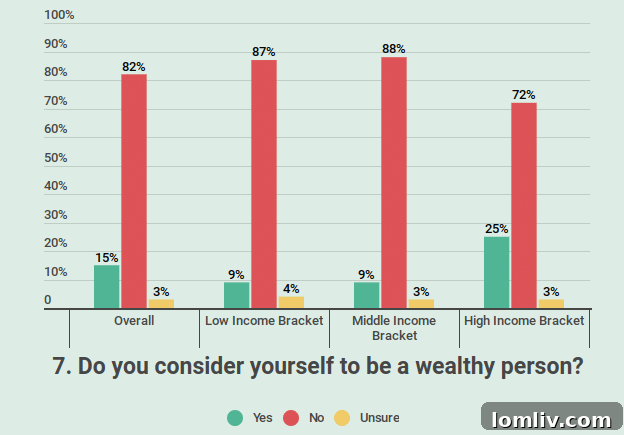
Defining Wealth: Shifting Benchmarks for a New Generation
The survey’s most compelling finding was the widespread belief among Millennials that they are not wealthy, a sentiment that persisted across all income tiers. This consistent result points to a potentially higher internal benchmark for what truly constitutes “wealth” in the minds of this generation. However, when asked to define specific income thresholds for being considered wealthy, interesting variations emerged based on their current financial status.
Perceptions of a “Wealthy” Annual Salary Across Brackets
When respondents were asked what annual salary range they would consider to be wealthy, their answers showcased notable discrepancies:
- Overall Perspective: Across the entire surveyed group, 31% of Millennials indicated that an annual salary falling between $101,000 and $250,000 would qualify an individual as wealthy. This range generally aligns with upper-middle-class income levels in many developed economies, suggesting a shared understanding of what constitutes a comfortable, affluent lifestyle.
- Low-Income Bracket’s View: A particularly insightful finding came from the low-income bracket (those earning $49,999 or less). A significant 45% of these respondents considered an annual income between $75,000 and $100,000 to be indicative of a wealthy person. This perspective suggests that for those at the lower end of the income scale, reaching a solid middle-class income level is seen as a major financial achievement, often equated with wealth itself.
Mike Brown offered a keen observation on this particular finding: “Interestingly, respondents that were part of the lower income bracket might have the best grasp of how much an individual needs to make to be considered wealthy.” He further supported this observation by citing external research, noting, “According to Pew Research, a single person needs to make at least $78,281 to be classified as a wealthy individual.” This alignment with established economic definitions suggests that, for many, the concept of wealth is not about exorbitant riches but about achieving a strong level of financial stability and comfort, often just above the average middle-class threshold.
This nuanced divergence in wealth perception highlights the multifaceted nature of financial well-being. For many Millennials, particularly those burdened by student loan debt, escalating living costs, and an often-unpredictable job market, the definition of wealth extends beyond mere income. It encompasses a broader sense of financial security, freedom from debilitating debt, and the ability to save effectively for significant life milestones such as homeownership, family planning, or a secure retirement – goals that often seem increasingly out of reach.
Millennial Spending Habits: Balancing Aspirations with Economic Realities
Beyond wealth perception, the LendEDU survey meticulously examined the practicalities of Millennial personal finance, specifically their monthly spending habits. The data provides a clear picture of how this generation allocates its income amidst persistent economic pressures.
- Housing Expenses: On average, Millennials dedicate a substantial portion of their income to housing, spending approximately $1,476 each month. This figure encompasses a wide range of costs, from rent payments in competitive urban markets to mortgage payments for those who have achieved homeownership, often representing the single largest monthly expenditure.
- Non-Housing Expenses: In addition to housing, Millennials spend an average of $1,832 monthly on non-housing related costs. This broad category includes essential expenditures such as groceries, transportation, utilities, and healthcare, alongside discretionary spending on entertainment, dining out, and personal care. Crucially, it also accounts for significant outlays like student loan payments, which are a defining financial characteristic of this generation.
To provide context for these figures, it’s important to acknowledge significant regional variations in the cost of living. For example, a recent ApartmentList.com rent report for Dallas reported median rents of $890 for a one-bedroom apartment and $1,110 for a two-bedroom. While these specific Dallas figures are notably lower than the average Millennial housing expenditure found in the survey, they illustrate the diverse housing markets across the country. The higher overall average indicates that many Millennials reside in high-cost-of-living areas, pushing up their aggregate housing costs. This discrepancy highlights the geographic disparities in financial burden experienced by the generation.
Income Bracket and Spending Correlation: A Picture of Financial Prudence
The survey also revealed a logical yet crucial correlation between income levels and spending habits. Mike Brown articulated this finding: “Millennials in the high-income bracket ($100,000 in yearly income or more) are spending the most per month, while those in the low-income bracket ($49,999 or lower) are spending the least. Further, middle bracket millennials ($50,000 – $99,999) are exactly where they should be relative to their income.” This consistent pattern suggests that, for the most part, Millennials are indeed adapting their spending to their current earning capabilities, a fundamental aspect of responsible financial management.
Furthermore, a reassuring 72% of respondents reported feeling that they were spending within their means. This high percentage suggests that despite facing significant economic anxieties and high costs of living, a substantial portion of the Millennial generation believes they are managing their budgets effectively and avoiding excessive debt. However, it’s important to consider that the definition of “within their means” can be subjective, often implying simply that they are not incurring unsustainable debt rather than actively building significant savings or rapidly accumulating wealth. For many, it’s a tightrope walk between current expenses and future aspirations.
The “Boomerang Generation”: Financial Constraints and Living Situations
The financial challenges confronting Millennials are further illuminated by their living arrangements, particularly the ongoing phenomenon often referred to as the “boomerang generation.” The LendEDU survey brought to light a significant factor driving many young adults to choose, or be compelled, to reside with their parents:
A striking 60% of Millennials who currently live with their parents explicitly cited financial constraints as the primary reason for doing so. This figure speaks volumes about the pervasive economic pressures impacting this demographic, ranging from the crushing weight of student loan debt and stagnant wage growth to the escalating costs of housing and daily necessities. While returning home can offer a vital temporary reprieve from these pressures, it often inadvertently delays critical independent financial milestones such as accumulating a down payment for a home, actively investing for retirement, or establishing robust personal credit histories.
For many, the decision to live at home is far from a mere lifestyle choice; it has evolved into a strategic necessity to navigate an exceptionally challenging economic environment. This enduring trend carries broader implications for intergenerational family dynamics, consumer spending patterns, and the housing market. It also critically highlights the increasing reliance on intergenerational support systems, which are becoming ever more vital for young adults striving to achieve foundational financial stability in an unforgiving economic landscape.
A Glimpse into the Future: Millennial Economic Outlook and Generational Wealth
The LendEDU survey concluded with a forward-looking assessment of Millennials’ future financial outlook, revealing a pervasive sense of apprehension about their long-term economic prospects. “Nearly a quarter of millennials believe they will be less wealthy than their parents in their lifetime,” Mike Brown observed. This sentiment reflects a profound concern about upward mobility and the very real possibility of failing to surpass the economic achievements and security levels of previous generations.
Several contributing factors fuel this widespread anxiety among Millennials:
- Persistent Student Loan Debt: While Millennials are often celebrated as the most educated generation, this academic achievement frequently comes tethered to a substantial burden of student loan debt. This debt can significantly impede wealth accumulation, delaying major financial milestones for years, sometimes even decades, after graduation.
- Economic Volatility and Recessions: Having come of age during the tumultuous Great Recession and subsequently enduring other periods of economic uncertainty, many Millennials have experienced a far more volatile and less predictable economic landscape than their parents’ generation. This has fostered a deep-seated caution and often hindered consistent financial planning.
- Stagnant Wage Growth Relative to Costs: Despite increased productivity, higher education levels, and greater workforce participation, wage growth for many Millennials has often lagged critically behind the rapidly escalating cost of living. This imbalance makes it inherently challenging to save adequately, invest strategically, and build substantial assets.
- Rising Healthcare and Retirement Costs: The escalating costs of healthcare, coupled with mounting uncertainties surrounding social security and traditional retirement benefits, add another significant layer of financial anxiety. Millennials are acutely aware that they will likely bear more responsibility for their own long-term financial security than prior generations.
This somewhat pessimistic outlook on generational wealth accumulation serves as a critical indicator for policymakers, financial institutions, and employers alike. It underscores an urgent need for innovative and targeted solutions to address the root causes of Millennial financial stress, including student debt reform, initiatives for affordable housing, and expanded access to accessible investment and wealth-building opportunities. While the generation demonstrates remarkable resilience and adaptability in managing their day-to-day finances, the systemic challenges they face cast a long and undeniable shadow over their long-term potential for accumulating significant wealth and achieving financial independence.
Implications and Moving Forward: Supporting the Millennial Financial Journey
The LendEDU survey provides a vital, multi-faceted snapshot into the intricate financial world of the Millennial generation. It reveals a group grappling with significant economic headwinds, characterized by a conservative self-assessment of wealth, generally prudent spending habits relative to income, and an increasing reliance on essential family support structures. Understanding these nuanced realities is not merely an academic exercise; it carries profound implications for the broader economy, future market trends, and critical social policy development.
For financial planners, lenders, policymakers, and even employers, these findings unequivocally emphasize the pressing need for tailored financial products, innovative services, and educational resources specifically designed to address the unique challenges faced by Millennials. Promoting comprehensive financial literacy from an early age, offering creative solutions for student debt refinancing, and robustly supporting initiatives for truly affordable housing could prove to be absolutely critical steps in empowering this pivotal generation to achieve their financial aspirations and build a more secure, prosperous economic foundation. The inherent aspiration for wealth, security, and upward mobility remains powerfully strong within the Millennial generation, even if the pathway to achieving these fundamental goals is proving to be considerably more arduous and complex than for generations past. Supporting their journey is essential for the economic health of the entire society.
For those interested in a more comprehensive review of the detailed findings and deeper insights, the full LendEDU survey can be accessed by clicking here.