

The Growing Divide: How Remote Work Reshapes Housing Affordability Across America
For decades, a widely accepted benchmark in personal finance has dictated that a household should ideally allocate no more than 30 percent of its gross income towards housing costs. This “30 percent rule” isn’t merely a suggestion; it’s a critical threshold used by housing economists and lenders to assess financial stability. Households exceeding this percentage are officially categorized as “cost-burdened,” signaling a significant strain on their financial well-being and often forcing difficult choices between housing and other essential needs like food, healthcare, or transportation.
The scale of this challenge is substantial. Even before the global pandemic reshaped our daily lives, a staggering one in three U.S. households found themselves navigating the difficulties of being cost-burdened in 2019. This pervasive issue has only intensified, exacerbated by a confluence of rising housing prices, stagnant wages for many, and the economic turbulence of recent years.
In the wake of unprecedented shifts in the global workforce, particularly the rapid adoption of remote work, a new layer of complexity has emerged in the housing affordability crisis. A groundbreaking report by Apartment List, titled “The Remote Work Divide in Housing Cost Struggles,” sheds crucial light on how the remote work revolution is carving out stark economic disparities between those with the flexibility to work remotely and those whose jobs necessitate an onsite presence.
The Remote Work Paradox: Two Worlds, Different Burdens
The Apartment List study reveals a compelling and concerning trend: essential onsite workers, who form the backbone of our communities, face disproportionately higher housing cost burdens. These individuals—including retail salespeople, food-service workers, construction professionals, and educators—are an astonishing 41 percent more likely to be cost-burdened by housing than their counterparts in remote-friendly occupations.
Remote-friendly jobs, such as software developers, accountants, and office clerks, often come with higher average salaries and the crucial advantage of geographic flexibility. This flexibility allows many remote workers to relocate to areas with lower housing costs, reducing their financial strain. Conversely, onsite workers are typically tied to specific locations, often urban or suburban centers where job opportunities are concentrated but housing expenses are notoriously high. Their roles, while indispensable, are frequently characterized by lower wage growth that struggles to keep pace with escalating rents and home prices.
This “remote work divide” isn’t just an economic statistic; it reflects a deepening chasm in quality of life. For onsite workers, the struggle to afford housing can mean longer commutes from more distant, cheaper areas, or residing in housing conditions that are less than ideal. It can also mean making sacrifices in other areas of their lives, leading to increased stress and reduced overall well-being. The pandemic, which forced many industries to embrace remote work, only highlighted and accelerated this pre-existing disparity, underscoring the vulnerability of those who must physically show up for their livelihoods.
Dallas-Fort Worth: A Regional Spotlight on Housing Affordability
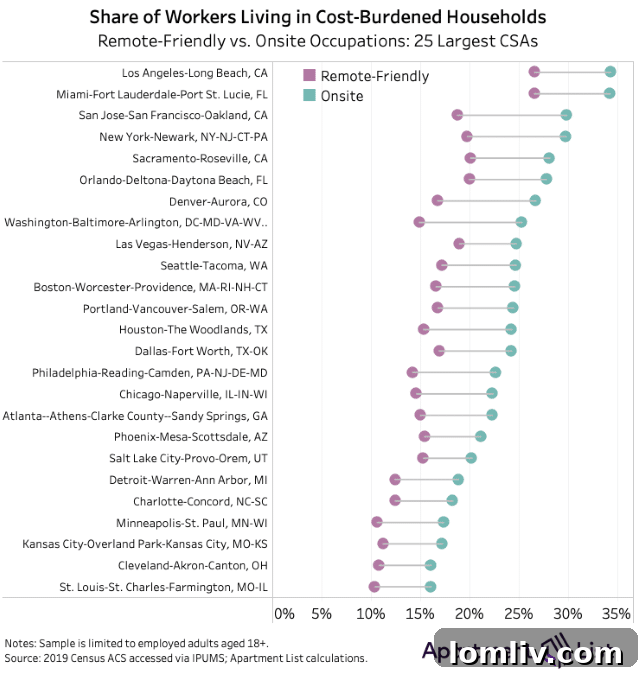
Apartment List, a leading San Francisco-based online marketplace for apartment listings, conducted a thorough national analysis and drilled down into regional specifics, offering valuable insights into local markets. The Dallas-Fort Worth metropolitan area, a rapidly growing economic hub in Texas, provides a poignant example of these national trends playing out at a local level. The data from the Dallas region vividly illustrates the remote work divide:
- Overall Cost Burden: In Dallas, a significant 24 percent of workers in onsite-dependent occupations live in cost-burdened households, a stark contrast to the 17 percent of those in remote-friendly jobs who face similar struggles. This 7-percentage-point difference underscores the uneven impact of housing costs based on job type.
- Renter Vulnerability: The cost-burden rates are notably more severe for renters compared to homeowners. In the Dallas area, renters make up a larger proportion of onsite workers (40 percent) than remote-friendly workers (33 percent), suggesting that those with less financial flexibility are also more likely to be renting. Among renters specifically, the financial pressure is even clearer: 37 percent of onsite workers who rent are cost-burdened, compared to 27 percent of remote-friendly workers who rent. This highlights the inherent instability and lack of wealth-building opportunities often faced by renters, who are more susceptible to market fluctuations and rent hikes without the buffer of property appreciation.
- Intersectional Disparities by Race: Even within the seemingly more secure group of remote-friendly workers, the data reveals significant racial disparities in the Dallas area. A disproportionate 29 percent of Black workers and 17 percent of Hispanic workers in remote-friendly roles are cost-burdened. This stands in sharp contrast to just 14 percent of White workers in similar positions. These figures point to deeper systemic issues, including historical inequalities in wealth accumulation, access to education and job opportunities, and persistent discriminatory practices in housing and lending, which continue to impact minority communities even within higher-earning, flexible professions.
The Persistent Struggle: A Look at Texas’s Broader Housing Crisis
The challenges highlighted by the Apartment List report are not new; they represent an intensification of long-standing housing affordability issues that have only gained momentum during and after the pandemic. As housing costs have steadily climbed, the financial squeeze on households has become increasingly severe.
A crucial analysis released in 2020 by the Harvard University Joint Center for Housing Studies further underscores the depth of this crisis in Texas. Their findings determined that by 2019, nearly half of all households in the state were categorized as either moderately (spending 30 percent to 50 percent of income on housing) or severely (spending more than 50 percent) cost-burdened. These figures paint a stark picture of a state grappling with an escalating housing crisis affecting a substantial portion of its population.
Whitney Airgood-Obrycki, a research associate at the Joint Center for Housing Studies, articulated the gravity of the situation to the Texas Tribune in 2020. She emphasized, “Texas is very unaffordable for the lowest-income households. This is true everywhere across the country, but when we look across the states, Texas does have one of the highest-burden rates for low-income renters who are making less than $15,000.” This statement draws attention to the acute vulnerability of the state’s most economically disadvantaged residents, who are often trapped in a cycle of housing insecurity due to insufficient income and soaring costs.
Beyond the Numbers: The Human and Economic Impact
The implications of widespread housing cost burdens extend far beyond individual household budgets. On a societal level, this crisis fuels economic inequality, hinders social mobility, and can lead to increased homelessness and community instability. Families burdened by housing costs often face difficult trade-offs, sacrificing investments in education, healthcare, and nutritious food—choices that have long-term consequences for children’s development and overall public health.
For the broader economy, a workforce struggling with housing affordability can impact productivity, create labor shortages in essential onsite roles in expensive areas, and stifle local economic growth. Businesses may find it harder to attract and retain workers if local housing costs are prohibitive, potentially leading to reduced services and slower development.
As the landscape of work continues to evolve with hybrid models and remote opportunities becoming more entrenched, understanding and addressing the remote work divide in housing affordability will be paramount. Policymakers, urban planners, and community leaders must consider integrated strategies that promote affordable housing development, support wage growth for onsite workers, and address systemic inequalities that disproportionately affect minority groups.
Delving Deeper: Access the Full Research
For those interested in a comprehensive exploration of these trends and a detailed comparison of the Dallas-Fort Worth area with other metropolitan regions across the United States, Apartment List’s exhaustive study is an invaluable resource. You can find their full report, offering granular data and in-depth analysis on the remote work divide and housing cost struggles, by following this link: Access the Full Apartment List Study Here.