Editor’s note: Jon Anderson is a columnist for Daltxrealestate.com. His opinions are his own.
Uptown Dallas’s Architectural Future: A Critical Look at Maple Avenue Developments
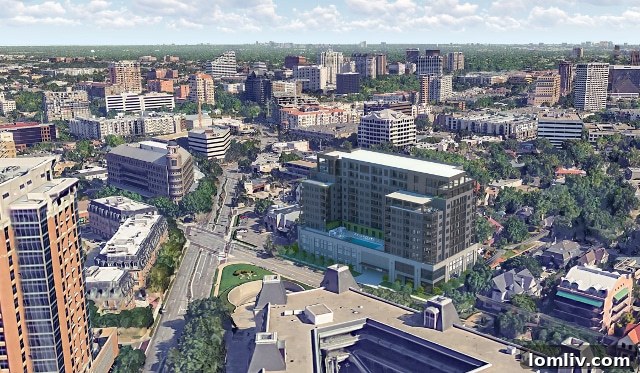
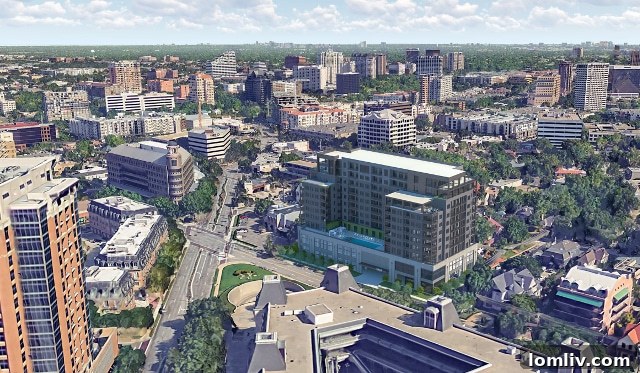
The evolving skyline of Uptown Dallas is a constant topic of discussion, with new developments frequently sparking debate among residents, urban planners, and architectural enthusiasts. Recently, a proposed project by Kairoi Residential on the former Old Warsaw restaurant site on Maple Avenue, directly across from the iconic Crescent Court, has drawn significant attention. My initial reaction to this development was one of profound disappointment, a sentiment that only deepened upon realizing Kairoi Residential was engaging with the Oak Lawn Committee (OLC) not to present the building’s overall architectural vision, but rather to seek a “landscape special exception.” This approach, focusing on peripheral details rather than the core design, raises critical questions about urban aesthetics and community contribution in one of Dallas’s most prestigious neighborhoods.
Architects and builders often emphasize that while the interior layout of a building dictates its leasable space, the exterior — its “skin” — leaves an indelible mark on the urban fabric. It profoundly influences the experience of every individual who walks or drives past it, contributing to or detracting from the neighborhood’s character. In a location as prominent and historically significant as the intersection of Maple Avenue and Cedar Springs Road, the design of a new structure carries immense responsibility. Given the existing architectural excellence and the ambitious projects recently announced for this four-corner intersection, constructing what appears to be an uninspired, low-slung structure can only be seen as a colossal missed opportunity for design innovation and urban enhancement.
The Enduring Legacy of Crescent Court and Uptown’s Transformation
To truly appreciate the significance of this location, one must look back to 1986, when the Crescent Court first emerged. It was not merely a building; it was the progenitor of Uptown Dallas’s remarkable gentrification and subsequent revival. Its distinctive postmodern architecture by Philip Johnson and John Burgee set a new standard for luxury and sophistication, radiating outward to influence the surrounding area. For decades, other 1980s and 1990s office buildings populated its borders, forming a consistent yet evolving urban landscape. Over the past decade, however, many of these older structures have given way to larger, more modern developments, reflecting Uptown’s continuous growth and its status as a premier destination for living, working, and leisure.
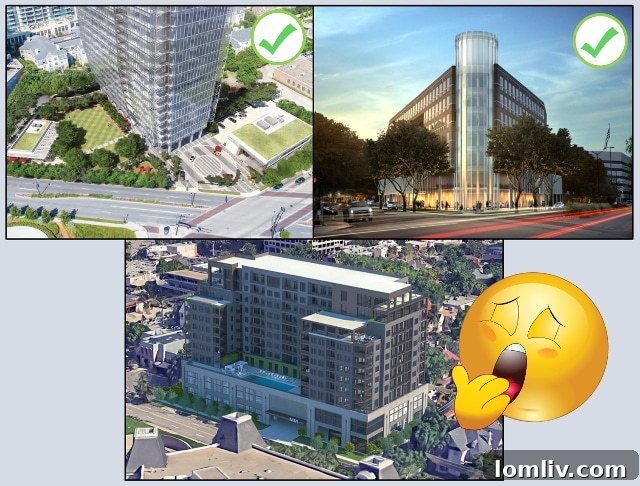
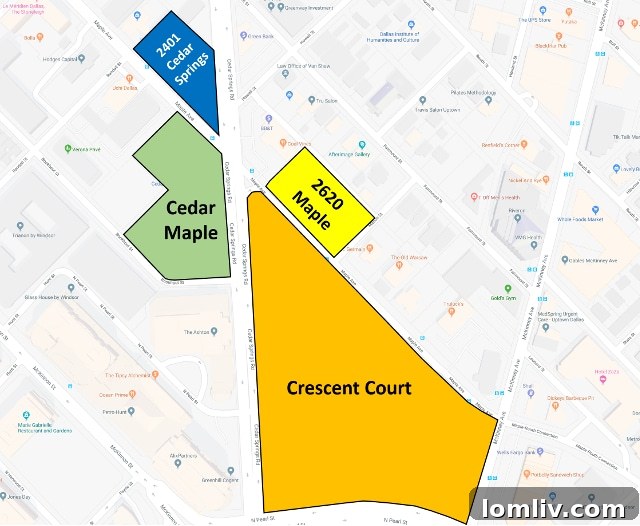
In just the last year, two of the Crescent’s prominent corners have undergone rigorous review by the Oak Lawn Committee, setting a high bar for contemporary urban design. On the upper left of the provided map is Granite’s Cedar Maple project, a forward-thinking development that promises to redefine its corner. Concurrently, the upper-right corner features Crescent’s 2401 Cedar Springs, an ambitious reimagining of a classic 1980s structure. Both of these projects are characterized by a strong emphasis on pedestrian interaction, incorporating generous green spaces and promoting transparency through extensive use of glass. This design philosophy aims to foster urban vitality, inviting light and foot traffic into the buildings and creating a more engaging street-level experience for the entire community. In stark contrast, Kairoi’s proposal seems to primarily focus on securing relief from landscaping requirements and garage screening on the back alley, sometimes euphemistically called a “promenade,” suggesting a less integrated and less pedestrian-friendly approach.
A Critique of the Kairoi Residential Design
The Kairoi project, as envisioned by GDA Architects, has been described as a “lumpy series of dark boxes” perched atop a light-colored plinth of above-ground parking. The resulting aesthetic is, regrettably, uninteresting and uninviting. Its generic appearance could easily be confused with other under-construction developments lacking distinctive features, such as the nearby Uptown Marriott. This design represents what I’ve termed the “Ornamental Gulag-style architecture,” where functionality and expediency seem to overshadow any genuine attempt at architectural innovation or contextual harmony. While it may include a pool, a common amenity, its overall contribution to the architectural prestige of Uptown Dallas appears minimal at best. This stands in stark contrast to the clear design intentions of the Cedar Maple and 2401 Cedar Springs projects, which prioritize visual engagement and human-scale interaction, aiming to elevate the urban experience rather than merely occupy space.
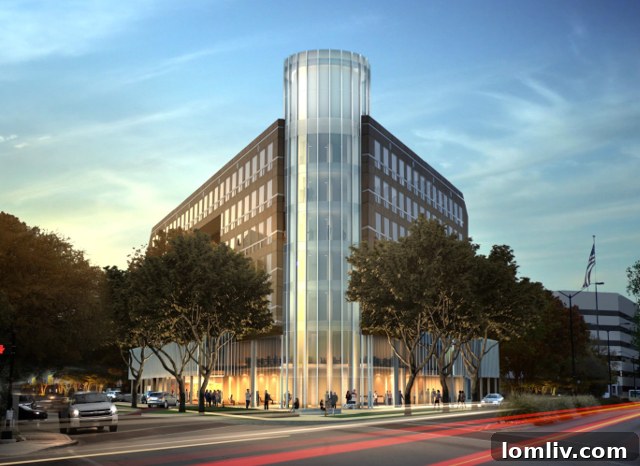
Although I harbored some reservations about the pedestrian and valet traffic patterns envisioned in Crescent’s updated design for 2401 Cedar Springs, it remains an otherwise highly attractive and thoughtful reuse of a sterile 1980s office building. This renovation masterfully “hikes up its skirts” to reveal an open, glass-fronted ground-floor lobby and a vibrant restaurant space, effectively transforming a once imposing and dark stone turret into a signature glass cylinder that now graces Cedar Springs Road. Such a transformation exemplifies how thoughtful design can breathe new life into existing structures, creating visually appealing and functionally superior spaces that actively contribute to the streetscape.
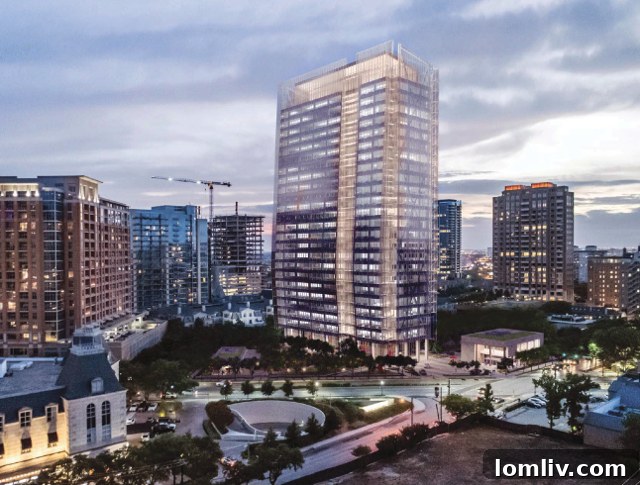
The empty plot in the foreground of the Cedar Maple project, as depicted above, is precisely where the future Kairoi development is slated to rise. Its prospective residents will undoubtedly enjoy privileged views of a gracious glass tower and its expansive front yard, while also looking upon the architectural royalty of the Philip Johnson and John Burgee-designed Crescent Court. However, occupants of these established, architecturally significant buildings will be afforded no such captivating vista from Kairoi’s project. Instead of an inspiring architectural contribution, they will face a bulky, unadorned block of apartments, inserting itself into an increasingly vibrant Uptown neighborhood without genuinely adding to its dynamic character. This renders it, regrettably, an “architectural leech” – a development that consumes valuable space and capital without enriching its surroundings. Furthermore, the decision to orient a 12-story sheer spine toward a century-old residential neighborhood (now largely converted to offices) raises concerns about light, privacy, and contextual sensitivity. A more thoughtful design approach could have undoubtedly mitigated these potential negative impacts, demonstrating a greater respect for the existing urban fabric and its inhabitants.
The Oak Lawn Committee and the Battle for Thoughtful Development
During its initial presentation to the Oak Lawn Committee, Kairoi’s representatives came with only two primary requests. First, they sought an exemption from the required 10-foot setback and accompanying green space along the alley, a standard provision designed to enhance aesthetics and pedestrian experience. Second, they asked for reduced parking lot screening across the back of the property. Granting these concessions would inevitably relegate the alley to a “threadbare afterthought,” primarily serving as a functional fire lane for moving vans and delivery vehicles. This utilitarian approach sharply contrasts with the more aspirational vision articulated by developers, who, when discussing amenities like dog parks, bicycle racks, and convenient access to Whole Foods, suddenly transform this same alley into a “promenade.” This incongruity highlights a troubling disconnect between the desired public image and the proposed design’s practical implications for urban living.
It was clear that this project garnered “little joy in Mudville,” a colloquialism indicating significant dissatisfaction from the OLC and community stakeholders. Consequently, the Kairoi team will be making a return appearance before the committee. My fervent hope is that this re-engagement will not merely involve minor tweaks, but rather a substantial reassessment – if not a complete redesign, then at least a significant improvement to its “skin.” The Maple Avenue site deserves an architectural statement that is truly worthy of its prestigious and vibrant surroundings, a design that contributes positively to Uptown’s legacy rather than diminishing it.
Progress on 2025 Cedar Springs Road: A Model of Engagement
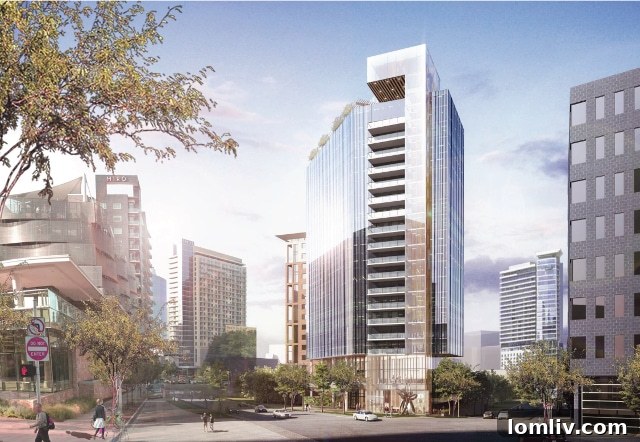
Also making a return to the Oak Lawn Committee for further review was the proposed boutique hotel development at 2025 Cedar Springs Road, situated on the far end of the Crescent, at the intersection of Cedar Springs Road and Olive Street. This project had previously been presented last month, and the OLC requested additional elevations to fully assess its impact. The developers have since diligently addressed the committee’s feedback, making thoughtful adjustments to the valet parking circulation and actively engaging with numerous neighbors to secure their invaluable support. While exhibiting very little change from its previous iteration, these proactive steps reflect a commitment to community collaboration and responsive design. The project now appears well-positioned to gain support and proceed to its next crucial stop at the Plan Commission, signaling a positive trajectory for this thoughtfully conceived boutique hotel.
Indeed, this month’s Oak Lawn Committee agenda focused on just these two significant cases, underscoring the importance of these developments to the future aesthetic and functionality of Uptown Dallas.

Shaping Dallas: Architecture, Community, and Urban Progress
Remember: My focus as a columnist consistently revolves around high-rises, the intricacies of Homeowners Associations (HOAs), and transformative renovation projects. However, my appreciation extends far beyond these specific areas to encompass the broader spectrum of modern and historical architecture, always seeking a delicate balance against the principles of the YIMBY (Yes In My Backyard) movement. This movement advocates for increasing housing supply to address affordability and density challenges, yet it must be thoughtfully integrated with considerations for design quality and community character. Between 2016, 2017, and 2018, the National Association of Real Estate Editors recognized my contributions to real estate journalism, honoring my writing with three Bronze awards (2016, 2017, 2018) and two Silver awards (2016, 2017). These accolades underscore my dedication to insightful analysis and compelling storytelling within the complex world of real estate and urban development.
Do you have a compelling story to share about Dallas’s real estate landscape, an architectural marvel (or misstep) that deserves attention, or perhaps even a marriage proposal you wish to make? Feel free to reach out and shoot me an email at [email protected]. While you are welcome to search for me on Facebook and Twitter, you might find my digital footprint elusive, a conscious choice in today’s interconnected world. Nevertheless, your insights and feedback are always valued as we collectively navigate the fascinating evolution of our urban spaces.