After weeks of intense legislative debate, two contentious special sessions, and significant political maneuvering between the Texas House and Senate, Republican lawmakers have successfully reached a landmark agreement to deliver substantial property tax relief to Texans. This long-awaited breakthrough marks a pivotal moment for homeowners and businesses across the state, promising the largest property tax reduction in Texas history.
The journey to this agreement was far from smooth, characterized by public disagreements and a determined push by Governor Greg Abbott to fulfill his promise to return a significant portion of the state’s record-breaking budget surplus to taxpayers. The relief package, valued at an impressive $18 billion, is designed to address the escalating burden of property taxes that has impacted countless Texas families and enterprises for years. Its multifaceted approach targets various property types and aims to provide immediate financial respite, injecting newfound optimism into the state’s economic landscape.
A Hard-Fought Legislative Battle for Texas Property Tax Cuts
The path to this historic property tax agreement was paved with considerable legislative challenges. Governor Greg Abbott had initially called lawmakers back for an extraordinary special session specifically to tackle property tax reform, following the regular legislative session’s inability to reach a consensus. This initial call, and subsequent calls for additional special sessions, underscored the critical importance of the issue to the state’s leadership and its citizens.
The core of the disagreement revolved primarily around the method of delivering property tax relief. The Texas House of Representatives largely favored increasing the homestead exemption, a mechanism that directly reduces the taxable value of a homeowner’s primary residence. In contrast, the Texas Senate championed a strategy known as “rate compression,” which involves using state funds to lower school property tax rates across the board for all property owners, regardless of homestead status. This fundamental difference led to a legislative stalemate, creating an atmosphere of tension and public debate between key figures like Lieutenant Governor Dan Patrick and House Speaker Dade Phelan.
For weeks, these legislative leaders engaged in robust public discussions, each advocating for their preferred approach, creating a political standoff that threatened to derail the entire relief effort. Texans watched closely, hoping their elected officials would bridge the divide and deliver on the promise of meaningful tax savings. The “proverbial shots fired” were a testament to the high stakes involved, reflecting the deep commitment of both chambers to secure what they believed was the most effective form of relief for their constituents. Ultimately, the pressure to deliver a substantial return on the state’s historic budget surplus, coupled with a united desire to ease the burden on taxpayers, spurred lawmakers towards a compromise.
The $18 billion compromise between the Texas House and Senate — which includes more than $5 billion approved for relief in 2021 — would give increased tax relief for the state’s 5.7 million homeowners and create a tax-credit pilot program for non-homesteaded properties. It would also cut taxes to small businesses and send billions of dollars to school districts so they can cut their tax rates across the board, according to details made public by state leaders Monday.
Texas Tribune
Unpacking the $18 Billion Historic Texas Property Tax Relief Package
The newly forged $18 billion property tax relief package represents a comprehensive strategy to significantly reduce the tax burden on Texans. This substantial sum, which also incorporates over $5 billion in relief already approved in 2021, targets various segments of the population and economy, ensuring broad-based benefits. Understanding the components of this agreement is key to appreciating its monumental impact on the state.
Enhanced Homestead Exemptions for Millions of Homeowners
A cornerstone of this relief plan is the substantial increase in the homestead exemption. This measure is specifically designed to provide direct relief to the state’s 5.7 million homeowners. The homestead exemption reduces the taxable value of a primary residence, meaning homeowners pay property taxes on a lower assessed amount. By significantly increasing this exemption, the state is effectively lowering the tax bill for a vast majority of its residents. For example, if the previous homestead exemption was $40,000 and it is now raised to $100,000, a home valued at $300,000 would be taxed on $260,000 instead of $300,000, representing a substantial saving. This direct approach ensures that individual homeowners see tangible savings on their annual property tax statements, a highly anticipated benefit given the rising property values across Texas.
School Property Tax Rate Compression: Benefits for All Property Owners
Complementing the homestead exemption, the agreement also includes significant funding directed towards school districts. This funding enables districts to effectively “compress” their maintenance and operations tax rates. In essence, the state will use its budget surplus to buy down a portion of local school property taxes. This mechanism is crucial because school property taxes typically constitute the largest portion of a Texan’s overall property tax bill. By reducing these rates, the relief package offers benefits to all property owners, not just those with homestead exemptions. This includes commercial properties, rental properties, and raw land, ensuring a wider economic impact. The infusion of state funds into school districts to facilitate these lower rates means that local schools will not suffer from reduced revenues; instead, the burden shifts from local property owners to the state’s general fund.
Tax Credit Pilot Program for Non-Homesteaded Properties
Recognizing that not all property owners benefit from homestead exemptions, the agreement thoughtfully includes a tax-credit pilot program specifically designed for non-homesteaded properties. This innovative program aims to provide relief to owners of commercial properties, rental homes, and other non-primary residences. While the exact details of this pilot program will be crucial, its inclusion signifies a commitment to comprehensive relief that extends beyond individual homeowners. Small businesses, landlords, and commercial enterprises stand to benefit from this initiative, potentially reducing their operational costs and fostering a more vibrant business environment in Texas.
Cutting Taxes for Small Businesses: Fueling Economic Growth
In a further boost to the Texas economy, the package also includes targeted tax cuts for small businesses. Small businesses are the backbone of local economies, and reducing their tax burden can free up capital for investment, job creation, and expansion. This relief could come in various forms, such as adjustments to property tax valuations on commercial properties or direct tax credits. By alleviating some of the financial pressures on these enterprises, the state aims to stimulate economic growth, enhance competitiveness, and support the entrepreneurial spirit that defines Texas.
Overall, the $18 billion deal represents a masterful legislative compromise, blending the House’s preference for direct homestead relief with the Senate’s emphasis on broader school tax compression. This hybrid approach ensures that the largest property tax cut in Texas history provides meaningful savings to a vast array of taxpayers, from individual homeowners to bustling small businesses, setting a new precedent for fiscal responsibility and relief.
Governor Abbott’s Vision Realized: A Political Triumph
Texas Gov. Greg Abbott has been a vocal proponent of property tax relief, making it a cornerstone of his administration’s agenda. His commitment to returning a significant portion of the state’s largest-ever budget surplus to property taxpayers was a central promise, and the successful agreement represents a significant political victory. In a public statement on Monday, Governor Abbott reiterated his satisfaction with the legislative outcome.
“Today’s agreement between the House and the Senate is a step toward delivering on that promise,” he said, expressing anticipation for the final legislative steps. “I look forward to this legislation reaching my desk, so I can sign into law the largest property tax cut in Texas history.” This sentiment highlights the gravity of the achievement and its alignment with the governor’s consistent public messaging. The resolution of the property tax deadlock not only fulfills a key campaign pledge but also showcases the ability of the state’s leadership to navigate complex political terrain and deliver tangible results for Texans.
My joint statement with @LtGovTX regarding our breakthrough deal to provide the largest property tax cut in Texas history! #txlege pic.twitter.com/DUMbUWf85u
— Dade Phelan (@DadePhelan) July 10, 2023
The joint statement issued by Lt. Gov. Dan Patrick and House Speaker Dade Phelan further cemented the sense of a unified front, signaling the end of the intra-chamber disagreements. This public display of collaboration, following weeks of highly visible tension, underscored the collective determination to achieve a shared goal of Texas property tax relief.
Dallas City Council Ad Hoc Committee: Local Advocacy for Tax Relief
In a swift and proactive response to the breakthrough announcement from Texas lawmakers, Dallas Mayor Eric Johnson promptly established an ad hoc committee. This newly formed body, the Ad Hoc Committee on Legislative Affairs, has been tasked with a crucial mission: to “advocate fervently for the passage of this property tax relief bill, which could include providing public testimony at the Texas State Capitol.” This immediate action by Dallas city leadership demonstrates the profound local impact and widespread support for the state-level tax reform efforts.
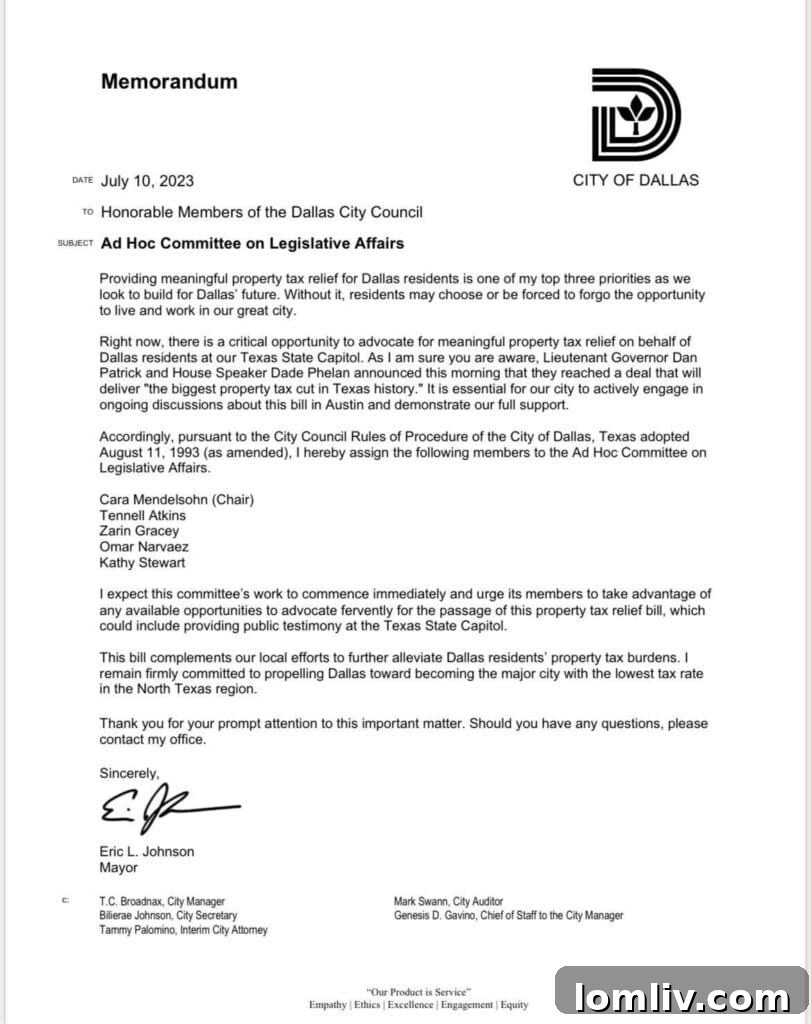
The committee is set to be chaired by District 12 Councilwoman Cara Mendelsohn, who has already expressed her enthusiastic acceptance of this important charge. Councilwoman Mendelsohn is a known advocate for fiscal responsibility and sensible taxation, often voicing these principles during council meetings. Her statement reflects the collective relief and optimism felt by many local officials and residents:
“I speak about responsible spending and taxation often at council meetings,” she said. “On behalf of Dallas residents, I am happy to advocate the biggest tax relief bill in Texas history.” Her leadership will be instrumental in ensuring that the voice of Dallas residents and businesses is heard as the legislation moves through its final stages.
The committee’s composition includes a diverse group of influential city leaders, further underscoring the broad support for this initiative. Members include Mayor Pro Tem Tennell Atkins, District 3 Councilman Zarin Gracey, District 6 Councilman Omar Narvaez, and District 10 Councilwoman Kathy Stewart. Their combined expertise and commitment will be vital in lobbying for the swift enactment of the bill, ensuring that Dallas residents begin to experience the promised property tax savings as soon as possible. This local engagement highlights the collaborative effort required to transform legislative agreements into tangible benefits for communities across Texas.
The Path Forward: Enactment and Future Implications for Texas
While the agreement represents a significant milestone, the legislation still needs to clear both the Texas House and the Senate before it can be sent to Governor Abbott for his signature. This final legislative hurdle is anticipated to be less contentious, given the bipartisan compromise that has now been reached. Once signed into law, this historic property tax cut will redefine the fiscal landscape for millions of Texans.
The long-term implications of this relief package are substantial. By reducing the property tax burden, the state aims to improve affordability for homeowners, stimulate economic activity through increased disposable income and business savings, and solidify Texas’s reputation as a fiscally conservative state committed to its taxpayers. This comprehensive approach to property tax reform is expected to have a lasting positive impact on the quality of life and economic prosperity across the Lone Star State.