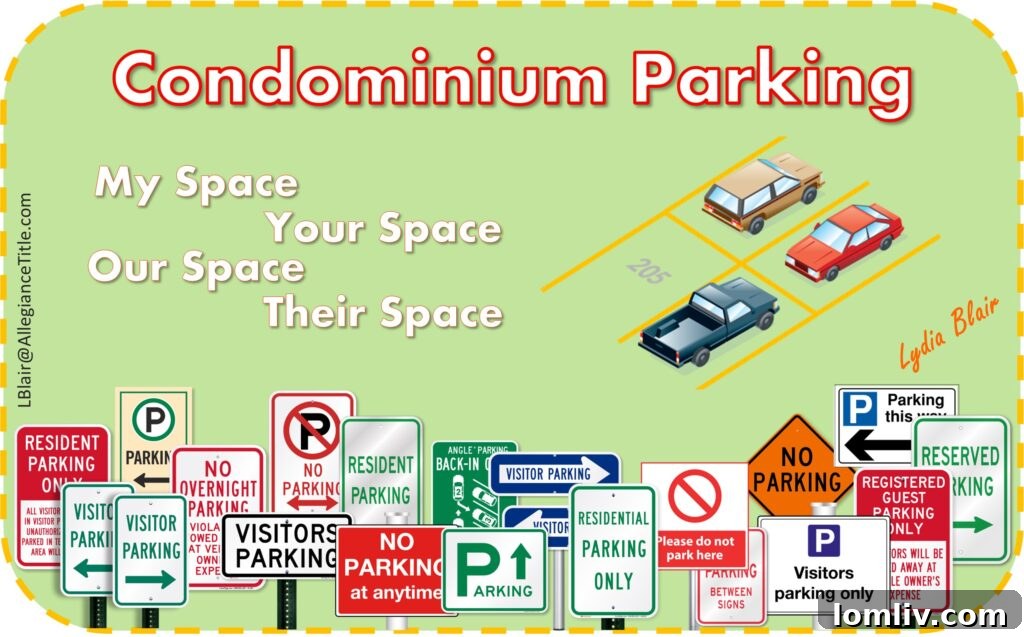
Navigating the intricacies of condominium living can be complex, and few aspects present as many questions as parking. Prospective condo owners often assume that the parking spot they use is theirs in the same way their unit is, a direct extension of their property title. However, the reality of condominium parking spaces is far more nuanced, often leading to confusion, disputes, and unexpected challenges. This comprehensive guide will demystify the legal and practical aspects of condo parking, helping you understand what you’re truly getting when you purchase a unit.
Unlike a traditional detached home where the driveway and garage are unequivocally part of your property, condominium parking typically operates under a different legal framework. Most condo owners don’t hold a separate title or deed to their specific parking spaces. Instead, these spaces are generally considered part of the condominium’s common elements, with specific usage rights assigned to individual units. This distinction is crucial for understanding your rights, responsibilities, and the potential limitations regarding your parking spot.
The Unique Nature of Condominium Ownership and Parking
To truly grasp the concept of condo parking, one must first understand the fundamental legal construct of a condominium itself. A condominium unit isn’t just a physical space within a building; it’s a legal invention that represents an interest in a specific airspace (your unit) combined with an undivided interest in the common areas of the entire property. This dual ownership model means that while you enjoy exclusive use of your individual unit, you also collectively own and share responsibility for all other areas within the condominium development.
Common areas, by definition, are those parts of the condominium property that are not part of any individual unit. They are owned jointly by all unit owners as tenants in common. These areas are broadly classified into two categories: general common elements and limited common elements. Understanding the difference between these is paramount to comprehending condo parking rights.
General Common Elements: Shared by All
General common elements are accessible and usable by all unit owners. These typically include the lobby, hallways, elevators, roof, exterior walls, structural components, recreational facilities such as pools and gyms, and often the land upon which the building sits. Every unit owner has an equal, undivided ownership interest in these areas, and the condominium association is responsible for their maintenance and upkeep, funded by common fees.
Limited Common Elements: Exclusive Use, Shared Ownership
Parking spaces almost universally fall under the classification of limited common elements. This is where the complexity lies. While still legally owned by all unit owners collectively, their use is exclusively assigned to specific individual units. Other examples of limited common elements often include balconies, patios, storage lockers, and sometimes even specific hallways or utility hookups serving only one unit. The key takeaway here is that you don’t “own” the parking space outright as a separate piece of real estate; instead, you own an undivided share of it along with everyone else, but you have the exclusive right to use it, as outlined in the condominium’s governing documents.
This “exclusive right to use” is often confused with direct ownership. While it grants you the ability to prevent others from using your assigned space and typically allows you to control its immediate maintenance (like cleaning), it does not grant you the same rights as owning a deeded parcel of land. You cannot, for instance, typically sell a limited common element parking space separately from your unit without specific provisions in the declaration and often an amendment to those documents.
Decoding Assigned Parking: Declarations and Regulations
The details concerning specific parking spaces assigned to units are meticulously laid out in the condominium’s foundational legal documents, primarily the Declaration of Condominium and its accompanying bylaws. These documents serve as the constitution for the condominium community, defining the rights and responsibilities of both the unit owners and the condominium association.
The Condo Declaration: The Master Blueprint
The Declaration of Condominium is the most critical document. It formally establishes the condominium regime, delineates the individual units from the common elements, and specifies how these common elements, including parking spaces, are allocated for use. Ideally, the declaration should clearly state which parking space, identified by a number or letter, is assigned to which unit. It may also detail how many spaces each unit receives and any special conditions related to their use.
However, a common issue arises from the **vagueness or incompleteness** of these descriptions. In many older condominiums, or even some newer ones, the exact location, dimensions, or specific identifying characteristics of parking spaces might be poorly defined or entirely missing from the official records. This ambiguity can lead to significant problems down the line, including disputes among unit owners, difficulties in transferring or selling units, and challenges for title companies trying to confirm property rights.
The Role of the Condo Association (HOA) and Its Regulations
Beyond the declaration, the condominium association (often referred to as the Homeowners Association or HOA) plays a vital role in regulating the use of common element parking spaces through its bylaws and specific rules and regulations. While the declaration outlines the fundamental assignments, the association’s rules govern the day-to-day practicalities and behaviors. These rules can be extensive and typically cover a wide array of aspects, such as:
- Vehicle Restrictions: Limiting or prohibiting certain types of vehicles, such as commercial trucks, recreational vehicles (RVs), boats, trailers, or inoperable cars.
- Number of Vehicles: Imposing limits on the number of vehicles a unit owner may park on the property, even if they have multiple assigned spaces.
- Guest Parking: Establishing designated guest parking areas and setting time limits or registration requirements for visitors.
- Maintenance and Aesthetics: Prohibiting vehicle repairs, washing, or detailing in parking areas to maintain cleanliness and appearance.
- Enforcement: Outlining procedures for enforcing parking rules, including fines, towing, or revocation of parking privileges for non-compliance.
It is imperative for both current and prospective unit owners to thoroughly review these documents. Ignorance of the rules is rarely an acceptable defense, and violations can result in significant penalties or even legal action from the association.
Reassignment and Amendments: A Complex Process
While parking spaces are typically allocated at the time the condominium is established and enshrined in the declaration, circumstances may arise where reassignment or reallocation becomes necessary or desirable. However, altering these assignments is generally a difficult and legally involved process. Usually, once parking spaces are assigned within the declaration, they cannot be changed without the explicit consent of the affected unit owner(s) and, crucially, an amendment to the declaration itself.
Amending a condominium declaration typically requires a supermajority vote of the unit owners, often ranging from 67% to 80% or more, depending on the specific state laws and the original declaration’s provisions. This high threshold is designed to protect existing property rights and ensure significant community consensus before fundamental changes are made. Scenarios where reallocation might be considered include correcting initial errors, accommodating new construction or changes to common areas, or resolving long-standing disputes. However, due to the complexity and potential for dissent, such reallocations are relatively rare.
Navigating Parking Space Transactions and Guarantees
For many unit owners, the desire to rent out an unused parking space or to ensure a specific space is legally transferred during a sale is a common concern. However, these transactions are subject to the same legal framework and documentation requirements that govern all aspects of condo parking.
Transferring or Renting Your Assigned Space
If a unit owner wishes to rent out their assigned parking space, or even transfer its use to another unit owner, the first step is always to consult the condominium’s declaration and bylaws. These documents will dictate whether such arrangements are permitted. Some declarations might explicitly allow it, perhaps with conditions (e.g., only to other unit owners, notification to the association, a fee payable to the association). Others might prohibit it entirely, viewing parking as an inseparable amenity of the unit.
If permitted, any private agreement between unit owners regarding the transfer of use or rental of a parking space should be thoroughly documented in a written contract. It is also wise, and often required by the association, to formally notify the condo board of the arrangement. It’s important to remember that such private agreements generally only transfer the *right to use* the limited common element, not its underlying ownership. If the declaration itself needs to be amended to permanently reallocate a space to a different unit, the complex amendment process described earlier would be necessary.
The Challenge of Guarantees for Buyers
When purchasing a condominium, buyers naturally want an ironclad guarantee that a specific parking space comes with their unit. This is especially true if parking is scarce or if the space is conveniently located. However, obtaining such a guarantee can be challenging if the parking space is merely an assigned limited common element rather than a separately deeded parcel.
For a buyer to truly “own” or have a fully deeded interest in a specific parking space in the same way they own their unit, the space would need to be accurately and legally described as a separate parcel or as an integral, legally inseparable part of the unit’s legal description. This legal description would need to include precise details such as:
- The exact location within the building or property (e.g., “Space A-17 in the underground garage, level P2”).
- The exact dimensions or size of the parking space.
- A unique identifier (number, letter) that is universally recognized.
- Any other specific characteristics that definitively separate it from adjacent spaces or common areas.
Without such a clear and legally sufficient description recorded with the county property records, the parking space remains an assigned limited common element, not a separately titled piece of property that can be individually transferred or insured as such.
Title Company’s Perspective: Insuring What’s Legally Recorded
This is where title companies often become a critical point of contention. Title companies are in the business of insuring ownership of real property based on recorded legal documents. They generally cannot and will not include a limited common element parking space in the legal description of the property being insured for a buyer, unless it is unequivocally identified in the property’s legal description as recorded with the county. Why?
A title company’s role is to warrant that the seller has clear title to the property being conveyed. If a parking space is merely an assigned “exclusive use” common element, the seller doesn’t hold direct title to it in the same way they do their unit. The title company cannot insure what isn’t legally owned or clearly delineated as part of the specific property being purchased. They can only confirm the legal status as described in the official declaration. Therefore, it is highly unlikely that a title company would issue an insurance policy specifically guaranteeing the ownership of a particular parking space unless it has its own unique parcel identification number or is explicitly and legally merged into the unit’s deeded description.
Due Diligence for Buyers: Protecting Your Investment
Given these complexities, it is paramount for any prospective condominium buyer to exercise thorough due diligence regarding parking. This includes:
- Reviewing All Governing Documents: Meticulously read the Declaration of Condominium, bylaws, rules and regulations, and any amendments. Pay close attention to sections on common elements, limited common elements, parking, and vehicle restrictions.
- Confirming Assignment with the Association: Obtain written confirmation from the condominium association management or board regarding the specific parking space(s) assigned to the unit you are purchasing.
- Visual Verification: Physically verify the location and numbering of the assigned parking space.
- Understanding Limitations: Be fully aware that “exclusive use” is not the same as direct “ownership” for a limited common element parking space.
Understanding these distinctions before closing on a unit can prevent future misunderstandings, disputes, and financial complications. While the convenience of an assigned parking space is undeniable, its legal status within the condominium framework requires careful scrutiny and a clear understanding of your true rights.
In conclusion, while the idea of owning a condominium often evokes images of simplicity and shared amenities, the reality, particularly concerning parking, is far more intricate. Condominium parking spaces are typically limited common elements, granting unit owners exclusive use rights rather than direct ownership. These rights are defined by the condominium’s declaration and regulated by the association. For buyers, it’s essential to conduct thorough due diligence and understand that a “guaranteed” parking space often means an “assigned” one, not necessarily a separately deeded property. Always consult with real estate attorneys and thoroughly review all governing documents to ensure you fully comprehend your rights and responsibilities regarding your condominium parking.