The year 2020 will undoubtedly be etched in history as a period of unprecedented change and challenge. It felt like a decade compressed into twelve months, marked by widespread postponements, societal shifts, and an enduring sense of uncertainty. Yet, amidst this global upheaval, the housing market, particularly in North Texas, displayed remarkable resilience. While the Daltxrealestate.com team takes a much-needed break to recharge, we’re revisiting some of our most impactful and thought-provoking stories from that pivotal year. These are the narratives that challenged conventional wisdom, sparked essential conversations, and offered a more balanced view of a fluctuating world.
From the perspective of a seasoned observer, not all significant stories are the most sensational. My Penthouse Plunge series, for instance, held deep personal meaning and resonated with many readers. Similarly, my most widely read column of 2020, “It took Dallas 12 Years to Kill a Skyline,” struck a raw nerve, capturing the attention of tens of thousands. And, of course, there was the delightful distraction of a well-crafted April Fool’s column that brought a touch of levity.
However, the articles that truly stood out for me were those that instigated tangible change or fostered vital dialogues. We saw the Reverchon Park controversy unfold, and a series of columns exposed the developer’s attempt to secure the Preston Center parking garage for high-rise development (here, here, here) – a plan that was ultimately withdrawn due to public scrutiny. We also shed light on the ill-conceived proposal for soccer fields beneath a major highway, which thankfully never materialized.
My truly favored pieces, however, were those that challenged the pessimistic market forecasts published by The Dallas Morning News during the initial phases of the pandemic. Through a series of articles (here, here, here, here, here), we aimed to provide readers with a more balanced and ultimately more accurate perspective on the market’s trajectory. These articles not only offered a counter-narrative to the prevailing gloom but also foreshadowed the current renovation frenzy that has since gripped the industry. I invite you to delve into the first column of that influential series and share your own favorite (or least favorite) columns in the comments below.
What happens when you play a country song backwards?
You get your girlfriend back, your house back, your truck back, your dog back…
This humorous analogy encapsulates a serious point: the way information is presented, especially in real estate news, can profoundly alter perception. After spending a rainy weekend meticulously re-reading every Dallas Morning News article on the residential real estate market since March 1, 2020, a clear pattern emerged. If a story contained negative news, it almost invariably led the narrative, often preceding a more balanced or even positive conclusion further down. My “read it backwards” suggestion stems from this observation. For many readers who only skim headlines or don’t finish an article (though certainly not you, dear reader), the overwhelming takeaway is often exclusively negative, distorting their understanding of the market’s true health.
Unpacking Dallas’s Resilient Real Estate Foundations
The advent of COVID-19 certainly sent shockwaves through the global economy, and the Dallas real estate market was not immune to initial trepidation. However, beneath the sensational headlines and fearful pronouncements lay exceptionally strong market fundamentals. These underlying strengths provided a crucial buffer against the economic downturn, setting Dallas apart from many other regions.
Dallas has been grappling with a significant housing shortage for years, a lingering consequence of the 2008 recession which led to a dramatic slowdown in construction. This deficit, amounting to tens of thousands of housing units, has only widened over time. Coupled with consistent population growth driven by robust job markets and corporate relocations, this supply-demand imbalance is the primary engine behind the steady appreciation of housing prices in Dallas since the market’s trough in 2012.
Even before the pandemic, the Dallas Morning News itself highlighted this critical issue. On March 4, in a pre-COVID analysis, the paper reported on Freddie Mac’s findings that “Texas is missing more than half-million houses.” The report specifically pointed out that Texas had the most severe housing shortage nationwide, accounting for 7.5 of every 100 houses lacking across the country. This fundamental issue underscored the market’s inherent strength, regardless of external shocks.
Further bolstering this positive outlook were subsequent DMN reports. On March 9, the headline read, “February was another big month for North Texas home sales,” indicating strong momentum leading into the pandemic. This was followed on March 10 by news that “D-FW home foreclosures and late payments continue to fall,” painting a picture of financial stability among homeowners.
Crucially, unlike the lead-up to the 2008 recession, where an oversupply of housing met unqualified buyers, such an explosive and destabilizing combination simply did not exist in the Dallas market in 2020. This fundamental difference provided a solid buffer against any looming economic storm.
In essence, Dallas entered 2020 with a significant housing deficit and robust demand from tens of thousands of households – a situation brewing long before COVID-19 emerged. This inherent shortage meant that even if residential construction experienced a material slowdown, the existing shortfall would only intensify, maintaining upward pressure on prices. This critical supply-demand dynamic was a key reason why construction was designated an “essential” industry during the lockdowns; any slowdown would more likely be due to developer financing challenges rather than a lack of underlying need or demand.
The Shifting Narrative: March’s Tumultuous Headlines
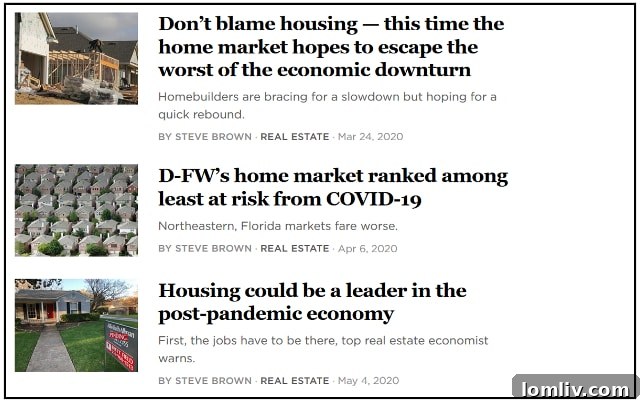
March 2020 proved to be a pivotal month, beginning with a sense of cautious optimism and quickly pivoting to a narrative dominated by economic anxieties. The media landscape reflected this abrupt shift, with headlines evolving from steady market reports to predictions of impending challenges. On March 12, a significant headline declared, “Home market could take a hit from economic headwinds.” This story succinctly captured the market’s internal conflict:
“There’s a tug of war in the housing market between cheap home financing and growing economic dread caused by the coronavirus outbreak.” The article quoted Jim Gaines, chief economist at the Real Estate Center at Texas A&M University, who offered a more tempered view: “The D-FW area really shouldn’t feel much of that [oil price impacts]. The housing sector will probably win out in your market. Dallas’ main concern is what the national economy does. It’s going to slow down — no doubt about that — but nobody knows how long or how deep it will be.”
Ironically, on the very same day, another article painted a starkly different picture: “Dallas on list of cities with most home value hikes.” This report noted Dallas’s impressive recovery from the 2008 recession, with home prices surging 75 percent above their previous peak, ranking third best nationally. While the article didn’t explicitly state the reasons, the underlying factors were clear: sustained underbuilding coupled with robust job growth and population influx.
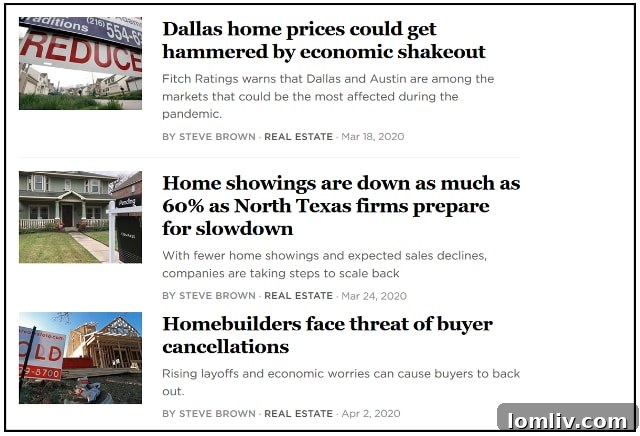
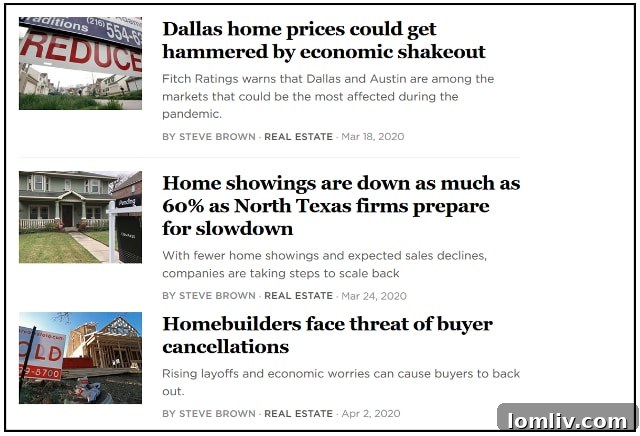
However, this glimmer of optimism was quickly overshadowed. By March 18, the narrative took a sharp turn with the headline, “Dallas home prices could get hammered by economic shakeout.” This alarming prediction primarily leaned on a warning from Fitch Ratings, an entity that had, for years, consistently labeled Dallas as overvalued. Yet, deeper within the article, more measured responses from A&M’s Jim Gaines and Lawrence Yun from the National Association of Realtors offered a crucial counterbalance. Both acknowledged potential disruption but emphasized the uncertainty surrounding its duration and depth, contingent on unknown variables like lockdown periods, unemployment rates, government aid, and vaccine development. The “hammered” headline, chosen for its sensational impact, unfortunately prioritized alarm over a more nuanced and balanced interpretation – a pattern that would recur.
The remainder of March saw COVID-19 continuing to dominate housing coverage. One DMN story, for instance, opened with a stark warning: “With the economy slamming on the brakes, homebuilders are potentially facing the greatest falloff in business in a decade.” Yet, it concluded on a more hopeful note, asserting: “Last time housing led the recession. This time it’s poised to bring us out.” Another headline blared, “Home showings are down as much as 60% as North Texas firms prepare for slowdown” – a hardly surprising development given the widespread shelter-in-place orders. This was bookended by “This Spring’s home market could see fewer houses up for grabs,” suggesting a tightening of inventory rather than a collapse in demand.
April’s Foreboding Forecasts and Underlying Realities
April continued the trend of cautious, if not outright pessimistic, reporting regarding residential real estate, with 22 stories in the DMN during the month. The first seven days, in particular, saw headlines heavily skewed towards impending doom and gloom, often overshadowing any signals of market resilience. This relentless focus on potential negative outcomes could easily sway public sentiment, regardless of the underlying market health.
Doom-laden Headlines:
- Newest home foreclosure numbers belie coming wave
- Latest D-FW apartment stats don’t hint at the coming storm
- Builders face threat of buyer cancellations
- Asking prices of D-FW homes for sale are already headed down
- Missing: 20,000 D-FW apartment renters to fill new units (though this story would later be contradicted by an April 29 update stating demand had “bounced back”)
- Dallas-area home prices were still ahead in February — but not by much
A Nuanced Warning:
- Dallas-based home investor says it plans to keep buying – This article, while seemingly positive, presented a subtle warning. The profiled investor, HomeVestor, specializes in purchasing homes below local median prices to convert them into rentals. While this offers options for some, it simultaneously diminishes the inventory of affordable homes available for first-time or lower-income homebuyers, exacerbating the existing shortage at a critical segment of the market that builders are not adequately serving.
A Beacon of Hope:
- D-FW’s home market ranked among least at risk from COVID-19 – This headline provided a much-needed counterpoint, suggesting that despite the widespread panic, the Dallas-Fort Worth market possessed inherent strengths that made it less vulnerable to the pandemic’s economic fallout. It highlighted expert analysis recognizing the unique factors protecting the region, aligning with the earlier assessment of strong market fundamentals. The disparity between such a headline and the preceding doom-centric ones underscores the importance of seeking out diverse perspectives and reading beyond the initial pronouncements to grasp the full picture of market health.
May’s Nuances: Beyond the “Hammered” Headlines
As May arrived, the Dallas Morning News appeared to moderate its real estate coverage, with the rate of new articles roughly halving compared to April’s intense output during the first two weeks. This reduction in frequency might have suggested a calmer market, yet the underlying sentiment in many headlines still leaned towards caution and negativity, even as initial forecasts began to stabilize.
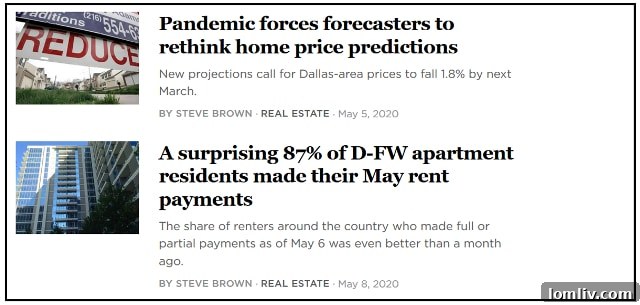
The month began with a seemingly more balanced approach, reflected in headlines like “Forecasters are taking a wait-and-see approach to home prices” – a sensible stance that, arguably, should have been adopted much earlier given the unprecedented circumstances. This was quickly followed by “Housing could be a leader in the post-pandemic economy,” a recognition of the market’s potential strength that, to those understanding the underlying demand-supply dynamics, felt like an obvious conclusion from the outset.
Despite these glimmers of rationality, the narrative soon veered back into negative territory with headlines such as “D-FW median home prices are down,” followed by the dramatic “North Texas home sales hammered by pandemic,” and concluding with “Home list prices since the pandemic have trended lower.” These headlines, while seemingly alarming, required a deeper look at the underlying data for proper interpretation.
Upon closer examination, the “decline” in home prices, as reported by this trio of articles, largely stemmed from a shift in the mix of available inventory. Fewer high-priced homes were being listed, which naturally brought down the overall average or median asking price. This isn’t necessarily indicative of a market slump across all segments; rather, it suggests that wealthier individuals might have been more inclined to defer selling their high-value properties during the initial uncertainty, while the market for mid-to-lower priced homes remained robust. Furthermore, while homes were being priced more aggressively from the outset to reflect the new market realities, a crucial insight was that fewer sellers were actually cutting prices compared to the previous year. This indicated that homes were being “priced-in” for COVID-19 expectations from the beginning, helping to keep overall prices within a relatively stable band.
Indeed, CoreLogic, a leading property data and analytics provider, forecasted a mere 1.8 percent decline in median DFW prices over the next year. This figure, though a decline, was hardly “Earth-shattering” and stood in stark contrast to the sensationalism of “hammered” headlines. The term “hammered” was deployed for a second time, despite the fact that the actual number of property sales (not prices) was down 17 percent in April – an entirely predictable outcome given the blanket shelter-in-place orders. A more accurate, less alarming headline might have been, “DFW home sales drop 17% reacting to stay-at-home orders,” utilizing the precise percentage rather than evocative, fear-inducing language. Such precise language allows readers to understand temporary market adjustments rather than perceiving a fundamental collapse.

The Psychology of Media: How Words and Sentiment Shape Our Outlook
The profound impact of media on human psychology and decision-making is a well-documented phenomenon. In a world saturated with information, the way news is framed – the words chosen, the sentiment conveyed – can significantly alter our mental outlook, perceptions, and even our behavior. This holds particularly true for sensitive subjects like the housing market, where financial decisions carry considerable weight.
Just last week, the BBC reported on compelling research from the University of California Irvine that vividly demonstrated how media coverage of disasters can profoundly impact our mental well-being. A research team led by Alison Holman was conducting a nationwide study on mental health involving 5,000 volunteers. Coincidentally, in the midst of their ongoing research, the tragic Boston Marathon bombing occurred. This provided the researchers with an invaluable pre-event mental health baseline, allowing for a unique comparison of reactions post-bombing.
Conventional intuition might suggest that the direct victims and their immediate social circles would experience the most significant deterioration in mental health. However, the study’s findings challenged this assumption. It revealed that individuals who engaged in repetitive and graphic news coverage of the event for more than six hours a day in the week following the bombing experienced a greater degradation in mental health than the actual victims themselves. This striking discovery underscored the potent, and often underestimated, psychological toll of prolonged exposure to negative media.
Armed with this crucial data, Holman’s team extended their investigation to examine the long-term health implications for those most stressed by the events of 9/11. Their findings were alarming: in the three years subsequent to 9/11, that particular group experienced a staggering 53 percent increase in cardiovascular problems. Most of these individuals had only witnessed the catastrophe unfolding (endlessly) on their television screens, highlighting how mediated exposure can manifest into severe physical health consequences.
Applying these insights to our own “little world” of real estate, the implications are clear. COVID-19 coverage was relentless for months, and indeed, many media outlets, including the BBC, were guilty of this pervasive reporting. In the realm of real estate, a dominant narrative of negativity often prevailed, even in the face of strong underlying market fundamentals. While The Dallas Morning News served as a primary focus of my analysis, the types of stories and angles they covered were echoed across various media platforms. This consistent barrage of “doom and gloom” headlines can create undue anxiety, deterring potential buyers and sellers, and potentially slowing market activity that is otherwise fundamentally sound.
Sensationalism sells, but at what cost to public perception and economic stability? Media outlets bear a significant responsibility to present information in a balanced and contextualized manner, avoiding language that instigates unnecessary panic. For readers, it becomes imperative to develop critical media literacy – to look beyond the headline, to seek out comprehensive data, and to understand the nuanced factors at play in the market. The “read it backwards” metaphor is more than just a clever turn of phrase; it’s a call to critically evaluate the information presented, to search for the full story, and to avoid letting initial negativity overshadow underlying truths.
A Call for Balanced Perspective in Real Estate Reporting
If you find yourself hesitating to buy, sell, or sign a lease, it’s worth asking yourself why. Is your apprehension based on solid market data and expert analysis, or is it perhaps influenced by a constant stream of sensationalized headlines? In an era of information overload, the power of parsing words and understanding sentiment cannot be overstated. The Dallas real estate market, despite the challenges of 2020, demonstrated remarkable resilience, underpinned by strong fundamentals that were often obscured by the prevailing media narrative.
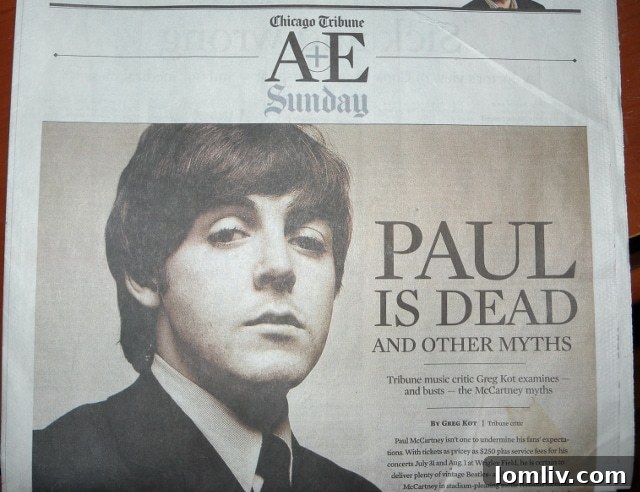
Moving forward, the onus is on both media and consumers to foster a more balanced and informed discourse. For media, it means prioritizing accuracy, context, and nuance over alarmist headlines. For consumers, it means cultivating a critical eye, seeking diverse sources, and understanding the core market dynamics rather than succumbing to fear-driven reporting. So, take a cue from the country song and start reading the news backwards – you might just find your confidence in the market returning. And rest assured, the market, much like Paul, still isn’t dead.