Shaping Dallas’s Future: A New Vision for Sustainable Urban Mobility
As cities worldwide grapple with the complexities of rapid growth, climate change, and evolving resident needs, the imperative for sustainable urban planning has never been more critical. Dallas, a bustling metropolis known for its expansive infrastructure and dynamic economy, finds itself at a pivotal juncture. The choices made today regarding its transportation networks and urban development will profoundly shape its identity and livability for generations to come. It’s against this backdrop that the Dallas chapter of the American Institute of Architects (AIA) recently hosted a groundbreaking Mobility Summit, dedicating crucial days to dissecting the challenges and opportunities for the city to foster long-term sustainability and enhance its allure.
The summit brought together architects, urban planners, policymakers, and community advocates, all united by a shared vision for a Dallas that can compete with leading global cities offering more integrated and holistic transportation solutions. The discussions underscored a burgeoning awareness that Dallas, historically a car-centric city, must pivot from its ingrained reliance on extensive highways and toll roads. A new generation of residents and forward-thinking urbanists are increasingly questioning the long-held assumption that commuting must be measured in hours, advocating instead for environments that prioritize human scale, accessibility, and environmental stewardship.
The Dallas Mobility Summit: Charting a Sustainable Future
The AIA Dallas Mobility Summit served as a vital forum for critical discourse, pushing the boundaries of traditional urban planning. Experts and local stakeholders convened to brainstorm innovative strategies for Dallas to evolve into a truly attractive and sustainable urban center. The core mission was to envision a Dallas that seamlessly integrates diverse transportation modes, fosters vibrant public spaces, and enhances the overall quality of life for its residents. This comprehensive approach is essential for a city aspiring to maintain its competitive edge and ensure enduring prosperity.
The dialogue at the summit starkly contrasted Dallas’s established identity with the aspirations of its future residents. For decades, the city’s growth has been inextricably linked to its extensive network of eight-lane highways, towering elevated thoroughfares, and numerous toll roads. This infrastructure, while facilitating regional connectivity, has simultaneously contributed to urban sprawl, environmental challenges, and a diminished sense of community in many areas. The summit highlighted the urgent need to critically re-evaluate these existing frameworks and explore alternatives that promote multimodal transportation, walkability, and greener urban landscapes.
A Turning Point for the Trinity River Corridor
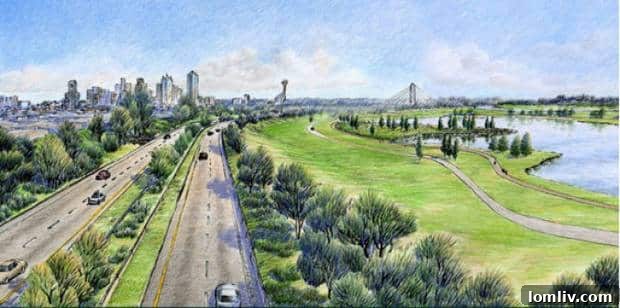
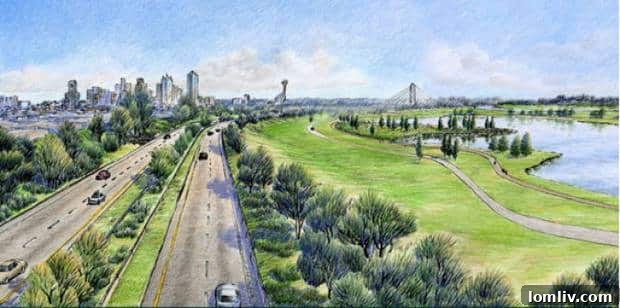
Among the most impactful discussions at the Mobility Summit was the re-evaluation of the contentious Trinity River Parkway project. As meticulously documented by veteran journalist Robert Wilonsky of Dallasnews.com, whose insightful reporting often captures the pulse of Dallas’s urban development debates, the summit facilitated significant breakthroughs. A key moment arrived with the powerful statements from Harvard professor and acclaimed urban planner Alex Krieger, a pivotal figure who co-authored Dallas’s original Balanced Vision Plan for the Trinity River Corridor. His re-assessment of the proposed road within the Trinity River levees sent ripples throughout the planning community.
Alex Krieger’s Paradigm Shift: From Parkway Supporter to Critic
Professor Krieger, a visionary behind the initial concept of a modest, four-lane parkway, took a remarkable step during the summit. Addressing an audience of influential city officials, policymakers, and architects, he offered a sincere apology for his role in a plan that, over time, had dramatically escalated in scope and cost.
[S]peaking to an audience of city officials and policy-makers and architects, he apologized for having played a part in the plan that initially proposed a smaller, four-lane “parkway” that has ballooned into a $1.5-billion massive highway that would likely restrict access to the other amenities proposed in the 2003 plan.
Said Krieger to a hearty round of applause, the road Dallas City Hall has long been pushing for “would be detrimental to the Trinity corridor and probably would not serve traffic particularly well long-term in Dallas.”
Krieger’s admission was a profound moment of reflection and a testament to evolving urban planning philosophies. What began as a vision for a manageable parkway, designed to complement the natural environment, had metamorphosed into a colossal $1.5 billion highway. Such a project, he now argued, would not only compromise the ecological integrity and recreational potential of the Trinity corridor but also fail to provide effective long-term traffic solutions for Dallas. His candid acknowledgment of the project’s detrimental potential resonated deeply, signaling a critical shift in perspective from one of the plan’s original architects.
Preserving the Vision: Gail Thomas and the Trinity Trust Foundation
Alex Krieger’s apology was extended directly to those who had consistently opposed a road within the park, notably Gail Thomas, President and CEO of the Trinity Trust Foundation. While Thomas graciously indicated that no apology was necessary, her comments underscored an unwavering commitment to the original, more pristine vision for the Trinity River. Her focus remains firmly on the realization of the incredible amenities envisioned for the corridor, rather than getting entangled in the protracted political debates surrounding the highway.
Gail Thomas, president and CEO of the Trinity Trust Foundation, is among those who refuses to publicly comment on the road. She says it’s a “political debate” for which she has neither the time nor the energy.
“I’ll tell you what I do want: I want the amenities we envisioned in the Trinity corridor and for the people of Dallas to come together as a community and enjoy the Trinity the same way the enjoy the Continental Bridge,” she says. “That’s what I want. That’s where my focus is.”
Thomas’s powerful statement highlights a crucial distinction: the aspiration for a vibrant, accessible, and naturally beautiful Trinity River as a community asset, much like the successful Continental Bridge project. Her vision champions lush green spaces, inviting recreational areas, and a renewed connection between Dallas residents and their natural environment, echoing the serene “beautiful watercolor images” that defined the initial, less intrusive plans. It’s a call to prioritize public enjoyment and ecological preservation over large-scale, potentially isolating infrastructure.
Reimagining Dallas’s Urban Core: The I-345 Debate and Beyond
Beyond the Trinity River controversy, another critical urban planning issue that garnered significant attention during the two-day summit was the ongoing campaign to demolish I-345. This initiative has been consistently championed by transportation advocate and event panelist Patrick Kennedy, who argues for removing the aging elevated highway that currently bisects downtown Dallas. The discussion around I-345 represents a broader movement to rethink the role of urban highways and their impact on city fabric, prompting calls for reconnecting neighborhoods and freeing up valuable land for new development.
Jeff Tumlin’s Holistic Approach to Urban Transportation
Offering a broader context for these discussions, transportation planner Jeff Tumlin, renowned for his work in removing highways in other major cities like San Francisco, provided an illuminating perspective on I-345 and Dallas’s transportation future. Tumlin urged Dallasites to view transportation not merely as a means to move vehicles, but as a fundamental metric of overall urban livability. His insights, as reported by Peter Simek, emphasized a critical gap in Dallas’s planning process:
Instead [Tumlin] pointed to a simple reason why Dallas, a city that has produced numerous well-considered plans for building a more efficient, sustainable, and urban core, has failed to realize the urban vision laid out in those plans. Goals and visions have to be translated into quantifiable objectives and qualify-able metrics, he said. In other words, planning documents are great, but unless they are translated into the language of the people who are implementing transportation policy — people like the bureaucrats at the NCTCOG — then nothing will ever get done.
Tumlin’s profound point underscores why even the most ambitious and well-intentioned urban plans often falter. He highlighted that Dallas possesses numerous exemplary plans for creating a more efficient, sustainable, and vibrant urban core. However, the failure lies in the translation of these lofty goals and visions into actionable, quantifiable objectives and measurable metrics. This means moving beyond abstract ideals to concrete indicators such as pedestrian safety improvements, economic value generated per square foot of public space, reduced carbon emissions from commuting, or increased access to public transit within a certain radius. Without these specific, data-driven targets, plans remain theoretical, unable to effectively guide the decision-making processes of implementing bodies like the North Central Texas Council of Governments (NCTCOG).
This holistic approach advocates for a fundamental shift in how urban projects are conceived and executed. Instead of focusing solely on traffic throughput, Tumlin proposes prioritizing metrics that contribute directly to the quality of life, economic vitality, and environmental health of the city. Lessons from cities that have successfully removed or downsized urban highways, like San Francisco, demonstrate the transformative power of such integrated planning, leading to neighborhood revitalization, increased property values, and improved public health outcomes.
Dallas at a Crossroads: The Path to a Thriving Future
Overall, Jeff Tumlin emphasized that the next two years represent a critical period for Dallas’s urban transformation. The decisions made during this short window will define the city’s trajectory for decades, determining whether it leans into a future of expansive regionalism driven by ever-larger highways, or embraces a more concentrated, human-scaled development model centered around mass transit and vibrant urban cores.
This, Tumlin concluded, is the overarching question facing Dallas. Will continued investment in bigger highways and a focus on regional sprawl dilute Dallas’s central power and urban identity, leading to a more dispersed, less connected metropolitan area? Or will strategic investments in robust mass transit systems, pedestrian-friendly infrastructure, and human-scaled projects foster the kind of critical mass necessary for Dallas to thrive as a dynamic, livable, and truly sustainable city in the future? The choice is stark and the stakes are incredibly high. Dallas stands at the precipice of a defining era, where bold, integrated, and people-centric urban planning holds the key to unlocking its full potential and ensuring a prosperous, equitable, and attractive future for all its residents.