

Navigating the Path to Homeownership: Affordability Insights for North Texas and Beyond
For many Americans, the dream of owning a home represents a significant milestone, a symbol of stability, and a cornerstone of personal wealth. However, turning this dream into a reality often presents a complex set of financial hurdles. Recent research sheds light on the nuanced landscape of home affordability across the United States, offering both encouraging news and stark reminders of the challenges that prospective buyers face, particularly when it comes to saving for a down payment.
A comprehensive report from Zillow, a leading real estate marketplace, has analyzed the intersection of income levels and housing costs in the nation’s 50 largest metropolitan areas. The findings, derived from the first quarter of the year, compared median mortgage payments against the most recent American Community Survey incomes for various educational attainment levels, meticulously adjusting 2017 figures to reflect 2019 inflation rates. The study aimed to determine where individuals with different educational backgrounds could theoretically afford to purchase a home.
The Surprising Realities of Affordability Across Major Metros
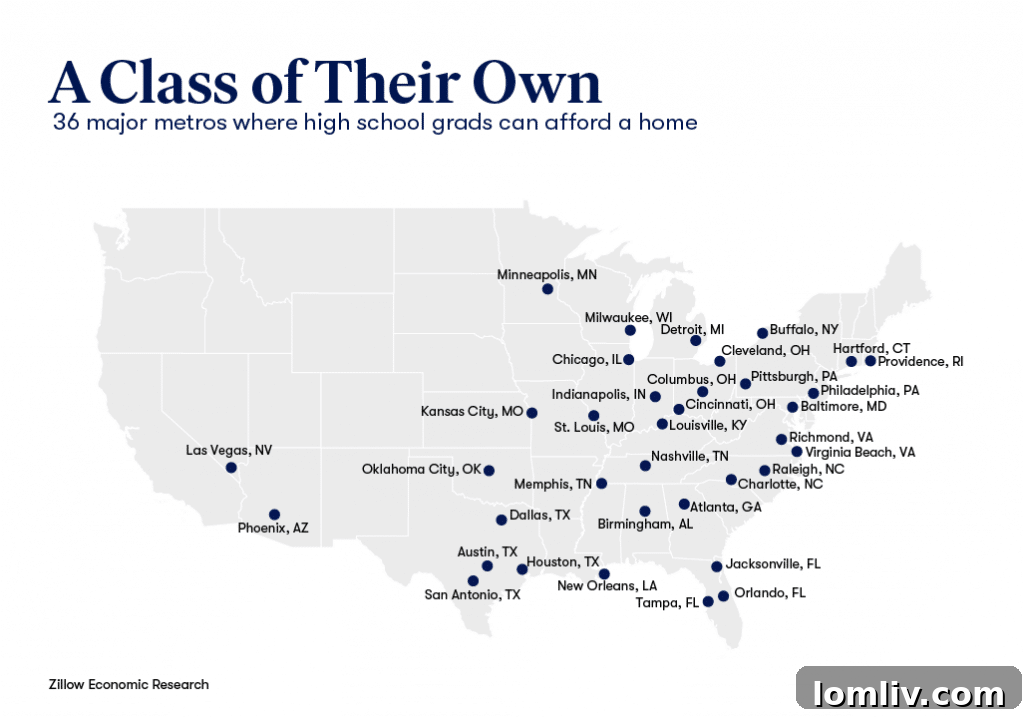
One of the report’s most striking revelations suggests that a significant number of metro areas are theoretically within reach for households earning an income commensurate with a high school diploma. Out of the 50 major metros examined, 36 were identified as being “theoretically affordable” under this income bracket. This surprising statistic challenges common perceptions about the exclusivity of homeownership in today’s market.
Notably, several prominent Texas cities were included in this encouraging list, signaling potential opportunities for aspiring homeowners in the Lone Star State. Dallas, Houston, San Antonio, and Austin – all vibrant and growing economic hubs – were among the 36 cities where a household with a high school diploma could, in theory, afford the median-valued home. This insight offers a glimmer of hope for individuals and families in North Texas and other major urban centers who might have previously felt priced out of the market.
The report also highlighted an even more accessible market: Oklahoma City. In this particular metro, the research indicated that a potential homebuyer wouldn’t even need a high school diploma to afford the median-valued home, underscoring the diverse economic landscapes and housing market dynamics present across the country.
Understanding “Affordability”: Beyond the Surface
It’s crucial to delve deeper into Zillow’s definition of “affordable” to fully appreciate the context of these findings. As the report clarifies, “That doesn’t mean all homes throughout those metro areas are affordable to all households with those degrees. Rather, the mortgage payment for a median-valued home in a given metro area is considered ‘affordable’ — it does not consume more than 30 percent of income — for a household making the typical salary of a household with those degrees.”
The 30 percent income rule is a long-standing benchmark in financial planning, widely accepted as a prudent guideline for housing costs. It suggests that a household should ideally allocate no more than 30 percent of its gross monthly income toward housing expenses to maintain financial stability. This threshold is designed to ensure that homeowners have sufficient funds remaining for other essential expenditures such as food, transportation, healthcare, and savings.
While this metric provides a valuable snapshot of monthly payment manageability, it’s important to recognize its limitations. True affordability encompasses a broader range of financial considerations that extend beyond the monthly mortgage payment. These often include property taxes, homeowners insurance, potential homeowners association (HOA) fees, and the ongoing costs of home maintenance and repairs – none of which are typically factored into the initial “affordable” calculation based solely on mortgage payments.
The Down Payment Dilemma: A Significant Barrier to Entry
Perhaps the most significant challenge omitted from the “theoretically affordable” equation is the daunting task of accumulating a down payment. For many aspiring homeowners, particularly those with modest incomes, saving a substantial sum upfront can be an arduous journey. The Zillow report highlights this practical impediment, noting that statistically, saving for a down payment can take seven years or even longer in many areas across the country.
This prolonged saving period poses a considerable barrier, especially for renters who are simultaneously navigating high rental costs. If a household is already dedicating a significant portion of its income, perhaps around 27.8 percent, to rent each month, the ability to consistently set aside additional funds for a down payment becomes an even more formidable financial endeavor. This creates a challenging cycle: high rent prevents saving, and lack of savings prevents homeownership, perpetuating rental status.
The average down payment for a conventional loan typically ranges from 5% to 20% of the home’s purchase price. For a median-valued home, even a 5% down payment can amount to tens of thousands of dollars, a sum that requires disciplined saving and significant financial planning. First-time homebuyers often face this challenge head-on, frequently without the benefit of equity from a previous home sale.
A Broader Look at National Affordability Trends
Despite the challenges associated with down payments, the national picture for mortgage affordability presents a somewhat more favorable trend. The Zillow report indicated that a mortgage on the typical U.S. home consumed just 16.8 percent of the country’s median household income in the first quarter. This figure represents a slight decrease from 17.6 percent in the fourth quarter of 2018 and remains comfortably below the 21 percent average recorded from 1985 through 1999.
These national ratios are well within the commonly accepted 30 percent rule of thumb for housing costs. This suggests that once a buyer has overcome the initial hurdle of the down payment, the ongoing monthly mortgage obligation for a median-valued home is, on average, quite manageable relative to national income levels. Factors contributing to this trend can include fluctuating interest rates, moderate wage growth in certain sectors, and the overall supply and demand dynamics of the housing market.
Implications for Aspiring Homeowners and the Real Estate Market
The insights from Zillow’s research carry significant implications for various stakeholders. For first-time homebuyers, particularly those with a high school diploma, the report offers a dual message: homeownership might be more theoretically achievable than perceived, yet practical obstacles like down payment savings remain formidable. This underscores the importance of early financial planning, exploring down payment assistance programs, and carefully researching local market conditions.
For the real estate industry, these findings highlight the need for continued innovation in loan products and financial solutions that address the down payment challenge. Policies aimed at supporting first-time buyers, alongside efforts to maintain a healthy balance between housing supply and demand, will be crucial in fostering a more accessible housing market.
Ultimately, while the dream of homeownership remains strong, realizing it requires a clear understanding of both the theoretical affordability based on income and the practicalities of saving for the initial investment. The journey to homeownership is often a marathon, not a sprint, demanding patience, financial discipline, and a strategic approach to navigate its complexities.
To access the full Zillow report and gain a deeper understanding of these market dynamics, you can click here.