Understanding the US Housing Market: Breakeven Points, Production Challenges, and Shifting Homebuyer Confidence

The dynamic landscape of the U.S. housing market is a constant subject of analysis for economists, prospective homeowners, and investors alike. Recent research from early 2018 provides crucial insights into various facets of this complex environment, from the financial calculus of renting versus buying to the broader trends in housing supply and consumer sentiment. One striking finding highlights the Dallas-Fort Worth (DFW) area, where it takes approximately a year and a half for a home to reach its buy-rent breakeven horizon, according to Zillow economists. This specific timeframe, revealed in their first-quarter 2018 research, offers a localized glimpse into a national trend that impacts millions.
The Buy-Rent Breakeven Horizon: A Critical Metric for Homeownership
The Zillow Buy-Rent Breakeven Horizon is an essential metric that quantifies the duration needed for owning a home to become more financially advantageous than continuing to rent a comparable property. This calculation isn’t simply about comparing monthly mortgage payments to rent. It’s a comprehensive assessment that incorporates a multitude of financial factors, offering a clearer picture of the long-term economic wisdom of buying versus renting. Nationally, the research indicated that it takes nearly two years to reach this pivotal point, underscoring the significant upfront costs and initial financial commitment involved in purchasing a home.
The breakeven horizon varies dramatically across different U.S. markets, reflecting diverse local economic conditions, housing demands, and cost structures. In the first quarter of 2018, Memphis, Tennessee, boasted the shortest breakeven time, at roughly one year and four months, making homeownership there a relatively swift financial advantage. Conversely, Los Angeles, California, represented the extreme end of the spectrum, with an extended breakeven period of more than three years and eight months. This stark contrast highlights the vast differences in market dynamics, particularly in high-cost urban centers where property values and transaction costs can significantly delay the financial benefits of ownership.
Within Texas, the breakeven points also showed considerable variation. Austin, a rapidly growing tech hub, recorded a breakeven point of 2.84 years. Houston, another major metropolitan area, had a shorter horizon at 1.67 years, indicating a more accessible entry point for potential homeowners. San Antonio rounded out the major Texas cities with a breakeven of 2.31 years. These regional differences are critical for prospective buyers to consider when evaluating their housing options.
Zillow’s research report meticulously outlines the complex reasons behind these varying breakeven horizons. Several key economic indicators and personal financial decisions play a pivotal role in this equation. Firstly, local rent prices directly influence the attractiveness of renting versus buying. In markets with rapidly rising rents, buying can quickly become the more sensible option. Secondly, home value appreciation is a significant factor; faster appreciation accelerates the accumulation of equity, thereby shortening the breakeven period. Thirdly, prevailing interest rates directly impact mortgage affordability and the total cost of borrowing, which can extend or shorten the time it takes to see a return on investment.
Beyond these market forces, the calculation also accounts for the substantial transaction costs associated with buying and eventually selling a home. These “hefty transaction costs” include real estate agent commissions, closing costs, title insurance, appraisal fees, and potential repair expenses, all of which chip away at initial gains. Furthermore, the breakeven analysis considers the opportunity cost for renters: the potential savings and investment gains they could realize by allocating a down payment towards other ventures and by avoiding homeownership expenses such as property taxes, maintenance, and insurance. Understanding these intricate layers is crucial for anyone contemplating the leap from renting to buying.
Housing Production Falls, But Is Still Better than 2017
Shifting focus from financial calculations to market supply, recent federal reports from April 2018 indicated a decline in housing production. Despite this monthly dip, the overall pace of new home construction remained higher than the figures from a year prior, suggesting a slow but steady recovery in building activity. The U.S. Department of Housing and Urban Development and the Commerce Department jointly reported that total housing production decreased by 3.7 percent in April, reaching a seasonally adjusted annual rate of 1.29 million units. This fluctuation is a common characteristic of the construction sector, often influenced by seasonal factors, weather, and the availability of resources.
The National Association of Home Builders (NAHB) provided further context, attributing the overall drop primarily to a slowdown in the multifamily housing sector. Multifamily starts, which include apartment complexes and condominiums, saw a significant fall of 11.3 percent in April. In contrast, single-family home starts remained relatively flat during the same period. This distinction is important, as single-family homes often cater to different segments of the market and respond to different demand drivers than multifamily units.
Despite the April dip, the outlook for single-family housing remained positive. NAHB Chief Economist Robert Dietz noted, “Single-family starts are up 8.3 percent for the first four months of the year relative to the start of 2017, which is higher than our forecast and bodes well for the rest of the year.” This upward trend in single-family construction is a crucial indicator of sustained demand in the market. However, Dietz also cautioned that home builders face persistent supply-side hurdles that impede their ability to meet this growing demand. These challenges include ongoing increases in building material prices, particularly lumber, which had added over $7,000 to the average cost of a single-family home by that point. Additionally, shortages of developable land and skilled labor continue to constrain production capacity, impacting both the speed and cost of new home construction.
Regional housing production trends further illustrate the uneven recovery across the nation. The Southern U.S. experienced a robust increase, with housing production rising by 6.4 percent in April. This surge in the South can often be attributed to factors such as population growth, relatively lower land costs, and a more favorable regulatory environment compared to other regions. Conversely, the Northeast, West, and Midwest all recorded declines in housing production during the same month.
Permits, which are leading indicators of future construction activity, mirrored these trends. Overall permits saw a modest decline of 1.8 percent in April, settling at a seasonally adjusted annual rate of 1.35 million units. Similar to starts, single-family permits showed resilience, increasing by 0.9 percent, while multifamily permits fell by 6.3 percent. The strong permit activity in the South, which saw a 12 percent rise, contrasted sharply with declines in all other regions, reinforcing the notion of a regionally diversified housing market recovery.
Prospective Homebuyers Becoming Iffy on Desire to Buy Amid Market Uncertainty
While the aspiration of homeownership remains deeply ingrained in the American psyche, a new survey of homebuyers revealed a growing sense of hesitation and uncertainty regarding the current state of the U.S. housing market. The dream of owning a home is still prevalent, but concerns about market health and investment viability are casting a shadow over future decisions for many.
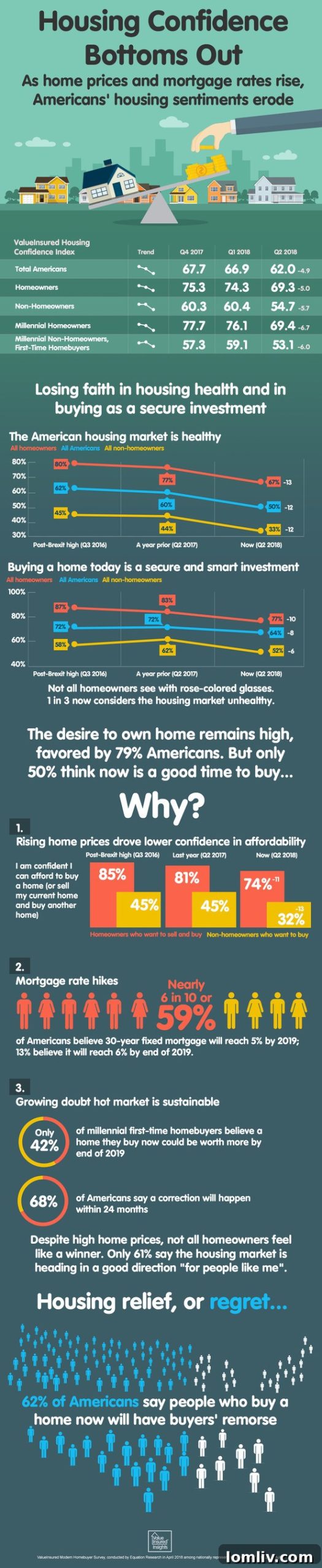
The ValueInsured quarterly Modern Homebuyer Survey painted a revealing picture of this shifting sentiment. A significant 79 percent of non-homeowners expressed a desire to own a home, reaffirming the enduring appeal of property ownership. However, this aspiration was tempered by considerable apprehension: 67 percent of respondents believed the housing market was unhealthy. Even more strikingly, 52 percent no longer considered buying a home a smart investment, a stark departure from the long-held belief in real estate as a consistently reliable asset.
The Dallas-based PVI agency’s Housing Confidence Index, a key measure of consumer sentiment, dropped to 62.0, marking a 4.9-point decline from the first quarter of the year. This decrease signals a tangible erosion of confidence among potential buyers, reflecting their growing anxieties about market stability and affordability.
Joe Melendez, CEO of ValueInsured, offered insights into these findings, explaining that while “housing confidence – as do home prices – goes up and down,” the current decline was particularly noteworthy among specific demographic groups, especially millennials. Many homeowners, particularly those in starter homes, feel “stuck” due to rapidly appreciating values in higher tiers, making it difficult to upgrade. This contributes to the persistent inventory shortage at the starter-home level, exacerbating the challenges for first-time buyers. The millennial generation, often burdened by student loan debt and facing higher entry costs, is particularly sensitive to these market dynamics.
The company identified three primary factors heavily influencing prospective homebuyers’ decisions and contributing to this wavering confidence. Firstly, concerns about the ability to afford a home are paramount. As home prices continue to outpace wage growth in many areas, the financial stretch required for a down payment and monthly mortgage payments becomes increasingly daunting. Secondly, the prospect of rising interest rates looms large. Higher rates translate to increased borrowing costs, directly impacting the long-term affordability of a mortgage and potentially pricing some buyers out of the market. Finally, a significant doubt persists regarding the sustainability of current home prices. Many prospective buyers fear they might be purchasing at a market peak, only to see values decline, undermining their investment.
Melendez emphasized the critical nature of this period, stating, “This is a pivotal time with rising prices and rates weighing heavily on consumers.” The observable trend of flat to declining home sales volume clearly indicates that both sellers and buyers are exercising caution, often hesitating to commit. He concluded that a resurgence in market activity, with more individuals “moved off the sidelines,” would likely depend on restoring a perceived sense of security and confidence in the homebuying process. For the housing market to regain its momentum, addressing these fundamental concerns about affordability, interest rate stability, and sustainable growth will be essential.