Rising Crime Rates in US Cities: An In-Depth Look at Urban Safety and Real Estate Impact
The issue of urban safety in the United States has once again emerged as a critical concern, casting a shadow over the promise of thriving metropolitan centers. Many major cities across the nation, including dynamic hubs like Dallas, are grappling with a disconcerting trend: a significant increase in murder rates and overall violence compared to previous years. This alarming surge follows a period of sustained decline in violent crime that offered hope for a safer urban future. However, current data suggests a troubling shift, evoking memories of challenges from earlier decades, particularly the late 1980s and early 1990s, often linked to the crack-cocaine epidemic, which saw cities like New York City record over 2,200 murders in 1993 alone.
This isn’t an isolated phenomenon; it signifies a broader societal challenge impacting communities nationwide. Reports indicate that more than 35 major cities have witnessed a noticeable uptick in violent crime, signaling a trend that demands immediate and comprehensive attention from policymakers, law enforcement agencies, and urban residents. To effectively address this resurgence, it is crucial to understand its scope, explore its multifaceted causes, and analyze its profound implications for urban living, community well-being, and particularly, the real estate market.
The Alarming Surge in Urban Violence Across America
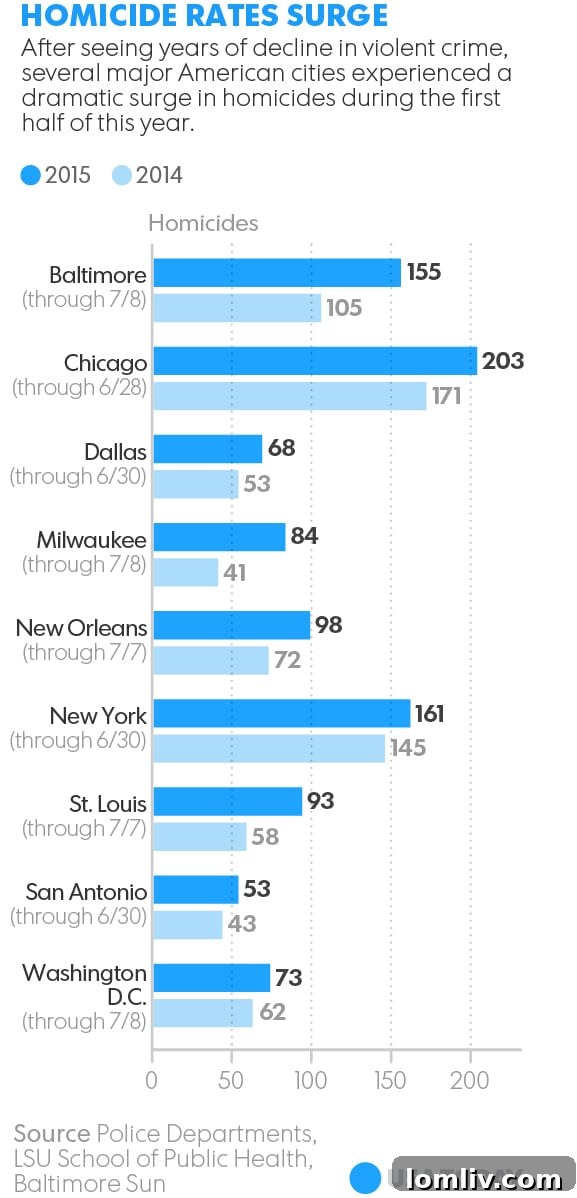
The statistics reveal a stark and concerning picture of escalating violence across various American urban centers. The sheer magnitude of the increases in some cities is particularly alarming, underscoring the severity and widespread nature of the challenge. For instance, data from late August of a recent year provided a grim snapshot of rising homicide rates:
In New Orleans, 120 individuals had been killed by late August, a significant increase from 98 during the identical period in the previous year. Baltimore experienced an even more dramatic escalation, with homicides reaching 215, a sharp rise from 138 at the same point in 2014. Washington D.C. also saw its count climb to 105, compared with 73 people a year prior. St. Louis reported 136 fatalities, marking a substantial 60 percent surge from the 85 murders recorded by the city at the same time last year.
These figures represent more than just cold statistics; they symbolize lives tragically cut short, families irrevocably fractured, and entire communities living under the pervasive shadow of heightened fear and insecurity. While the intensity of these surges varies from one city to another, the collective trend points towards a systemic issue impacting diverse urban environments, from sprawling metropolises to smaller regional centers.
Regional Snapshots: Examining Trends in Major Cities
A closer look at specific metropolitan areas reveals distinct patterns and varying degrees of this problem. In Dallas, for example, murder rates climbed by 17% over the preceding year. While concerning for residents and authorities, this figure is less extreme than what was observed in Milwaukee, which grappled with a staggering 76% increase in murders, making it one of the hardest-hit cities. New York City, despite its immense population density, experienced a comparatively lower but still significant 9% rise in its murder rate.
Houston also faced its own unique set of challenges. Its murder rate was reported to be up by 44% in July of the comparative year. However, local police noted that this trend was showing signs of slowing in the latter part of that period, and paradoxically, overall violent crime rates were decreasing. This complex dynamic in Houston – a rise in murders coexisting with a decrease in other violent crimes – underscores the inherent difficulty in analyzing crime trends and highlights that the underlying factors are rarely simple or easily categorized.
In the first six months of 2015, the murder rate had increased compared to the first six months of 2014, according to crime statistics released by the Houston Police Department.
Police said this was a 44 percent increase from last year.
“Murders were up 58 percent for the first three months of the year, so the number is trending down the last three months,” HPD said in a statement.
Such nuanced data demands a deeper investigation into the specific catalysts at play in each urban context rather than a one-size-fits-all explanation.
Unpacking the Complex Web of Causes Behind Rising Crime
The fundamental question that resonates throughout these discussions is: why are these alarming increases occurring? Law enforcement experts and criminologists largely agree that there is no singular, straightforward answer. Instead, a complex interplay of “disparate factors” appears to be at work, with their influence and intensity fluctuating from one city to another. While definitive certainty remains elusive, several prominent theories and contributing elements are frequently discussed and debated:
Law enforcement experts say disparate factors are at play in different cities, though no one is claiming to know for sure why murder rates are climbing. Some officials say intense national scrutiny of the use of force by the police has made officers less aggressive and emboldened criminals, though many experts dispute that theory. Rivalries among organized street gangs, often over drug turf, and the availability of guns are cited as major factors in some cities, including Chicago. But more commonly, many top police officials say they are seeing a growing willingness among disenchanted young men in poor neighborhoods to use violence to settle ordinary disputes.
The “De-Policing” Debate and Law Enforcement Scrutiny
One prominent, though often contentious, theory attributes part of the rise in crime to what some term “de-policing” or the “Ferguson Effect.” Proponents of this viewpoint argue that intensified national scrutiny of police use of force, coupled with a shifting public narrative, may have led officers to become less proactive or aggressive in their daily policing tactics. The perceived fear of public backlash, legal repercussions, or career damage, it is argued, might cause officers to pull back from engaging in assertive crime prevention. This perceived hesitancy, according to the theory, could inadvertently empower criminals and contribute to an increase in illicit activities and violence. However, a significant number of experts in criminology and police science widely dispute this theory, often citing a lack of conclusive empirical evidence and suggesting that other, more deeply rooted factors are at play.
Socioeconomic Disadvantage and Community Trust
A more widely accepted and empirically supported explanation focuses on underlying socioeconomic issues. Many top police officials and community leaders observe a concerning trend: a growing willingness among “disenchanted young men in poor neighborhoods” to resort to violence as a means of resolving even minor disputes. This phenomenon points to profound societal problems such as entrenched poverty, inadequate access to quality education and viable employment opportunities, and systemic inequalities that can collectively foster environments where violence becomes a normalized or perceived necessary solution. When communities lack genuine trust in formal justice systems, or when residents feel consistently marginalized and unheard, internal conflicts can rapidly escalate without effective non-violent resolution mechanisms or trusted intermediaries.
Gang Activity, Drug Trafficking, and Gun Availability
The persistent and evolving issues of organized street gang rivalries remain a significant and often overlooked driver of violence in many urban centers. These rivalries are frequently fueled by fierce disputes over lucrative drug turf, illicit markets, and perceived slights. The widespread availability and easy access to firearms further exacerbate these conflicts, transforming what might otherwise be non-lethal arguments into deadly encounters. The presence of guns exponentially increases the lethality of confrontations, contributing disproportionately to homicide rates even as other forms of violent crime might fluctuate or decline.
Other Contributing Factors to Urban Crime
Beyond these primary theories, experts continue to meticulously explore a comprehensive range of other contributing factors that interact in complex ways. These include the significant impact of mental health challenges and crises within communities, the lingering and devastating effects of the opioid epidemic, and even the social disruptions, economic anxieties, and stresses caused by recent global events such as pandemics. The intricate interplay of these numerous elements creates a highly complex and dynamic urban environment, making the formulation and implementation of comprehensive and effective solutions an exceptionally challenging endeavor.
The Tangible Impact on Real Estate and Urban Development
The escalating crime rates have profound and pervasive implications that extend far beyond immediate public safety concerns. They significantly influence urban economics, reshape community structures, and critically impact the real estate market. A personal anecdote from a Dallas resident vividly illustrates the pervasive undercurrent of anxiety: “Last night, I left Bed, Bath & Beyond on Park Lane at 9:15 p.m. The officer on duty said to me, be safe. ‘You, too,’ I replied.” Such casual yet poignant warnings underscore a pervasive sense of apprehension that subtly but powerfully shapes residents’ daily decisions and perceptions.
So, how precisely does this heightened concern for safety affect real estate and urban development?
Migration Patterns and the Search for Security
One of the most immediate and observable impacts of rising crime is its influence on migration patterns within metropolitan areas. As crime rates surge in central or historically more affordable neighborhoods, there is often a distinct “push to the north,” or more broadly, an exodus to suburban communities or to other districts within the city that are perceived as safer. Consumers consistently prioritize security and frequently associate it with better-performing schools, lower crime statistics, and an overall higher quality of life. This powerful perception drives increased demand in specific, desirable, low-crime zones, leading to escalating property values and robust development in these areas, while other neighborhoods struggle with stagnation, disinvestment, or even decline.
Property Values and Investment Deterrence
Persistent high crime rates can significantly depress property values in affected neighborhoods. The omnipresent uncertainty and fear effectively deter potential buyers and investors, resulting in reduced demand and slower appreciation—or even outright depreciation—of real estate assets. Developers, understandably risk-averse, become hesitant to undertake new projects in areas perceived as unsafe or unstable, thereby stifling economic growth and thwarting urban revitalization efforts. This creates a challenging and often self-perpetuating cycle: a lack of investment leads to fewer amenities, reduced job opportunities, and diminished community engagement, which in turn can further exacerbate social problems and contribute to increased crime.
Quality of Life and Lifestyle Choices
Crime impacts not only the monetary value of property but also the fundamental quality of life and the intricate ways residents interact with their urban environment. In high-crime areas, people may become less willing to walk outdoors, utilize public transportation, visit parks, or actively participate in community events. This collective retreat indoors leads to less vibrant and less observed streets, effectively diminishing the “eyes on the street” effect, a concept powerfully championed by urban theorist Jane Jacobs. Jacobs argued that active, bustling public spaces—characteristic of West Village-style urban developments where people live, walk, work, and dine—naturally deter crime through increased natural surveillance and by fostering stronger community cohesion. For specific areas like Inwood and Forest mentioned in the original context, cultivating such dynamic and engaged environments is absolutely critical for both enhancing safety and catalyzing revitalization.
The Broader Economic and Social Costs of Insecurity
Beyond direct impacts on property values, there are broader and often less tangible economic and social costs associated with pervasive urban crime. Businesses may elect to relocate or entirely avoid establishing a presence in high-crime zones, leading to job losses and a reduction in access to essential goods and services for local residents. Homeowners and businesses are often compelled to invest more heavily in security measures—such as alarm systems, reinforced doors, and security personnel—diverting financial resources that could otherwise be allocated to productive investments or crucial community improvements. Moreover, the psychological toll on residents, including chronic stress, anxiety, and a reduced sense of well-being, represents a significant, though harder to quantify, cost that erodes the overall health and happiness of urban populations.
The unsettling news, such as reports of another police officer being shot in Lake County, Illinois—a region often considered one of the serene counties circling Chicago—further underscores the pervasive and indiscriminate nature of these challenges. It serves as a stark reminder that perceptions of safety can be fragile, and no community, regardless of its perceived tranquility, is entirely immune to the ripple effects of rising violence and the anxieties it breeds.
Strategies for a Safer Urban Future
Effectively addressing the complex issue of rising urban crime demands a multi-faceted, collaborative, and deeply empathetic approach. No single solution will suffice, but a synergistic combination of strategies focusing on prevention, intervention, and robust community empowerment offers the most promising and sustainable path forward for our cities:
- Community-Oriented Policing: Shifting towards policing models that prioritize building genuine trust, fostering positive relationships, and actively collaborating with residents can significantly enhance intelligence gathering, reduce community fear, and encourage greater cooperation in crime prevention efforts.
- Targeted Interventions and Prevention Programs: Implementing programs specifically designed for at-risk youth, developing effective gang deterrence strategies, and expanding access to comprehensive substance abuse treatment can address the underlying root causes of violence and provide viable alternatives to criminal activity.
- Socioeconomic Investment: Long-term and sustainable solutions fundamentally involve substantial investment in quality education, robust job creation initiatives, affordable housing programs, and essential social services within disadvantaged neighborhoods. Addressing systemic poverty and deep-seated inequality is absolutely fundamental to creating environments of sustainable safety and opportunity.
- Thoughtful Urban Planning and Design: Embracing principles of urban design that proactively promote active public spaces, foster mixed-use developments, and enhance walkability can naturally elevate safety by increasing natural surveillance and fostering stronger community interaction, aligning perfectly with Jane Jacobs’ “eyes on the street” philosophy.
- Collaborative Governance and Partnerships: Effective crime reduction requires strong and sustained partnerships between law enforcement agencies, local government officials, respected community leaders, non-profit organizations, and engaged residents. Shared responsibility, coordinated efforts, and open communication are critical for developing and implementing comprehensive safety strategies that resonate with community needs.
- Evidence-Based Gun Violence Prevention: While often a contentious issue, constructive discussions around responsible gun ownership, rigorous efforts to reduce illegal gun trafficking, and the implementation of evidence-based violence prevention programs are crucial components in mitigating the disproportionate impact of firearms on urban homicide rates.
Conclusion: Reclaiming Our Urban Spaces for a Prosperous Future
The resurgence of elevated crime rates in many US cities presents a formidable and pressing challenge, threatening not only the immediate safety and peace of mind of residents but also the long-term vitality, economic health, and cultural vibrancy of our urban centers. The complex interplay of socioeconomic factors, evolving policing strategies, and dynamic community characteristics means there are no simple, universally applicable answers. However, by steadfastly acknowledging the multifaceted nature of the problem, committing to substantial investment in evidence-based solutions, fostering genuine and equitable community partnerships, and embracing urban planning principles that prioritize both safety and vibrancy, cities can begin the crucial process of reclaiming their spaces.
The overarching goal must be to cultivate urban environments where all residents feel genuinely secure, where abundant opportunities are accessible to everyone, and where the full promise of urban life can be realized without fear. By building upon the legacy of past progress in crime reduction and integrating forward-thinking strategies, we can work towards a truly resilient, equitable, and prosperous future for all American cities, ensuring that the current challenges become catalysts for deeper, more effective change rather than harbingers of continued decline.