In the vibrant world of architecture, awards ceremonies serve as crucial platforms to recognize innovation, creativity, and the enduring impact of design. One such event, the annual awards for unbuilt projects hosted by the Dallas chapter of the American Institute of Architects (AIA), always sparks considerable discussion. This particular year, the ceremony coincided with the passing of legendary architect I.M. Pei, casting a reflective shadow over the proceedings. As I navigated the various entries alongside Candy Evans, our esteemed founder and publisher, a striking pattern emerged: the designs that most captivated my attention predominantly hailed from outside the Dallas metroplex, despite the awards recognizing work by Dallas-based firms.
This observation led to a significant “Aha!” moment, shifting the focus of my ongoing series, “Why Can’t Dallas Have Nice Things.” While it might be tempting to criticize Dallas architecture as bland – a common refrain – the true revelation was that Dallas-based architectural firms demonstrably possess the talent and vision to produce compelling work. The root of the issue, it became clear, lies not with the architects themselves, but often with their local Dallas-area clients, who sometimes appear to lack the imagination or fortitude to embrace truly pioneering designs. This revelation broadens the scope of my critique, pointing a finger more squarely at local developers and their preferences than at the inherent capabilities of Dallas’s architectural community.
Adding another layer to this intriguing narrative were the insights shared by the out-of-town judges. They noted a pervasive pragmatism among the Dallas-area entries for “unbuilt” projects. Unlike the fantastical concept cars unveiled at auto shows – radically different, often unbuildable design studies driven purely by innovation and aesthetic wonder – many of the architectural submissions felt less like “dream projects” and more like proposals simply awaiting a shovel in the dirt. The entries frequently lacked that audacious spark, that undeniable sense of “WOW” that defines truly visionary, unbuilt concepts. Instead of imaginative, gravity-defying confections, we saw competent, practical designs that merely hadn’t broken ground yet. This highlighted a missed opportunity for architects to truly push boundaries and present designs unfettered by immediate construction constraints.
The Paradox of “Unbuilt”: Preservation vs. Vision
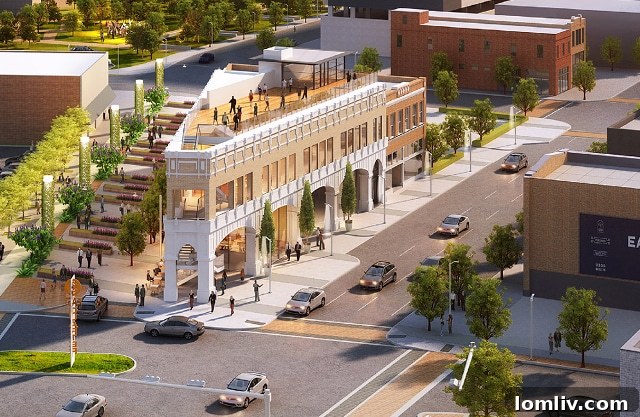
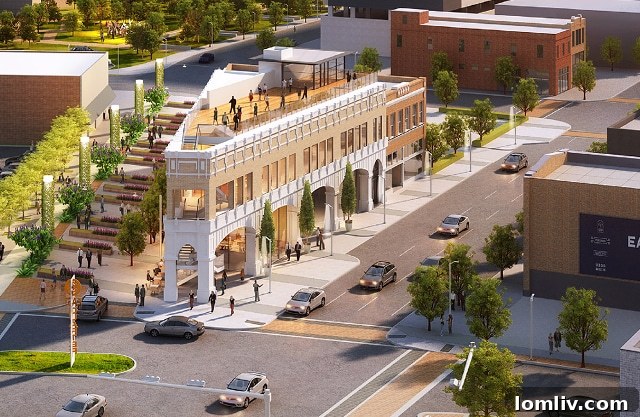
A prime example of this paradox was the Critic’s Choice Award, selected by Mark Lamster of the Dallas Morning News. This honor went to Omniplan’s reimagining of the historic Magnolia Service Station, nestled downtown on Commerce Street and Cesar Chavez Blvd. Originally built in 1920, the project presented a wonderful renovation and revitalization scheme. However, its classification as an “unbuilt” project raised eyebrows. With the East Quarter district undergoing a significant renaissance, it’s highly probable that the design depicted in the rendering is precisely what the property will soon look like, with only minor adjustments. The building has stood for nearly a century; its revival is a testament to preservation and urban renewal. While I wholeheartedly applaud the effort to restore such a significant landmark and integrate it into the neighborhood’s revitalization, labeling a well-established building’s renovation as “unbuilt” stretches the definition of the term considerably. It prompts us to consider whether awards for “unbuilt” projects should focus more on radical new ideas than on the commendable, yet essentially reconstructive, work of adaptive reuse.
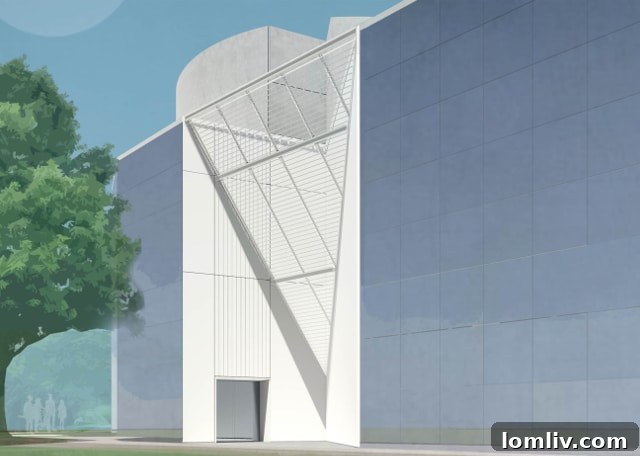
Beyond the Magnolia Service Station, only one other winning project was located within Dallas. This was a thoughtfully conceived, restrained addition to an existing building at 5401 N. Central Expy, envisioned by Entos Design. The original structure, characterized by its rounded, low-slung form gracefully curving around a triangular lot, unmistakably dates back to 1982, its birthdate announced by its distinctive shape and silver-mirrored façade. The existing entryway, however, was a jarring, garish primary blue – a hallmark of certain post-modern sensibilities. This building serves as the home for John Carona’s property management company, Associa.
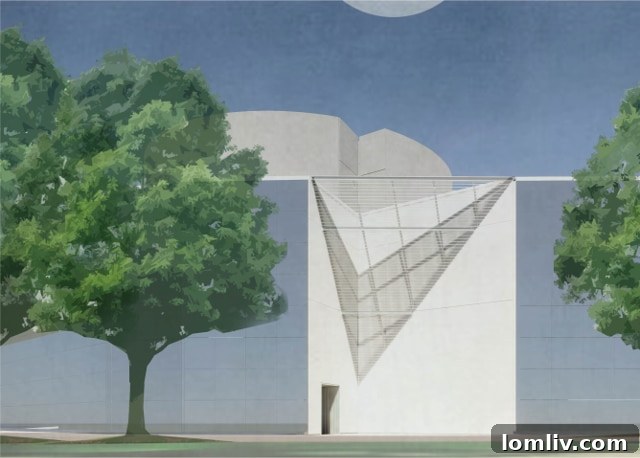
As illustrated in the image above, Entos Design’s proposal masterfully eliminates the anachronistic blue entryway, replacing it with a “simple” yet sophisticated louvered grate. What elevates this design to a standout status is its ingenious use of light and shadow. Throughout the day, as the sun traverses the sky, the louvered structure creates an ever-changing interplay of light and shade that dynamically draws attention to the doorway, transforming a mundane entrance into an artistic statement. For a relatively modest investment, this design promises a dramatic aesthetic uplift and a visually engaging experience. The mystery remains: why such an elegant, impactful, and seemingly cost-effective improvement has not yet been realized. It stands as a testament to the power of subtle, intelligent design, reminding us that “unbuilt” can also mean “yet to be constructed,” even for projects that appear eminently feasible and desirable.
A Tale of Two Architectures: Dallas vs. The World
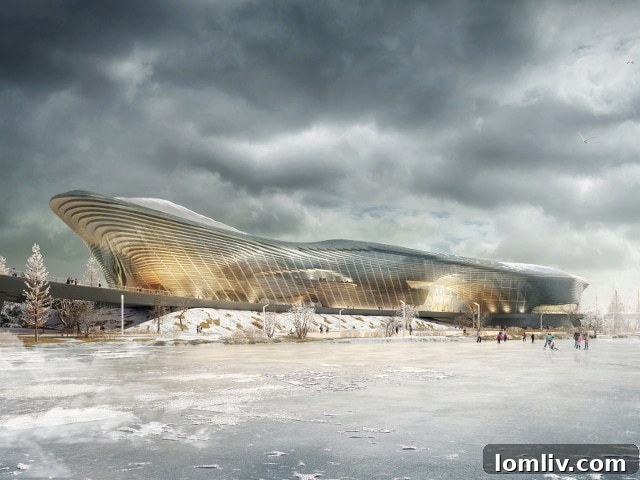
To summarize the distribution of accolades, out of numerous entries, six projects were ultimately recognized. The Dallas-based projects that received awards were, at their core, a doorway renovation and a historic gas station restoration. In stark contrast, the remaining two-thirds of the winners were groundbreaking, from-scratch projects located in international and distant U.S. cities, including Berlin, New York, Indiana, and the stunning Concert Hall in Kaunas, Lithuania (pictured above) by CallisonRTKL. These global projects embodied the true spirit of “unbuilt” architecture: bold, imaginative, and often pushing the boundaries of what’s currently constructible or envisioned. This dichotomy underscores a critical point: while Dallas firms are clearly capable of world-class design, the opportunities they receive locally often seem to gravitate towards pragmatic renovations rather than truly visionary new constructions. This disparity naturally leads to a renewed, impassioned plea: “Come on, Dallas developers!” The city deserves, and its architects are capable of delivering, more aspirational urban statements.
The Ghost Towers of Dallas: A History of Unbuilt Dreams
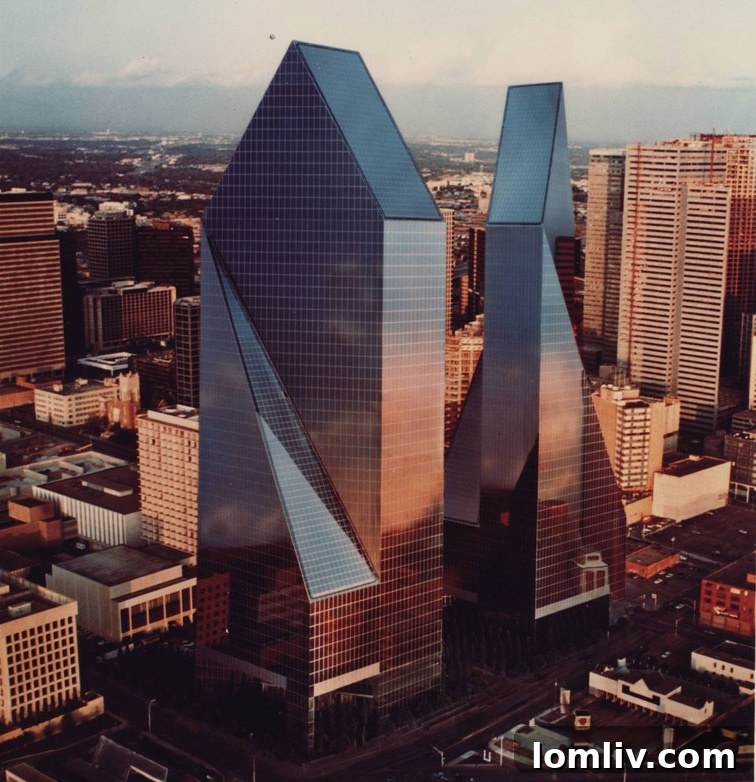
Dallas, like any burgeoning metropolis, has its own fascinating history of projects that remained “unbuilt.” The landscape is dotted with tales of planned towers and grand visions that never materialized. A poignant example stems from the tumultuous period of the oil bust and the Savings & Loan crisis in the 1980s. During this era, many ambitious high-rise proposals for Dallas were tragically aborted; records indicate that at least 23 proposed towers between 1978 and 1985 never saw the light of day. One of the most iconic “half-built” visions was I.M. Pei’s Fountain Place. The initial, breathtaking concept envisioned two identical, crystalline towers, precisely rotated 90 degrees from each other, creating a striking architectural dialogue (as seen in the rendering above). However, due to the economic downturn, only one of these magnificent structures was ever completed.
Now, over three and a half decades later, a remarkable turn of events is unfolding. AMLI is constructing a second tower on the Fountain Place site. While this new addition is not an identical twin to Pei’s original – it’s shorter and features a distinct design – it crucially incorporates the same distinctive exterior glass, creating a powerful visual continuity that harmonizes the two buildings. This modern project, unlike Pei’s office tower design, will house 367 rental apartments – a residential use for downtown Dallas that would have been scarcely contemplated, let alone pursued, in the 1980s. This transformation reflects the evolving urban fabric of Dallas, shifting from a predominantly corporate downtown to a more vibrant, mixed-use environment. The completion of the second tower, even in a modified form, offers a fascinating glimpse into how “unbuilt” dreams can eventually be realized, adapting to new times and new needs.
The history of Fountain Place, alongside the narratives of the AIA Unbuilt Awards, paints a comprehensive picture of Dallas’s architectural journey. It highlights the city’s aspirations, the economic realities that have shaped its skyline, and the persistent longing for more imaginative, boundary-pushing designs. Dallas boasts incredible architectural talent, and the challenge now lies with developers and clients to match that talent with equally bold and forward-thinking visions. Embracing visionary “unbuilt” projects isn’t just about constructing new buildings; it’s about shaping the city’s identity, fostering innovation, and leaving a lasting legacy of design excellence for future generations.

Remember: My focus consistently revolves around high-rises, homeowners’ associations (HOAs), and the intricate world of renovation. Yet, my appreciation extends broadly to modern and historical architecture, always balancing these against the dynamic forces of the YIMBY (Yes In My Backyard) movement, advocating for urban development. My dedication to architectural discourse has been recognized by the National Association of Real Estate Editors, which honored my writing with three Bronze awards in 2016, 2017, and 2018, complemented by two Silver awards in 2016 and 2017. If you have a compelling story to share, an architectural gem to highlight, or even a marriage proposal to make (I’m all ears!), please don’t hesitate to reach out via email at [email protected]. You’re welcome to search for me on Facebook and Twitter, though finding me there might prove to be an engaging challenge!