Dallas, a dynamic city dedicated to urban sustainability, has proudly operated a comprehensive residential recycling program since 2017. This initiative forms a crucial pillar of the city’s broader environmental goals, encouraging residents to actively participate in waste reduction and resource conservation. However, a recent wave of rigorous recycling audits, particularly affecting long-standing homeowners, has unexpectedly sparked widespread confusion and frustration. Many residents feel caught off guard by the intensified enforcement, attributing their bewilderment to a perceived lack of clear, consistent, and proactive communication from the city regarding proper recycling guidelines and the implications of non-compliance.
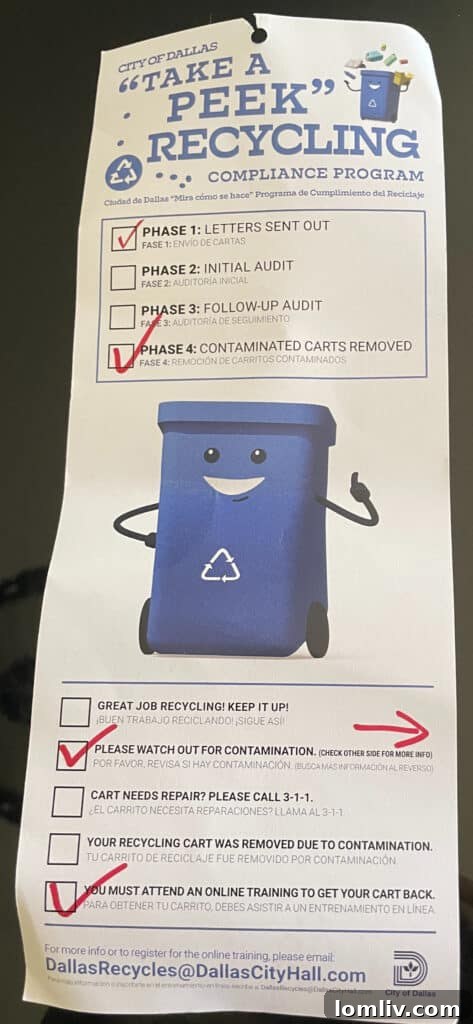
Central to this enhanced focus on recycling compliance is the “Take a Peek” program, an integral component of Dallas’ ambitious Zero Waste campaign. Under this initiative, trained sanitation workers conduct visual inspections of residential recycling bins directly at the curb. The program’s primary objective is to verify that these bins contain only appropriate recyclable items, free from contaminants that can compromise the entire recycling stream. When a bin is identified as containing non-recyclable materials—a situation termed a “contaminated bin”—homeowners are typically engaged through a structured, three-round communication process. Persistent non-compliance can ultimately lead to the temporary removal of the recycling bin. To facilitate the return of a removed bin, affected residents are frequently informed that they must complete a mandatory online training course, a requirement that has emerged as a significant source of both logistical challenges and public discontent.
The prevailing sentiment among many Dallas residents, particularly those who have long prided themselves on their diligent recycling habits, ranges from sheer exasperation to profound frustration. This mood was vividly captured in a recent post on Nextdoor, a widely used neighborhood social media application. One resident voiced a common concern, stating, “I understand the need for education and compliance… but it does seem that the City hasn’t thought this through completely. The City must be getting all kinds of calls and emails. What a waste of admin time, not to mention our own.” This powerful sentiment resonates deeply within the community, underscoring a perceived chasm between the city’s policy objectives and the practical realities of its implementation. The implied surge in calls and emails, as highlighted by the resident, points to potential strains on city administrative resources and considerable inconvenience for numerous homeowners across Dallas.
The public outcry and community discussion surrounding these audits gained substantial momentum following a poignant Nextdoor post by a seasoned recycler and Hollywood Heights homeowner. Her personal account of having her recycling bin removed, inadvertently triggered by a guest mistakenly placing a bag of trash inside, rapidly amassed over 8,000 views and dozens of supportive comments within a single week. This significant level of community engagement undeniably underscores the deep-seated concern among residents and highlights the urgent need for greater clarity and understanding surrounding the nuances of the Dallas recycling program.
The homeowner’s unsettling experience serves as a compelling, real-world illustration of the communication breakdowns that numerous residents have reported. Despite her immediate action to remove the misplaced trash item and promptly contacting 311 to arrange for a pickup, she never received the anticipated warning letter. “The next thing I know my bin was removed,” she recounted, expressing her dismay at the absence of any direct interaction or even a knock on her door. Subsequent calls to the Dallas Sanitation Department revealed an additional hurdle: she would be required to complete an online training course, which, ironically, she was informed was still “getting ready” and not yet available. Her attempts to secure a firm guarantee for her bin’s return were met with a representative’s blunt refusal and an abrupt termination of the call, leaving her feeling unheard, unsupported, and increasingly frustrated by the opaque process.
From the city’s operational vantage point, Danielle McClelland, Division Manager for Zero Waste, acknowledged the inherent communication challenges but firmly asserted that her department employs multiple methods of outreach. While she clarified that the department cannot assume responsibility for issues pertaining to undelivered postal mail, she emphasized that a physical tag affixed directly to the recycling bin constitutes a direct and undeniable form of communication. “If they say they didn’t get a letter, they would have gotten a tag,” McClelland stated, reinforcing the city’s position that residents are, in fact, receiving ample notification regarding their recycling status. This perspective highlights the city’s reliance on a diverse, multi-pronged communication strategy, even if some of these methods are perceived by residents as less effective or are inadvertently overlooked.
Navigating the ‘Take a Peek’ Program: A Quest for Transparent Information
A persistent and perplexing challenge, frequently cited by both concerned residents and our independent investigation, is the striking scarcity of comprehensive and readily accessible online information pertaining to the “Take a Peek” program. Despite its direct mention on the audit tags prominently affixed to residential recycling bins, a casual online search often yields only superficial details, contributing significantly to the widespread confusion among homeowners. This pronounced lack of a centralized, user-friendly, and informative resource creates a substantial barrier for homeowners who are genuinely seeking to understand the intricate nuances of the program and proactively avoid issues of non-compliance.
The difficulty in unearthing relevant information is not merely anecdotal. A revealing survey conducted in mid-2022, specifically designed to gauge public awareness of Dallas’ waste management initiatives, brought forth telling results. At least one resident explicitly articulated their lack of awareness, stating they had “never heard of ‘take-a-peek; not sure what it does or how it connects to the Zero Waste plan.” Such candid feedback unequivocally underscores a significant deficiency in public outreach, suggesting that the program’s vital role within the city’s overarching sustainability objectives is not effectively reaching its intended audience. Furthermore, direct attempts to engage with the city through the provided contact email, [email protected]—the very address left on audit tags—proved entirely unforthcoming. No reply was received within a five-day period, including a weekend, a lack of responsiveness that only exacerbates resident frustration and reinforces the perception of inadequate official support.
The primary point of contact for numerous municipal services, the 311 hotline, regrettably also presents significant navigational obstacles for residents seeking recycling information. Callers attempting to inquire about recycling are routinely rerouted to an automated recording that immediately directs them towards unrelated options, such as water bill payments or coyote activity reports, making it inherently challenging to even reach the appropriate department. Our direct interaction with a 311 agent further exposed systemic inefficiencies. The agent candidly admitted her inability to provide access to the crucial online training information, operating under the belief that “the video link has to be given directly to the homeowner whose recycling bin has been removed.” This restrictive policy, while potentially conceived to ensure targeted education, inadvertently erects an unnecessary bureaucratic hurdle for individuals proactively striving to understand and adhere to the city’s recycling regulations. Ultimately, our inquiry resulted in another redirection back to the Sanitation Department, creating a frustrating and time-consuming loop for citizens merely attempting to navigate the municipal system.
Demystifying ‘Take a Peek’: Insights and Clarifications from City Officials
In a concerted effort to obtain clearer insights into the operational mechanics and underlying philosophy of the “Take a Peek” program, and to address the escalating community concerns, our team submitted seven specific questions via email to multiple city officials. The initial responses, however, were largely redirective, consistently pointing us towards Sarah Lopez, the designated Zero Waste Recycling Coordinator. Regrettably, Ms. Lopez did not offer an immediate reply to our emails, and her voicemailbox was found to be full, potentially indicating capacity constraints within the critical department responsible for overseeing this vital municipal program.
Fortunately, Danielle McClelland, the proactive Division Manager for Zero Waste, stepped forward to provide much-needed clarification and detailed information. She offered a comprehensive overview of the audit process, shedding critical light on both the methodology and the scope of the program. For instance, the recent audit route specifically targeted approximately 572 households situated within the Hollywood-Santa Monica area of East Dallas. McClelland meticulously outlined the systematic steps involved: “We identify which households we’re going to review. We mail them a letter. We do three rounds of reviews. We do visual inspections. If there’s something in the cart that should not be there, we leave a note on their cart, gate, or front door knob if we have access to that. We usually come back the following week. We leave a note that says, ‘Great job,’ if they’re doing it correctly. If they have damaged carts, we let them know how to get a replacement.” This detailed explanation helps to illustrate a structured and multi-layered approach, explicitly designed to provide residents with multiple opportunities for engagement and correction.
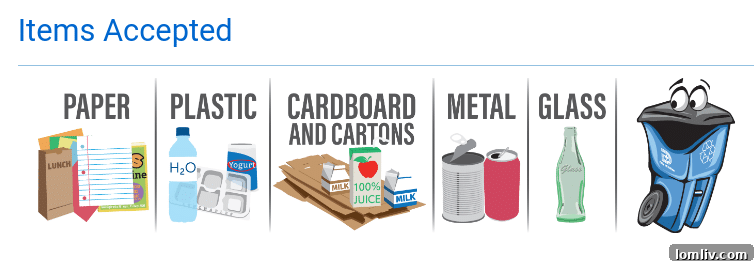
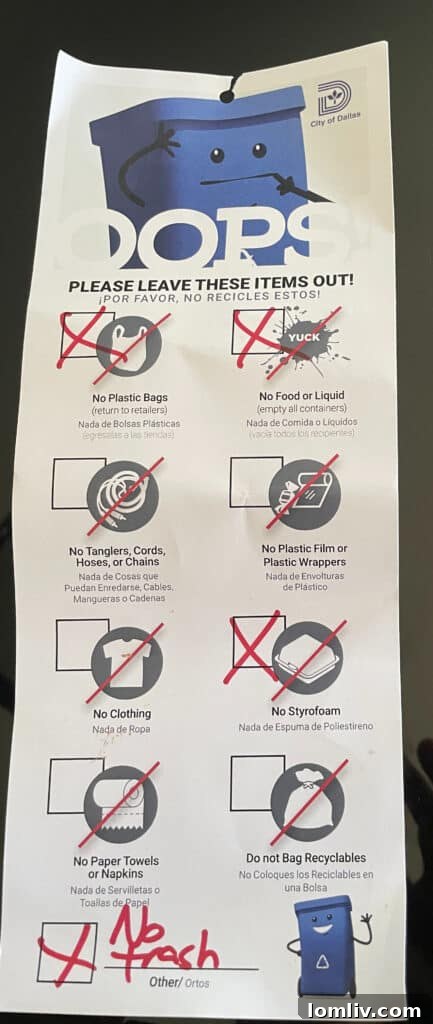
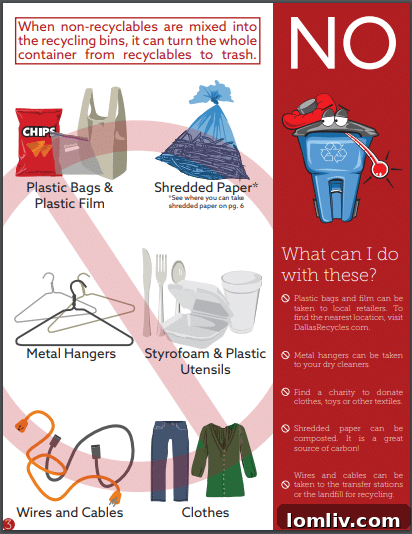
The fundamental objective of the “Take a Peek” curbside audit program, as articulated by McClelland, is to significantly “reduce contamination” within the residential recycling stream. Contamination presents a critical and costly issue, as it not only severely diminishes the quality and market value of otherwise recyclable materials but also substantially increases processing costs at recycling facilities. In severe cases, highly contaminated batches can even be entirely diverted to landfills, negating the entire purpose of recycling. Understanding the most common culprits of contamination is therefore essential for effective recycling. McClelland specifically highlighted several frequent offenders consistently found in Dallas recycling bins: Styrofoam, paper towels, various forms of food waste, and plastic bags. These items, despite common misconceptions, are currently non-recyclable within Dallas’s system and can cause significant operational problems and inefficiencies at material recovery facilities.
Addressing the widely discussed online training video, McClelland provided crucial clarification regarding its evolution and underlying purpose. Initially, the city offered an in-person training class, but this format transitioned to a more accessible online course in the wake of the COVID-19 pandemic. It is vital to understand that the direct link to this specialized training is not publicly available through general web searches. Instead, it is specifically dispatched to homeowners who have repeatedly demonstrated non-compliance by consistently placing contaminated items in their residential recycling bins. This targeted educational approach is meticulously designed to ensure that valuable resources are directed towards those most in need of a refresher on proper recycling protocols and guidelines. McClelland further noted that, to date, her department has not encountered any resident who has outright refused to participate in the required training while simultaneously expecting their removed bin to be returned, suggesting a general willingness to comply once the process and its necessity are clearly understood.
McClelland underscored a profoundly important aspect of the city’s program: “Dallas’ recycling program is voluntary.” While participation is robustly encouraged for the undeniable environmental benefits it offers, the city does not enforce it as a mandatory municipal service. However, for those who elect to participate and wish to do so effectively, education on proper sorting techniques is paramount. McClelland affirmed that if a resident encounters difficulties in accessing or viewing the online video, her department is notably accommodating, offering to “send them the slide deck, with the assumption they’re going to look at it.” This flexible approach aims to empower residents with the indispensable knowledge required for correct recycling. “We are not the recycling police,” McClelland asserted with emphasis, clarifying the department’s core role as educators and facilitators rather than punitive enforcers. “Our goal and our job is to help people learn to recycle correctly. We are accommodating to that extent, but education is key. If a person isn’t willing to receive that education, then it kind of defeats the whole purpose of the reviews.” This comprehensive statement encapsulates the city’s overarching philosophy: while residential participation is voluntary, effective and correct participation necessitates a genuine commitment to understanding and diligently applying the established recycling guidelines.
Bridging the Gap: Enhancing Communication for a More Effective Dallas Recycling Program
The recent experiences of Dallas homeowners vividly illuminate a critical area for immediate and substantial improvement: the pressing need for enhanced, proactive, and easily digestible communication regarding the city’s residential recycling program. While the “Take a Peek” audits represent a necessary enforcement component of the broader Zero Waste initiative, their ultimate effectiveness is intrinsically linked to residents’ clear and unambiguous understanding of the specific rules and the precise consequences of non-compliance. Future communication strategies could explore and implement multiple avenues to effectively bridge the current information gap. This might include prominently featuring detailed “Take a Peek” program information and frequently asked questions on the Dallas Sanitation Department’s main website, developing concise and visually engaging infographics, or actively leveraging local media outlets to widely disseminate information well in advance of audits commencing in a particular neighborhood. Ensuring that crucial information, such as the vital online training link, is readily accessible to residents whose bins have been removed, without imposing undue bureaucratic hurdles, would significantly alleviate frustration and cultivate a much greater sense of cooperation. A more user-friendly 311 system, equipped to directly and efficiently address recycling inquiries, coupled with responsive and helpful email support, would also empower residents to resolve issues efficiently and unequivocally reinforce the city’s commitment to genuine community engagement and support.
The Future of Recycling in Dallas: A Shared Responsibility Towards Zero Waste
Ultimately, the enduring success of Dallas’ ambitious Zero Waste campaign and its vital recycling initiatives rests firmly on a robust foundation of shared responsibility and mutual understanding. The City of Dallas bears a clear responsibility to articulately communicate its recycling guidelines, to provide easily accessible and comprehensive educational resources, and to diligently maintain transparent and responsive communication channels with its residents. Residents, in turn, share a parallel responsibility to actively seek out and internalize this crucial information, to meticulously sort their recyclables according to established guidelines, and to participate thoughtfully and conscientiously in the program. By actively fostering an environment characterized by mutual understanding, proactive engagement, and continuous dialogue, Dallas can steadily advance closer to realizing its ambitious sustainability goals. Addressing the current points of friction, particularly those surrounding communication clarity and educational efficacy, will be paramount in transforming existing confusion into confident compliance and ensuring that the residential recycling program not only operates with optimal efficiency but also garners the full support and enthusiastic participation of its vibrant community. This collaborative and cooperative approach promises not only to reduce waste volumes but also to profoundly strengthen community trust and cultivate a truly greener, more sustainable Dallas for current and future generations.