The North Texas real estate market continues to be a hotbed of activity, consistently drawing attention from homebuyers, investors, and industry analysts alike. From its leading position in national housing market rankings to the evolving landscape of apartment demand and the ever-present question of housing affordability, the region presents a dynamic and complex picture. This week, we delve into the latest insights impacting the Dallas-Fort Worth area and broader North Texas, examining recent studies and reports that shed light on market performance, homeowner expenditures, and the ongoing recovery of the rental sector.
North Texas Dominates WalletHub’s 2018 Best Real Estate Markets Ranking
North Texas has once again proven its mettle in the national real estate arena, with a significant presence on WalletHub’s authoritative list of the country’s best housing markets. The financial analytics platform recently unveiled its 2018 rankings, highlighting eight North Texas cities and towns among the nation’s top performers. This strong showing underscores the region’s robust economic health and attractive living conditions, which continue to draw new residents and investment.
WalletHub’s comprehensive analysis involved a meticulous comparison of 300 cities of diverse sizes across the U.S. To achieve a holistic view, the study utilized 22 key indicators, meticulously chosen to reflect both housing-market attractiveness and underlying economic strength. These indicators spanned a wide spectrum, ranging from crucial metrics such as median home-price appreciation, which signals investment potential, to home sales turnover rate, indicating market liquidity, and broader economic indicators like job growth, which drives housing demand.
In a remarkable achievement, Frisco was crowned the best city in the U.S. for buying a house, a testament to its rapid development, high quality of life, and sustained property value growth. Following closely, McKinney secured the second spot, and Allen clinched the third, cementing North Texas’s reputation as a prime location for homeownership. The strong performance didn’t stop there: Richardson earned a respectable No. 7, Denton came in at No. 10, Carrollton at No. 12, Fort Worth at No. 15, and Irving rounded out the top 21. Even other major regional players like Garland (No. 41), Plano (No. 44), Dallas (No. 84), Arlington (No. 86), and Mesquite (No. 112) demonstrated solid standing within the national context, showcasing the widespread appeal and economic vitality of the entire metropolitan area.
Further breaking down the rankings by city size provides an even clearer picture of North Texas’s dominance. In the large cities category, Fort Worth emerged as an impressive No. 3, reflecting its burgeoning urban core and expanding economic opportunities. Dallas, the region’s largest city, also made a significant appearance at No. 17. For midsize cities, McKinney took the top honor, with Irving at No. 6, Grand Prairie at No. 12, Garland at No. 14, and Plano at No. 16. The small cities category saw Frisco again at the pinnacle, closely followed by Allen at No. 2. Richardson, Denton, and Carrollton also showcased strong performances at No. 5, No. 7, and No. 9, respectively. These granular insights confirm that North Texas offers attractive housing markets across various urban scales, catering to diverse preferences and economic needs.
Housing Affordability in North Texas: A Growing Challenge
While North Texas boasts an enviable real estate market, a recent study by Zillow highlights an increasingly critical aspect for residents: housing affordability. According to Zillow’s second-quarter affordability study, Dallas-Fort Worth homebuyers are indeed spending less of their monthly income on mortgage payments compared to the national average, but the margin is narrowing. This trend signals a tightening market where the dream of homeownership, while still attainable for many, requires careful financial planning.
The study, which meticulously analyzed 35 of the nation’s largest metropolitan areas, revealed that the average American homebuyer allocates approximately 17.5 percent of their monthly income towards mortgage payments. This figure, while still below the historical average, reflects a significant shift. The report indicated a year-over-year increase of over 2 percent in the share of median household income required to cover median mortgage payments on a median-priced home in the second quarter. This upward pressure on affordability is largely attributed to a combination of factors: persistently rising home prices, driven by high demand and limited inventory, and a gradual but steady increase in mortgage interest rates, which directly impact monthly payments.
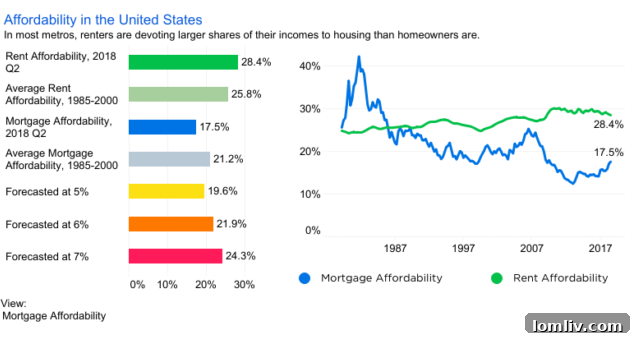
Despite the recent increases, the national average of 17.5 percent remains below the long-term historical average of 21.2 percent. However, the current income-to-mortgage ratio has reached levels not seen since 2009, indicating a significant tightening of the market over the past decade. This trend raises concerns, especially for first-time buyers and those with lower incomes who are already struggling to save for down payments and closing costs.
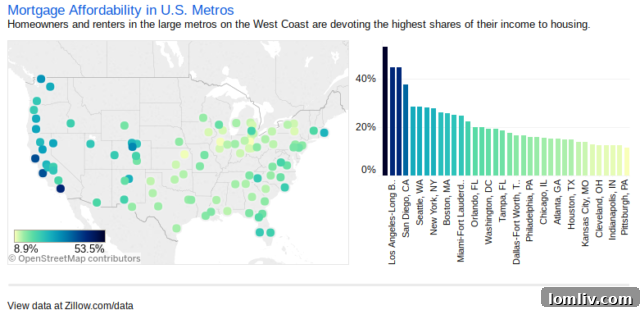
Aaron Terrazas, Zillow Senior Economist, commented on the situation, stating, “While mortgage rates remain low by historic standards, they are creeping upward, eating into what buyers can pay, and in a handful of pricey markets, affordability already looks unnervingly low.” This expert insight underscores the delicate balance between historically low rates and rising home values, which together are creating a challenging environment for many prospective homeowners. Terrazas further elaborated on the plight of lower-income buyers, particularly in expensive markets, noting that for this demographic, even the lowest-priced homes can be financially out of reach due to soaring mortgage costs relative to their earnings.
Zillow’s analysis painted a stark picture of the widening gap between household incomes and the escalating costs of homeownership. In 2017, households in the lower income brackets bore a disproportionate burden, dedicating an average of 23.9 percent of their income to mortgage payments. In stark contrast, higher-earning households enjoyed significantly lower financial strain, spending less than 13 percent of their income on their mortgages. This disparity highlights a growing equity gap and a potential barrier to wealth creation for a substantial portion of the population in the Dallas-Fort Worth real estate market.
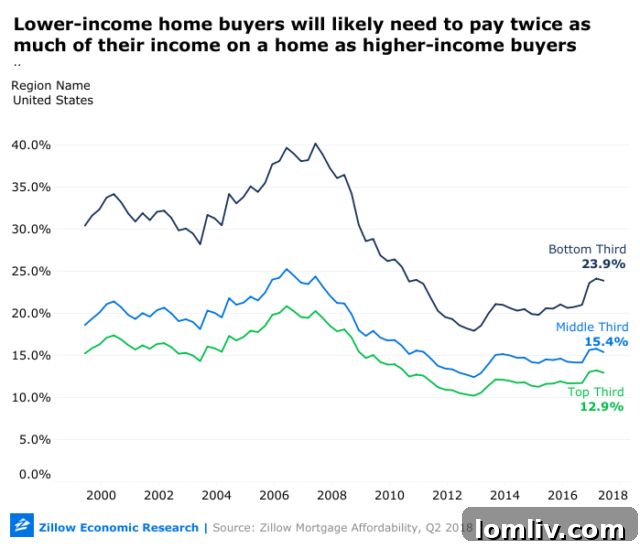
The situation is even more precarious for renters, who typically face even higher housing cost burdens. On average, renters across the nation allocate 28.6 percent of their earnings toward rent. For those in the lowest income brackets, this figure can skyrocket to upwards of 60 percent of their income, leaving minimal disposable income for other necessities and savings. This rental affordability crisis not only affects individuals and families but also has broader implications for economic stability and social mobility within the Dallas-Fort Worth region.
Texas Apartment Markets Show Strong Post-Recession Recovery
The apartment markets across major Texas metropolitan areas, including Austin, Dallas-Fort Worth, and San Antonio, have largely recovered from the lingering effects of the last recession. This positive trend was highlighted in a recent study by the Texas A&M Real Estate Center, which analyzed the robustness and trajectory of the state’s rental housing sector. The recovery signifies a return to stability and growth, driven by sustained population influx and strong employment figures across these urban centers.
Houston’s apartment market, while also on a recovery path, experienced a unique disruption and subsequent new cycle of recovery following the devastating impact of Hurricane Harvey in the previous year. The natural disaster temporarily altered market dynamics, increasing demand for rental units as displaced residents sought temporary and long-term housing solutions, thereby accelerating its recovery in a distinct manner.
Looking ahead, the study projects a stable future for the leading Texas markets. “In the absence of a major shock to the U.S. and Texas economies, apartment markets in Austin, DFW, and San Antonio are projected to move toward their long-term, steady-state average growth rates,” the report concluded. This forecast suggests a period of more predictable and sustainable growth, benefiting both renters and property owners, as markets adjust to fundamental supply and demand principles rather than post-recession volatility.
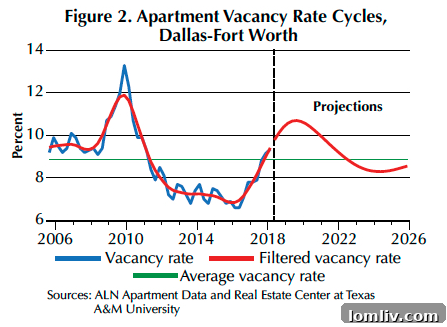
The analysis underpinning these findings utilized extensive time series data for vacancy rates and rent-growth rates, spanning from the third quarter of 2005 through the first quarter of 2018. This long-term perspective allowed researchers to accurately map market cycles, identify recovery patterns, and forecast future trends with greater precision.
Specifically, in the Dallas-Fort Worth apartment market, the vacancy rate experienced a significant peak of 13.3 percent in 2009, a direct consequence of the recession. Following this high, the market demonstrated remarkable resilience, with vacancy rates steadily declining to a trough of 6.8 percent by the first quarter of 2016. This rapid absorption of available units was largely due to robust job growth and a continuous influx of new residents seeking rental housing.
The study elaborated on this period of strong performance, stating, “Absorption exceeded unit deliveries in five of the six years between 2010 and 2015.” This meant that the number of occupied units grew faster than new construction could add to the supply, driving down vacancies. However, as new construction picked up pace to meet the sustained demand, vacancy rates began a modest upward trend, reaching 9.4 percent in the first quarter of 2018. This indicates a market that is still healthy but with increasing inventory coming online.
Projections from the study suggest that DFW’s vacancy rate will continue this gradual increase, peaking around the third quarter of 2019, before settling into a long-term average of approximately 8.9 percent. This stabilization indicates a healthy equilibrium between supply and demand, preventing an oversupply that could negatively impact rent growth.
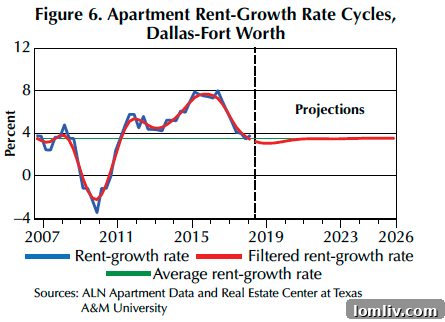
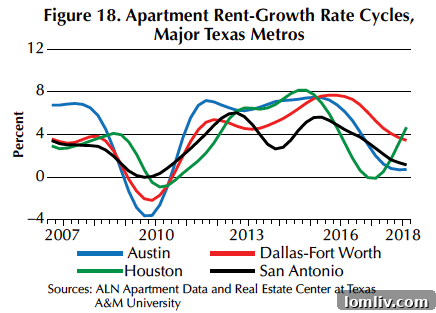
Regarding rent growth, the Dallas-Fort Worth apartment market experienced a peak rate of 8 percent in the second quarter of 2016, a clear indicator of strong demand outstripping supply. Following this peak, rent growth rates have reverted closer to their long-term average of 3.6 percent, signifying a more normalized and sustainable market environment. The study concluded its findings on rent dynamics by observing, “Austin, DFW, and San Antonio markets are currently experiencing decreasing rent-growth rates while Houston is in an early stage of increasing rent-growth rates.” This differentiation reflects the unique market pressures and recovery phases for each major Texas city, with Houston’s post-Harvey rebuilding efforts driving a different trajectory for its rental market.
Residential Construction Employment Shows Robust Growth in August
The residential construction sector continues to be a cornerstone of economic growth, particularly in booming regions like North Texas. The latest data indicates a sustained upward trend in employment within this vital industry. The National Association of Home Builders (NAHB) reported a significant increase of 12,900 residential construction jobs in August, building on a prior increase of 6,800 jobs in July. This consistent growth underscores the ongoing demand for new housing and the industry’s commitment to expanding housing supply.
As of last month, total employment in residential construction reached 2.83 million individuals. This figure is segmented into two main categories: 802,000 workers directly employed by home builders and remodelers, and a substantial two million employed by specialty trade contractors, such as electricians, plumbers, and roofers. The six-month moving average for job gains in the industry now stands at an encouraging 5,383 new positions per month. On a net basis, home builders and remodelers have collectively added approximately 136,600 jobs, reflecting strong sector expansion and a healthy pace of new construction projects.

Further demonstrating the strength of the labor market in this sector, the unemployment rate for construction workers experienced a notable decline to 4 percent on a seasonally adjusted basis. This represents a significant drop of 0.4 points from July and marks the lowest unemployment rate recorded for construction workers since 2001. Such a low rate suggests a highly competitive labor market, where skilled workers are in high demand, and it may also indicate potential challenges for builders in finding sufficient labor to keep up with construction timelines and housing needs.
In broader economic news, the Bureau of Labor Statistics reported an overall increase of 201,000 jobs across the economy in August, following a gain of 147,000 jobs in July. The national unemployment rate held steady at 3.9 percent, indicating a robust job market. Job gains have averaged a healthy 207,000 per month this year, pointing to sustained economic expansion. The number of unemployed persons also saw a decrease, falling by 46,000 in August and a total of 423,000 over the year. These positive employment figures across the board, coupled with the specific strength in residential construction, paint a picture of a thriving economy that continues to support strong real estate markets like those found in North Texas.