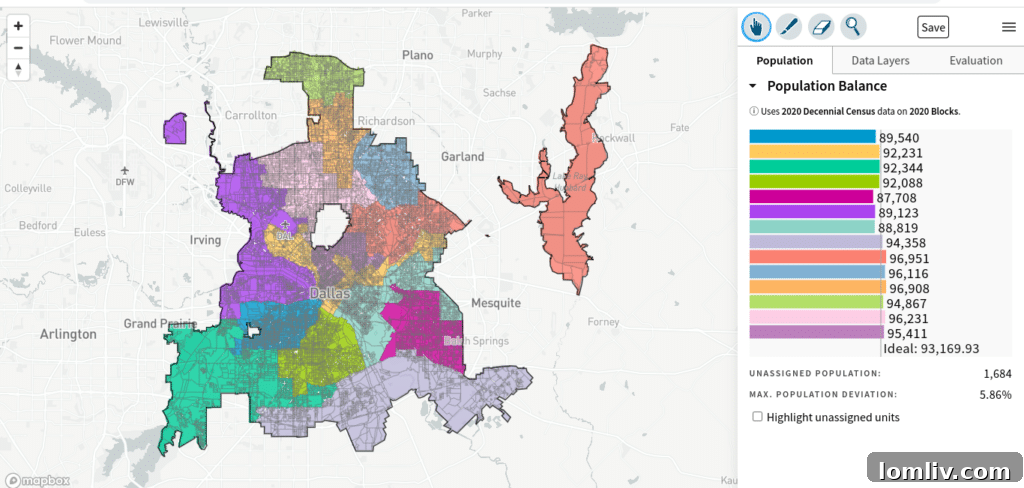
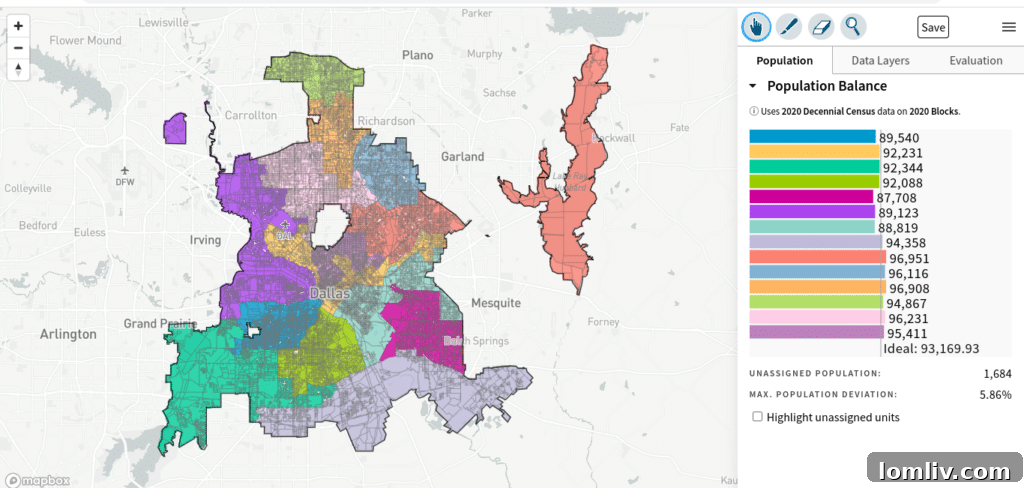
Under the looming shadow of a critical June 29 deadline set by the U.S. Justice Department, the Dallas City Council took decisive action on Monday, June 27, 2022, by officially approving a new redistricting map. This pivotal decision, a culmination of extensive public engagement and intricate negotiations, aimed to realign the city’s electoral districts for the upcoming decade. The approved plan meticulously incorporated valuable citizen feedback and specific requests from various communities and council members, striving to maintain the integrity and cohesion of numerous neighborhoods across the sprawling city. This redistricting initiative is a cornerstone of democratic representation, ensuring that population shifts, as identified by the latest U.S. Census data, are accurately reflected in the composition of city council districts, thereby upholding the principle of “one person, one vote.”
However, the journey to consensus was not without its challenges. While the final map represented a broad agreement, it did not satisfy every stakeholder. A suggested modification, crucial to some, ultimately failed to gain approval. The atmosphere of Monday afternoon’s meeting, which spanned just over an hour, was further charged by restrictions on discussions regarding pending modifications. Council members were not permitted to extensively debate or lobby for their proposed changes, leading to palpable frustration. This tension culminated in an unguarded moment when an unidentified elected official, caught on a hot microphone, vocally dismissed the process as “[expletive] cowardly.” This outburst underscored the deep-seated disagreements and the intensity of the political stakes involved in redrawing electoral boundaries, a process that inevitably pits various community interests and political strategies against each other.
The approved plan, officially designated as Plan No. 132918, was spearheaded by District 9 Councilwoman Paula Blackmon. Her submission proved to be the pivotal document, successfully integrating nearly all individual modifications proposed by her fellow council members. This comprehensive approach aimed to create a map that was both legally sound and reflective of community aspirations. Notably, the only significant exception to Blackmon’s integrated plan was Plan No. 133018, put forth by District 5 Councilman Jaime Resendez. This specific modification was not approved due to what were officially cited as “contiguity issues.” These issues typically refer to situations where a proposed district would create non-adjacent or geographically disconnected areas, which is generally impermissible under redistricting laws designed to ensure districts are compact and contiguous. The challenge of creating contiguous districts while simultaneously balancing population equality and preserving communities of interest often leads to complex trade-offs and difficult decisions for redistricting bodies.
Councilwoman Blackmon provided detailed justifications for the various components integrated into her approved submission. These justifications highlight the city’s commitment to strategic community development, preservation of neighborhood identity, and effective utilization of public assets. Each proposed modification was carefully evaluated for its impact on residents, services, and the overall socio-economic fabric of Dallas. The process demanded a delicate balance of diverse interests, ensuring that the new boundaries would serve the city efficiently for the next decade. Blackmon’s ability to synthesize numerous proposals into a cohesive plan ultimately garnered the necessary support, reflecting a pragmatic approach to a highly complex and often contentious civic responsibility. Her justifications not only addressed legal requirements but also spoke to the practical benefits and community desires underlying each boundary adjustment, showcasing a deep understanding of local dynamics.
Among the key modifications integrated into the final map were several proposals designed to strengthen specific community ties and optimize resource allocation:
Plan No. 131227: Strategic Alignment for the Horse Park
This modification addressed the strategic placement and community integration of the Dallas Horse Park. The Horse Park, a significant recreational and economic asset for the city, currently faces District 5 with its primary entrance and exit points. Historically, residents in its existing district have experienced challenges accessing the facility, limiting their engagement and the park’s overall community benefit. By realigning the boundaries to place the Horse Park squarely within District 5, the plan aims to create a stronger, more intuitive connection between the facility and its most accessible community. This reclassification is expected to empower future District 5 leadership and community members to actively rally around the park, developing initiatives to maximize its potential. This includes exploring opportunities for enhanced programming, increased public access, and leveraging it as a focal point for neighborhood events and economic development. Furthermore, the Pemberton Hill Neighborhood Association, a long-standing advocate for the park’s development, views the Horse Park as an integral part of their neighborhood identity. Their unwavering support and belief in the park’s community value underscore the importance of this realignment, ensuring that a vital civic asset is properly aligned with the community that can best champion its future growth and accessibility. This move promises not only logistical improvements but also fosters a stronger sense of ownership and collaboration, transforming the Horse Park into a truly integrated community hub rather than an isolated facility.
Plan No. 132556 (also known as 133010): Preserving Kiest Park in District 4
Kiest Park represents another significant community asset whose district affiliation was carefully considered. This modification ensures that Kiest Park remains historically situated within District 4. The park has deep roots in the community, having been utilized extensively by District 4 residents for generations as a vital green space and recreational hub. Its retention within District 4 acknowledges and reinforces these long-standing community ties, preventing disruption to existing usage patterns and neighborhood affiliations. Moreover, the decision to keep Kiest Park in District 4 also served a crucial function in balancing population figures across the various districts, a mandatory aspect of redistricting. By carefully managing population distribution, the city council aims to ensure that all districts have roughly equivalent numbers of residents, thus upholding the principle of equitable representation. This balance is critical for fair elections and ensuring that each council member represents a similar number of constituents. Kiest Park, therefore, plays a dual role in this redistricting plan: maintaining historical community connections and contributing to demographic parity, both of which are fundamental to a healthy democratic process and responsive local governance.
Plan No. 132432 (also known as 133000): Respecting Neighborhood Identity and Demographics in Midway Hollow
This amendment specifically addressed the preferences of residents within District 6 and District 13, particularly concerning the Midway Hollow area. The core objective was to implement boundary adjustments that largely respected the wishes of these communities while maintaining minimal changes to the demographic composition based on the original proposed map. This careful approach highlights the city’s commitment to community self-determination and stability. Specifically, this amendment achieved two key outcomes: Firstly, it designated Lenel Place as a clear and unambiguous border between District 6 and District 13 in the Midway Hollow neighborhood, covering the area south of Walnut Hill, east of Marsh Northaven Road, and west of Webb Chapel. Establishing such clear geographical markers helps to eliminate confusion for residents regarding their district affiliation and ensures a more intuitive understanding of electoral boundaries. Secondly, the plan explicitly keeps neighborhoods situated south of Forest Lane, between Josey Lane and Webb Chapel (north of Royal Lane), entirely within District 13. These precise adjustments were designed to uphold existing community structures and social networks, minimizing disruption to residents’ sense of belonging and their established relationships with their respective council representatives. By prioritizing resident input and maintaining demographic stability, this amendment reinforces the idea that redistricting should serve to empower communities, not fragment them.
Plan No. 132516: Fostering Collaboration and Preserving Community Cohesion Across Multiple Districts
This comprehensive modification introduced amendments to district lines affecting District 2, District 5, District 7, District 9, and District 14, demonstrating a wide-ranging effort to refine boundaries for optimal community benefit. The primary driver behind this intricate adjustment was the imperative to maintain the integrity of communities sharing similar interests and challenges. Neighborhoods such as Owenwood, Parkdale, Ash Creek Greenbelt, Claremont, Hillridge, Old Buckner Terrace, and Lakeland Hills were specifically identified for preservation within their current, cohesive structures. The redesigned borders are strategically crafted to foster the continuation of vital collaboration between these neighborhoods and their community stakeholders. This includes ongoing and future capital improvement projects, critical corridor studies aimed at enhancing infrastructure and connectivity, and the future development of parks and recreation centers within these areas. For instance, the plan specifically supports existing collaborative frameworks and funding mechanisms for the Parkdale and Ferguson corridor study and the Lawnview public improvements, demonstrating a forward-looking approach to urban development. A key objective of this specific map adjustment was to keep the Parkdale/Lawnview neighborhood entirely intact, including the significant Parkdale Lake, ensuring that this community remains united within District 7. For decades, residents of this area have tirelessly advocated and worked to maintain their community’s cohesion, and this plan honors their persistent efforts. Moreover, the map was meticulously designed to keep key urban green spaces and recreational areas—Deep Ellum Bark Park, Harwood Park, and Lubben Park—together. By adjusting district lines carefully, the city aims to prevent disruption to the progress already being made in these communities and to uphold their collective identity. Similarly, adjustments within District 9 were specifically calibrated to ensure the Casa View neighborhood remained a cohesive unit, reinforcing the overarching goal of supporting stable, identifiable communities.
The approval of these new district boundaries marks a significant milestone in Dallas’s civic landscape. These meticulously redrawn lines will officially become effective for the crucial May 2023 city council election, ushering in a new era of representation. Once implemented, these boundaries are designed to remain in effect for a full decade, providing a stable framework for local governance and community development. This ten-year cycle is intricately tied to the U.S. Census, which every ten years provides updated population data. Following each decennial census, cities like Dallas are legally mandated to reassess and adjust their electoral districts to account for demographic shifts, ensuring that representation remains fair and equitable across all neighborhoods. This continuous process of redistricting underscores the dynamic nature of urban populations and the democratic commitment to adapting governance structures to reflect these changes, guaranteeing that every voice in Dallas has proportional representation in the council chamber.