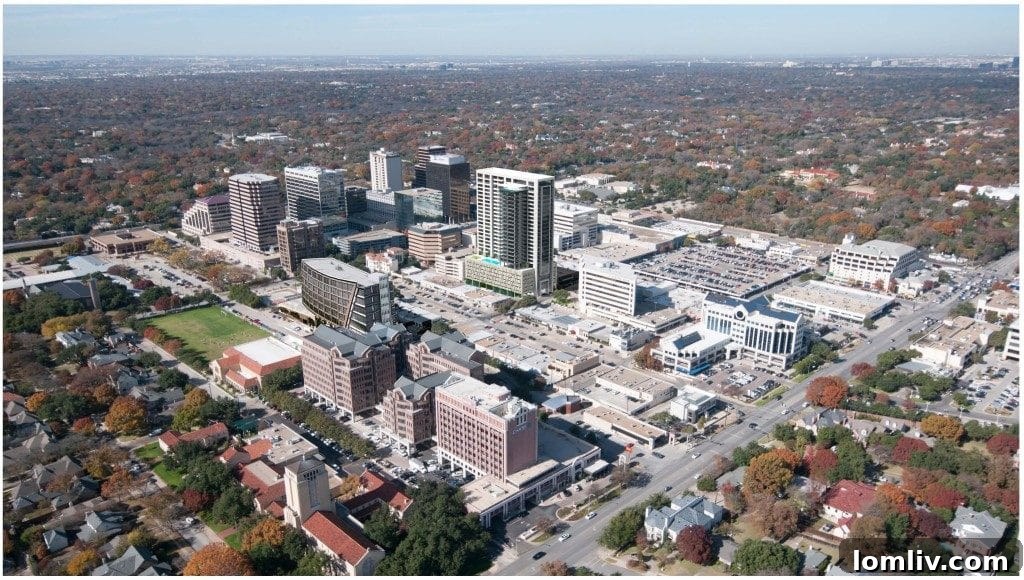
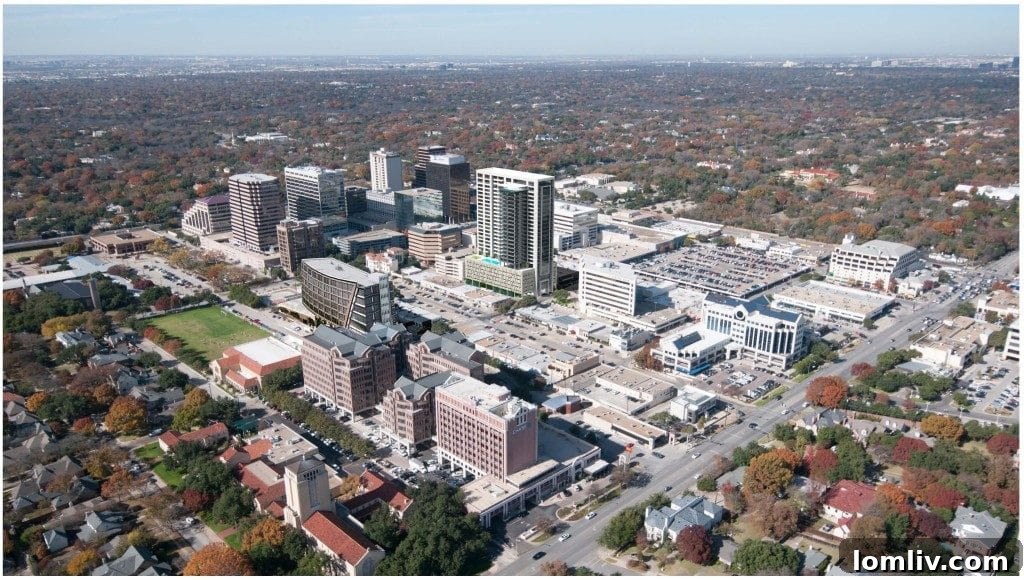
The extensive dialogue surrounding the Preston Center Area Plan by Kimley-Horn has been a journey marked by both aspiration and considerable skepticism. In the initial segment of this analysis, we delved into the specifics of the data presented for the various zones within this ambitious urban planning initiative. It became abundantly clear that of all the delineated zones, Zone 1 and Zone 4 stand out as areas with the most significant potential for transformation and growth. While our previous discussion offered a comprehensive overview of Zone 1, this installment shifts its focus to Zone 4, often colloquially referred to as the ‘Pink Wall’ area, and critically examines some of the fundamental research that, regrettably, remains incomplete or inadequately addressed even 16 months into the planning process. Understanding these underlying issues is crucial for anyone interested in Dallas urban planning, Preston Center development, and the future of sustainable growth in the region.
Kimley-Horn’s Projections for Zone 4: The ‘Pink Wall’
The data presented by Kimley-Horn for Zone 4, much like that for Zone 1, elicited significant concern and even alarm among residents and local stakeholders. The core premise of these projections rested on the assumption that every existing complex within Zone 4 would be rebuilt to its absolute maximum zoning potential. This approach, while perhaps illustrating a theoretical maximum, starkly overlooked critical real-world limitations, most notably in-place deed restrictions that legally bind many properties. The practicality of such a scenario unfolding in the near to mid-term is, to put it mildly, impossibly unlikely.
During a pivotal public meeting, a seasoned local developer articulated this very point, highlighting the economic absurdity of tearing down relatively new buildings, particularly those constructed within the last decade or two, merely to add a single floor or marginally increase density to meet full zoning potential. The financial investment required for such extensive demolition and reconstruction, coupled with the lost revenue during the redevelopment period, would render such projects economically unjustifiable. This developer’s expert perspective underscored a fundamental disconnect between the theoretical maximums presented by Kimley-Horn and the pragmatic realities of real estate development in Dallas.
While Kimley-Horn adhered to its ambitious goal of integrating approximately 1,700 new residential units across the area from Preston Road to Hillcrest, the developer’s more grounded estimate placed this figure closer to 600 units. This represents roughly one-third of the Kimley-Horn projection, a discrepancy that points to vastly different timelines and levels of feasibility. Even this more conservative estimate would, by all accounts, unfold over many years, rather than a rapid transformation. The implications of this inflated projection are significant, as it paints a picture of dramatic, swift change that is neither realistic nor desired by many in the community.
Despite the hypothetical addition of such a large, and arguably unrealistic, number of residential units, the projected shift in the residential ratio within Zone 4 was surprisingly minimal, moving from 93 percent to just 94 percent. This marginal increase led many to question the impact of such extensive development if the fundamental character of the zone, in terms of residential proportion, barely shifts. The true ramifications, however, become terrifyingly clear when examining the projected traffic quantities.
Traffic Implications and Transportation Modes in Zone 4
The impact on local infrastructure, particularly traffic, is where the Kimley-Horn data truly reveals its potential for disruption. Zone 4, which currently experiences an average of 18,823 vehicle trips per day, is projected to absorb an additional 10,750 trips. This would push the total daily traffic volume to just under 30,000 trips. While it is important to acknowledge that this substantial increase would likely materialize over a decade or more, the sheer magnitude of added vehicles raises critical concerns about existing traffic congestion in Preston Center, road capacity, and the overall quality of life for residents.
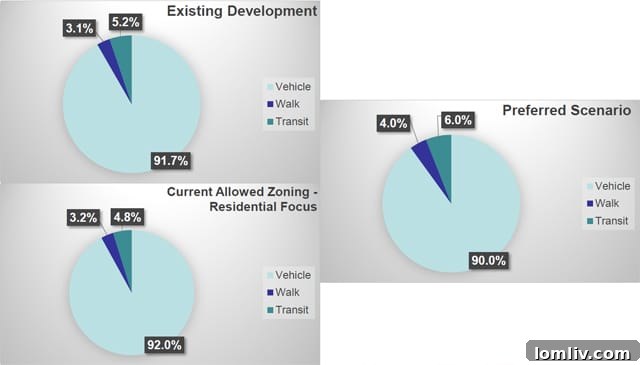
Furthermore, an examination of the projected transportation modes reveals a disheartening lack of progress towards more sustainable and integrated transit solutions. Despite grand visions of enhanced walkability and improved public transit, the data suggests minimal change in how people will navigate the area. Walking, for instance, is projected to increase only marginally from 3.1 to 4.0 percent. Public transit usage sees a similarly modest rise from 5.2 to 6.0 percent. Meanwhile, automobile trips, already dominant, are forecast to drop by a mere 1.7 percentage points, from 91.7 to 90 percent. These figures demonstrate that while the sheer number of daily trips will grow substantially with development, the methods of transportation will remain largely unchanged. This casts a long shadow over the stated goal of improving walkability in Preston Center and fostering a more pedestrian-friendly environment, suggesting a significant failure in integrated planning.
My Analysis: Beyond Raw Data to Practical Insight
From a professional standpoint, Kimley-Horn’s approach to data presentation leaves much to be desired. While presenting maximum zoning potentials can be a starting point, it is imperative for urban planning firms to deliver data that is tempered by the likelihood of actual development. A more nuanced approach, one that integrates common sense and economic realities, would have provided a significantly more accurate and useful picture of development options within Zone 4. It’s not enough to show what “could” happen; the more critical question is what is “likely” to happen.
I believe there are established methodologies and calculations that could have been applied, correlating factors such as building age, current market value, and existing deed restrictions against zoning potential to produce a realistic probability of redevelopment for specific parcels. Without this layer of practical interpretation, the data becomes an abstract exercise, detached from the lived experience of the community.
It is hardly surprising that residents reacted with alarm at the prospect of seeing the equivalent of another 12 Athena-sized buildings erected in Zone 4, especially when a more realistic assessment might suggest a likelihood closer to four such developments. This “unintended scare-mongering,” a recurring theme in Kimley-Horn’s deliverables, stems directly from their apparent inability or unwillingness to apply common sense and practical context to raw data. Professional research should not merely present possibilities but should also delineate probabilities and their associated impacts.
Having conducted research for nearly 25 years, I firmly believe that data interpretation is the single most critical skill a researcher can possess. Presenting raw, uncontextualized data without suggesting practical applications or likely outcomes is akin to “throwing a wriggling fish on the table without suggesting recipes.” A truly valuable research output guides decision-makers towards actionable insights, rather than leaving them to grapple with speculative scenarios.
Just as I argued regarding Preston Center development, a crucial component of Kimley-Horn’s research should have involved extensive groundwork, specifically polling residents to understand their genuine desires and concerns. Such surveys should not only have covered general area redevelopment and associated timelines but also probed property owners about their likelihood of seeking to redevelop their own parcels in the future. This kind of direct community engagement is indispensable for building consensus and crafting a plan that truly serves the needs of those it impacts.
Unanswered Questions: The Problem of Implementation Triggers
One of the most glaring deficiencies in this planning process is the complete absence of any substantial research dedicated to traffic optimization. This was not a minor detail; it was a guiding principle for the very formation of the task force itself. Without foundational research to support any proposed outcomes, the subsequent “implementation priorities” slides presented feel like little more than a desperate attempt to throw “spaghetti against the wall,” hoping something might stick. This lack of strategic foresight undermines the credibility of the entire planning effort.
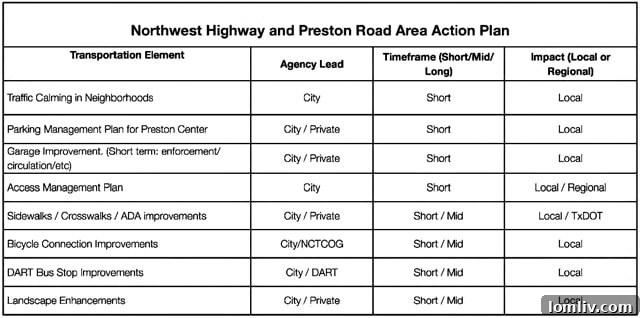
Consider the bullet points listed as “Implementation Priorities.” “Traffic Calming in Neighborhoods” sounds commendable on paper, but what does it truly entail beyond the simplistic notion of speed bumps? Which specific streets are most in need of intervention, and what are the most effective, context-appropriate solutions? Sixteen months into this process, initiatives such as a “Parking Management Plan for Preston Center,” “Garage improvements,” and an “Access Management Plan” remain mere items on a wish list. This prolonged inaction begs a critical question: What exactly has been accomplished during this time? More importantly, what tangible results did the hefty investment of $350,000 yield if these fundamental components of urban infrastructure remain in conceptual limbo?
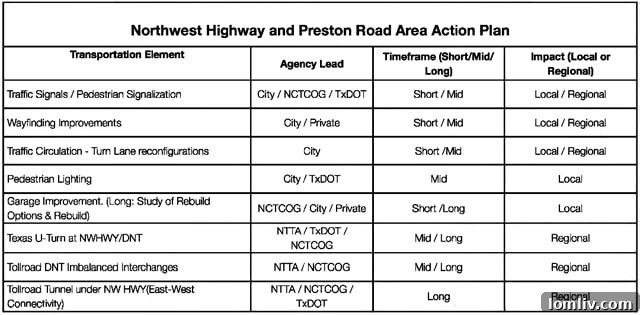
The sentiment applies equally to the second list of implementation priorities. After 16 months, it is astonishing to find that research into these crucial items has not even commenced. This is not merely an oversight; it represents a profound failure to deliver on the original *raison d’être* of the task force. These are not secondary considerations; they are the bedrock upon which any cogent, effective proposal for Preston Center urban development must be built. Leaving them perpetually “to be determined” after such a significant time and financial investment is unacceptable.
My Analysis: The Dynamics of the Task Force and Consultants
Engaging an external research project inherently assumes two fundamental conditions: first, that the commissioning body (in this case, the Task Force) possesses a clear understanding of its objectives and requirements; and second, that the hired consultants (Kimley-Horn) possess the competence and expertise to execute the work effectively. Based on the unfolding of this project, it is reasonable to question whether either of these conditions was fully met.
I am inclined to be gracious and assume that the Task Force, comprising largely volunteers, was and perhaps still remains, ignorant of the precise research processes and deliverables truly required for such a complex urban planning Dallas endeavor. Assembling a task force without a single member possessing a deep understanding of the research process, coupled with the inevitable influence of personal agendas, likely doomed the project to a degree of failure from its inception. The lack of foundational knowledge among the decision-makers can lead to vague directives and an inability to critically evaluate the outputs.
However, this does not absolve Kimley-Horn of their professional responsibility. As a theoretically experienced consulting firm that has undoubtedly undertaken similar projects before, they should have demonstrated a far greater capacity for guiding an ostensibly ignorant client in the correct direction. A truly effective consultant acts not merely as an order-taker but as an expert advisor, proactively anticipating needs, clarifying objectives, and ensuring that the research conducted is pertinent, practical, and actionable. The absence of such guidance suggests either a lack of capability on Kimley-Horn’s part or an unwillingness on the Task Force’s part to heed expert advice, or perhaps, a detrimental combination of both.
Reflecting on the entire trajectory of this project, my writings have often revealed fleeting glimmers of hope, invariably overshadowed by an overarching sense of disappointment. For instance, one must question the strategic wisdom of allocating resources to a demographic research firm merely to confirm that Preston Hollow is, as previously observed, “old, white, and rich.” While such data might hold some contextual value, its priority seems misplaced when fundamental research into traffic optimization, parking management, and access strategies remains critically unaddressed and unfunded. The allocation of resources should directly align with the most pressing needs and the core objectives of the plan.
In conclusion, the Preston Center Area Plan, in its current iteration, appears to be a blueprint for development, but crucially, it falls short of being a blueprint for *smart, effective, and sustainable development*. The true potential of Preston Center can only be realized through meticulous research, realistic projections, genuine community engagement, and a commitment to implementing tangible solutions for critical infrastructure challenges. Anything less risks squandering valuable resources and public trust, ultimately failing to deliver the vibrant, functional future that this vital Dallas community deserves.
About the Author: With nearly two decades of experience in real estate and urban analysis, I specialize in high-rises, HOAs, and property renovation, appreciating the delicate balance between modern design, historical architecture, and the needs of the YIMBY (Yes In My Backyard) movement. My commitment to insightful analysis and community-focused dialogue extends beyond these pages. If you’re interested in hosting a Candysdirt.com Staff Meeting event to discuss critical real estate trends and urban development in Dallas, please consider me your go-to expert. My contributions to real estate journalism were honored in 2016 with both Bronze and Silver awards from the prestigious National Association of Real Estate Editors. Do you have a compelling story to share, a perspective on Dallas real estate development, or even a marriage proposal you’d like to announce? Feel free to reach out via email at [email protected]. I look forward to hearing from you and continuing the conversation.