Texas’ Booming Job Market: A Deep Dive into Employment Growth and Economic Trends
In the heart of the Lone Star State, the economic mantra consistently echoes: it’s all about jobs, jobs, jobs. Texas continues to solidify its reputation as an economic powerhouse, drawing businesses and talent with its robust job market and dynamic growth opportunities. This unparalleled expansion is not merely anecdotal; it’s backed by solid data, showcasing a resilient and diversifying economy that outpaces national trends.
Unpacking Texas’ Impressive Employment Growth
A comprehensive new report from the esteemed Real Estate Center at Texas A&M University provides a detailed look into this thriving landscape. The state’s economy generated an astonishing 276,400 nonagricultural jobs between June 2014 and June 2015 alone. This translates to an impressive annual growth rate of 2.4 percent, a figure that comfortably surpasses the United States’ national average of 2.1 percent for the same period. Such consistent outperformance underscores Texas’ unique blend of pro-business policies, a skilled workforce, and strategic geographical advantages.
While the state as a whole exhibited remarkable growth, many of its major metropolitan areas demonstrated even more accelerated gains. North Texas, in particular, stood out as a beacon of job creation, illustrating the regional disparities and unique strengths that contribute to the state’s overall economic health. This localized dynamism is a key indicator of Texas’ ability to foster diverse economic engines, ranging from energy-rich hubs to technology-driven innovation centers.
Top Texas Cities Leading the Job Creation Charge
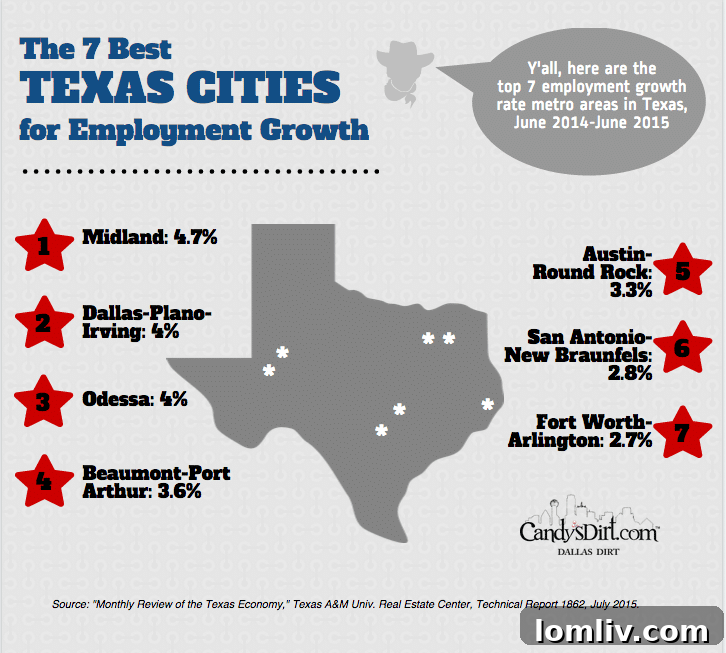
The report meticulously ranked the state’s metropolitan areas by their job creation prowess, revealing an intricate tapestry of economic activity across Texas:
- Midland claimed the top spot, a testament to its powerful, albeit often volatile, energy sector.
- The Dallas-Plano-Irving metro area secured a strong No. 2 position, highlighting its diversified economy and growing corporate presence.
- Following closely were Odessa, another significant player in the energy industry, and Beaumont-Port Arthur, recognized for its industrial and port-related employment.
- Austin-Round Rock demonstrated its consistent growth as a technology and innovation hub.
- San Antonio-New Braunfels showed robust job gains, driven by its diverse sectors including military, healthcare, and tourism.
- Fort Worth-Arlington landed at No. 7, recording a healthy 2.7 percent job growth, underscoring its expanding manufacturing, logistics, and aerospace industries.
These rankings illustrate the varied economic strengths present throughout Texas, showcasing both the traditional pillars of the state’s economy and its rapidly emerging sectors.
North Texas: A Model of Economic Diversification and Resilience
The success of regions like North Texas can largely be attributed to their economic diversification. As Luis Torres, a research economist at the Real Estate Center, explains, “The North Texas economy is more dependent on the U.S. economy, so it’s not energy-based, compared to the Houston or Midland-Odessa economy, where energy has a bigger weight.” This crucial distinction means that North Texas, particularly the Dallas economy, is less susceptible to the fluctuations of global energy markets. Instead, its fortunes are closely tied to the broader national economic performance. “Because the U.S. economy is growing and doing better, you’re seeing that reflected in the Dallas economy,” Torres added, emphasizing the region’s strong correlation with national economic trends.
Indeed, the widespread nature of this growth across Texas is striking. The report indicated that virtually every single Texas metro area, with the sole exception of Wichita Falls, registered more jobs in June 2015 compared to a year prior. This near-universal employment expansion paints a picture of a state enjoying broad-based economic prosperity.
Key Sectors Driving Texas’ Employment Surge
Understanding which sectors are fueling this job growth provides critical insights into Texas’ evolving economic structure. The report highlighted several key industries experiencing significant expansion:
- Leisure and Hospitality: 5.05 percent growth. This sector’s robust expansion reflects Texas’ growing tourism industry, thriving entertainment venues, and increasing population, all of which demand more services in hotels, restaurants, and recreational facilities.
- Education and Health Services: 3.87 percent growth. As Texas’ population continues to surge, so does the demand for quality education and healthcare. This sector benefits from continuous investment in new schools, universities, hospitals, and medical research facilities.
- Professional and Business Services: 3.54 percent growth. This category, encompassing a wide array of services from legal and accounting to consulting and administrative support, is a cornerstone of a maturing, diversified economy. Its growth signals an increasing demand from other businesses, including the numerous corporations relocating or expanding within Texas.
- Transportation, Warehousing, and Utilities: 3.52 percent growth. Texas’ central location and extensive infrastructure, including major airports like DFW and vast highway networks, make it a crucial hub for logistics and distribution. The growth in this sector directly supports the state’s role in national and international trade.
- Construction: 3.34 percent growth. Fuelled by both population influx and commercial expansion, the construction sector is booming. New residential developments, corporate campuses, and infrastructure projects across the state keep this industry consistently busy, creating numerous jobs.
These sector-specific insights reveal a state building a diversified and sustainable economic foundation, less reliant on a single industry and more robust against potential market shifts.
Dallas as a Strategic Transportation Hub
The role of geography and infrastructure in Texas’ economic success cannot be overstated, particularly for cities like Dallas. As Real Estate Center research economist Ali Anari points out, “The correlation between the Dallas economy and the U.S. economy is very high, and the main reason is because Dallas is a transportation hub and all the goods and services that pass in the state use Dallas transportation systems.” This strategic positioning allows Dallas to act as a crucial artery for commerce, facilitating the movement of goods and services across the state and beyond, thereby cementing its economic importance.

Texas Unemployment: A Picture of Economic Health
Beyond job creation, another highly encouraging piece of news from the report concerns the state’s unemployment rate. In June, Texas recorded an unemployment rate of 4.4 percent, a figure significantly lower than many other states and indicative of a healthy, functioning labor market. What’s even more impressive is that many major metro areas within Texas boasted even lower rates, reflecting concentrated economic strength.
- The Dallas-Plano-Irving area, for instance, showcased a remarkably low unemployment rate of 4 percent, ranking as the seventh-lowest in Texas. This figure underscores the intense demand for labor in one of the nation’s fastest-growing metropolitan areas.
- Similarly, Fort Worth-Arlington also achieved a 4 percent unemployment rate, placing it as the tenth-lowest in the state. Such low unemployment rates in major urban centers are a strong testament to their vibrant economies and robust job-generating capacities.
These low unemployment figures are not just statistics; they represent tangible benefits for Texans, including greater job security, competitive wages, and broader opportunities for career advancement.
The Outlook: Navigating Challenges and Sustaining Growth
Looking ahead, the outlook for the North Texas economy remains exceptionally bright, according to Real Estate Center Director Gary Maler. “The rate of growth is slowing for [energy-based] areas, but for Dallas, it is still growing and not declining,” Maler stated. This optimistic projection for North Texas is largely driven by its diversified economic base and continued appeal to major corporations. “There’s a positive outlook for this region because of all the companies moving their offices there, like Toyota,” Maler added, referencing high-profile corporate relocations that bring significant investment and job opportunities.
However, Maler also noted a more cautious perspective for other areas of the state, particularly those with economies heavily reliant on the energy sector, such as Midland-Odessa and Houston. “In Midland-Odessa or Houston, you have red flags and everybody is really watching those areas closely,” he warned. While their annual growth rates were still positive at the time of the report, the long-term sustainability of these rates is subject to market dynamics.
The volatility of global oil prices poses a significant challenge. Maler explained, “Their annual rates are still positive, but because of the hedging all the oil companies did for this year, next year, if the oil prices continue to go down, that will affect employment growth.” Hedging strategies can offer short-term protection, but sustained low oil prices can inevitably impact investment and employment in energy-centric regions. Furthermore, geopolitical factors, such as international oil deals, introduce additional layers of uncertainty. “Also, if this Iran deal goes through and the Republicans in Congress don’t block it, then the Iranians could dump more oil on the market and prices could go even lower. It all bears a lot of watching,” Maler concluded, emphasizing the complex interplay of economic and political forces shaping Texas’ energy landscape.
Conclusion: Texas’ Enduring Economic Strength
Texas continues to be a magnet for businesses and individuals seeking opportunity, driven by a powerful combination of job growth, economic diversification, and a favorable business climate. While the state’s energy-rich regions face inherent volatility, the broader Texas economy, particularly its diversified metropolitan areas like Dallas-Plano-Irving and Austin-Round Rock, demonstrates remarkable resilience and a capacity for sustained growth. The continuous influx of major corporations, coupled with robust activity across key sectors like professional services, healthcare, and transportation, paints a picture of a state that is not just growing, but evolving.
The insights from the Real Estate Center at Texas A&M University affirm that Texas remains a premier destination for employment and investment. Its ability to create hundreds of thousands of jobs annually, coupled with consistently low unemployment rates, reinforces its status as an economic leader. As the state navigates future economic headwinds and geopolitical shifts, its diversified economic base will be its greatest asset, ensuring that the mantra of “jobs, jobs, jobs” continues to define the Lone Star State’s prosperous future.
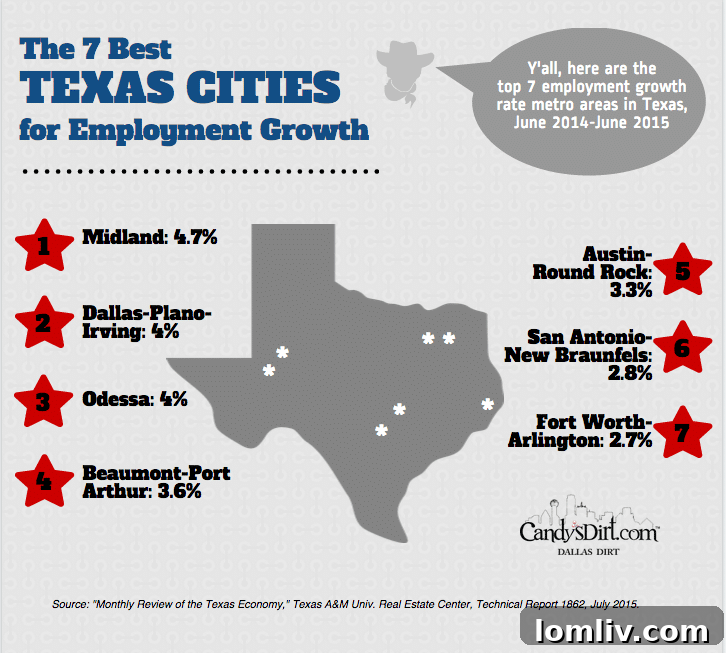
For a visual summary of these trends, download the full-size infographic, “7 Best Texas Cities for Employment Growth,” by clicking HERE.