In the dynamic landscape of the American economy, metropolitan areas constantly vie for corporate investment and talent. Dallas, a vibrant hub in the heart of Texas, often finds itself at the forefront of these discussions. This week, we delve into a comprehensive analysis of Dallas’s standing in the national corporate relocation arena, examine the health of the Texas economy as reported by the Dallas Federal Reserve, and explore the financial stability of Texans through the lens of home equity. Understanding these key indicators provides invaluable insight for residents, businesses, and investors seeking to navigate the evolving economic currents of the Lone Star State.
Dallas Continues to Attract Corporate Headquarters: A Resilient Economic Hub
While the highly publicized race for Amazon HQ2 may have concluded with Dallas not being the chosen site, the city has every reason to be optimistic about its appeal to major corporations. Recent analyses consistently demonstrate that Dallas remains a highly coveted destination for corporate headquarters relocations and expansions across the United States. This sustained interest underscores Dallas’s robust economic fundamentals, strategic geographical position, and burgeoning business environment, reinforcing its status as a premier economic powerhouse.
An in-depth study by CityLab, drawing upon a new database of corporate headquarters maintained by research partners at the University of Toronto School of Cities, sheds light on the broader trend of corporate geographic dispersion. Richard Florida, co-founder of CityLab and a prominent urban theorist, highlights that corporate headquarters are not merely consolidating in a few superstar cities but are spreading significantly across the nation. This dispersion strategy allows companies to tap into diverse talent pools, leverage varying operational costs, and access new markets, making regions like Dallas increasingly attractive.
Florida’s ongoing research meticulously tracks the location and evolving economic geography of Fortune 500 headquarters over four decades, from 1975 to the present. It’s important to note a specific caveat in this analysis: it excludes service firms, a decision rooted in their exclusion from Fortune’s list back in 1975 to maintain historical consistency. Despite this, the findings offer compelling insights into the shifting preferences of major corporations over time.
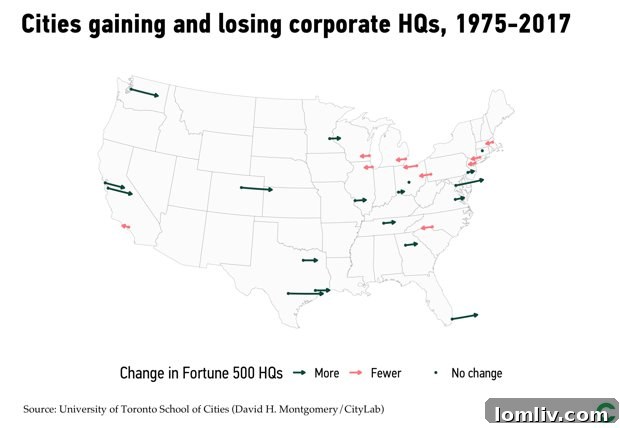
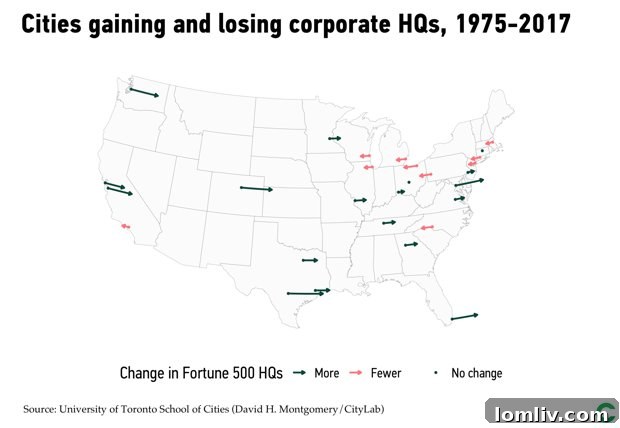
The research reveals a significant trend: while established tech and innovation hubs such as San Francisco, Seattle, and Washington D.C. have seen notable gains in corporate headquarters, a parallel boom has occurred in the Sunbelt. Dynamic cities like Houston, Dallas, Atlanta, and Miami have also experienced substantial increases in their corporate footprint. This eastward and southward shift signifies a strategic re-evaluation by companies, often favoring regions with lower operating costs, robust population growth, and a business-friendly regulatory climate.
Conversely, traditional corporate strongholds have faced declines. New York and Los Angeles, despite still hosting the largest absolute number of corporate headquarters, have each seen a 17 percent decline in their share between 1975 and 2017. Other major cities like Chicago experienced an even sharper 28 percent decline, and Boston a 21 percent decrease. These figures suggest a gradual decentralization of corporate power, moving away from older, more expensive metropolitan areas towards emerging economic centers.
When assessing growth in headquarters locales, Dallas and Houston stand out remarkably, ranking third and fourth nationally, with 22 and 20 net gains respectively during the period studied. This impressive performance highlights Texas’s magnetic pull for businesses. The reasons are multifaceted: a favorable tax environment, a skilled and growing workforce, competitive commercial real estate prices, and a strategic location that offers excellent connectivity for national and international operations. Dallas, in particular, benefits from its status as a major transportation hub, with two large airports and an extensive highway network, facilitating seamless business travel and logistics.
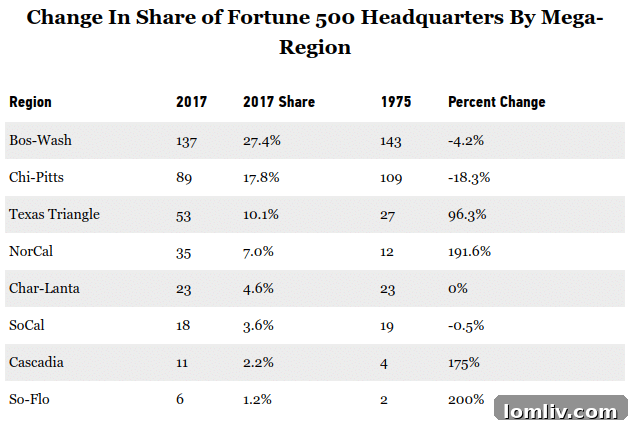
The CityLab analysis further introduces the concept of “major mega-regions,” a broader geographic categorization that combines interconnected metropolitan areas. These regions are given distinctive appellations such as “Bosh-Wash” (Boston-Washington D.C. corridor) and “Chi-Pitts” (Chicago-Pittsburgh corridor), representing vast economic clusters.
Within this framework, the Texas Triangle region—encompassing the major economic powerhouses of Dallas, Houston, and Austin—emerges as a formidable player. This interconnected super-region secures an impressive third place nationally in terms of corporate headquarters, collectively hosting 53 Fortune 500 companies among its three primary cities. The synergy within the Texas Triangle is a testament to the region’s diverse economic strengths, from Dallas’s finance and logistics dominance, Houston’s energy and medical expertise, to Austin’s burgeoning technology and innovation sector. This collaborative strength creates an unparalleled ecosystem for corporate growth and innovation, further solidifying Texas’s position as a leading destination for businesses worldwide.
Is Texas Real Estate Equity-Rich, or Are Homeowners Underwater?
The state of home equity is a critical indicator of financial health for homeowners and a significant driver of consumer confidence and economic stability. Understanding whether a majority of mortgaged properties hold substantial equity, or if a considerable portion of homeowners are “underwater” (owing more than their home is worth), provides vital insights into the real estate market and the broader economy.
According to a recent report by ATTOM Data Solutions, the number of equity-rich mortgaged properties across the U.S. has shown a notable increase, reaching approximately 14.5 million this month. This positive trend suggests a generally healthy housing market where property values have appreciated, allowing homeowners to build substantial wealth through their real estate investments. Specifically, the report indicates that nearly 26 percent of the 55 million mortgaged properties analyzed are considered “equity-rich.” An equity-rich property is defined as one with a loan-to-value (LTV) ratio of 50 percent or lower, meaning the property owner possesses at least 50 percent equity in their home. This level of equity offers homeowners significant financial flexibility, enabling them to refinance, secure home equity loans, or sell their property with a substantial profit.
The distribution of equity-rich properties varies significantly across the country, reflecting regional differences in economic growth, housing market dynamics, and historical price appreciation. States with the largest share of equity-rich properties are predominantly on the coasts and in regions with strong, long-term real estate markets. These include California, Hawaii, Washington, New York, and Oregon. These states often feature high demand, limited supply, and robust economies that drive consistent property value growth, allowing homeowners to accrue significant equity over time.
Conversely, states with a higher proportion of property owners underwater typically face different economic conditions or have experienced slower recoveries from past housing downturns. The report identified Louisiana, Mississippi, Iowa, Arkansas, and Illinois as states with the most property owners underwater. In these regions, factors such as slower job growth, less robust population increases, or specific local economic challenges can contribute to stagnant or declining property values, making it harder for homeowners to build equity and potentially leaving them in a precarious financial position.
Turning the focus to Texas, the data paints a largely positive picture that aligns with the state’s robust economic performance. Approximately 28 percent of all mortgaged properties in Texas fall into the desirable equity-rich category. This figure is slightly above the national average of 26 percent, underscoring the strength and resilience of the Texas housing market. A significant portion of Texas homeowners enjoy substantial equity in their homes, indicating strong wealth accumulation and financial stability across the state. This high level of equity can empower Texans to make significant financial decisions, whether it’s investing in home improvements, funding education, or facilitating moves to different properties, contributing to overall economic activity.
Furthermore, the report shows that only about 5 percent of mortgaged properties in Texas are considered seriously underwater. This low percentage is a testament to the healthy appreciation of real estate values and responsible lending practices within the state. When compared to the national landscape, Texas stands out as a state where homeowners are generally well-positioned, enjoying the benefits of property ownership without the severe financial strain associated with negative equity. This positive home equity environment contributes significantly to consumer confidence and supports the broader real estate sector, making Texas an attractive market for both residents and investors.
Texas Economic Expansion: Navigating Potential Headwinds for Sustained Growth
Texas has long been a beacon of economic expansion, characterized by its diverse industries, business-friendly policies, and burgeoning population. However, even the most robust economies are subject to cyclical fluctuations and external pressures. Recent assessments from the Dallas Federal Reserve suggest that while the state’s economic expansion remains strong, it could be headed for a period of slowdown. This outlook warrants a closer examination of the factors at play and their potential implications for the Lone Star State.
The Dallas Fed consistently monitors key economic indicators, including employment growth, industrial production, manufacturing activity, and energy sector performance, to gauge the state’s economic health. Texas’s economy is notably diverse, relying on more than just its traditional oil and gas industry. Significant contributions come from technology, advanced manufacturing, healthcare, aerospace, and a booming logistics and trade sector fueled by its strategic location and extensive transportation infrastructure. This diversification has historically provided a buffer against downturns in any single industry.
However, the global economic environment, along with national monetary policy shifts, can exert considerable influence. Potential headwinds for the Texas economy include a global economic slowdown, which could reduce demand for Texas exports and energy products. Rising interest rates, implemented by the Federal Reserve to combat inflation, can also cool down consumer spending and investment, particularly in interest-sensitive sectors like real estate and manufacturing. Changes in the labor market, such as wage growth outpacing productivity or labor shortages in key sectors, could also pose challenges. Furthermore, while the energy sector is more resilient due to diversification, significant fluctuations in oil and gas prices can still impact state revenues and investment decisions.
Despite these potential challenges, Texas possesses inherent strengths that could mitigate the severity of any slowdown. The state’s rapid population growth continues to drive demand for housing, goods, and services, acting as a powerful internal economic stimulus. Its business-friendly regulatory environment and lack of state income tax remain strong incentives for companies seeking to relocate or expand, as evidenced by the consistent influx of corporate headquarters discussed earlier. The ongoing investment in infrastructure, particularly in major metropolitan areas, supports continued growth and improves connectivity for businesses and residents.
The connection between the overall economic health and specific real estate trends is profound. A thriving economy, characterized by job growth and business expansion, directly fuels demand for commercial and residential real estate. This, in turn, contributes to property value appreciation and helps homeowners build equity. Conversely, a significant economic slowdown could impact job security, reduce consumer confidence, and potentially cool the housing market, affecting equity levels and the pace of corporate relocations. Therefore, the Dallas Fed’s outlook serves as a crucial guide for businesses planning expansions and for individuals making long-term financial decisions.
In conclusion, while the Dallas Fed suggests a potential moderation in the pace of Texas’s economic expansion, the state’s fundamental strengths and diversified economic base position it favorably to navigate future challenges. The ability of Texas, and particularly Dallas, to attract and retain corporate headquarters, coupled with a generally healthy home equity market, underscores a resilient economic landscape. Vigilant monitoring of economic indicators and adaptive strategies will be key to sustaining the remarkable growth trajectory that Texas has enjoyed for years.