In the vibrant and rapidly evolving landscape of Dallas, a city synonymous with growth and redevelopment, a peculiar anomaly has often surfaced: the surprising stagnation of property appraisals for multi-family residences and key investment properties. While new developments consistently reshape the urban fabric and neighborhoods boom with activity, the assessed values of existing properties, particularly those held by investors, have sometimes lagged far behind market realities. This discrepancy not only raises questions about the fairness of our taxation system but also about the efficiency of our appraisal mechanisms.
The Dallas Central Appraisal District (DCAD) plays a pivotal role in determining the value of every property within Dallas County, directly influencing the amount of property taxes homeowners and investors pay. Accurate and timely appraisals are fundamental to ensuring that Dallas has the necessary revenue to fund essential public services, maintain infrastructure, and support community growth. When appraisals fail to reflect true market values, particularly in areas experiencing rapid appreciation, the city’s financial health and the principle of equitable taxation are undermined.
Just last year, we highlighted an intriguing case involving properties on Lemmon Avenue. This block, originally slated for a major Central Market development before HEB shifted its strategic focus to McKinney Avenue, presented a clear example of undervalued assets. For years, these properties’ assessed values remained conspicuously low, despite their prime location and the area’s development potential. In 2019, DCAD finally took significant action, substantially raising the assessed valuations for these properties. This move, while belated, confirmed what many observers already knew: market values in Dallas’s thriving corridors were far outpacing official appraisals.
However, the Lemmon Avenue scenario was not an isolated incident. I’ve frequently explored the inconsistencies within DCAD’s appraisal methods, particularly in areas ripe for redevelopment. A notable example involved a specific block of Fitzhugh Avenue, nestled between Swiss and Gaston Avenues. This stretch of Fitzhugh, known for its dynamic blend of historic charm and modern revitalization, has become a microcosm of Dallas’s real estate evolution. My initial inquiry was sparked by a new listing for a modest 616-square-foot detached house at 921 N. Fitzhugh. The asking price seemed surprisingly high given its size, yet its location—a burgeoning urban pocket—suggested strong underlying value. This curiosity prompted a deeper investigation into the property taxes, which quickly expanded to encompass thirteen distinct properties within that same block.
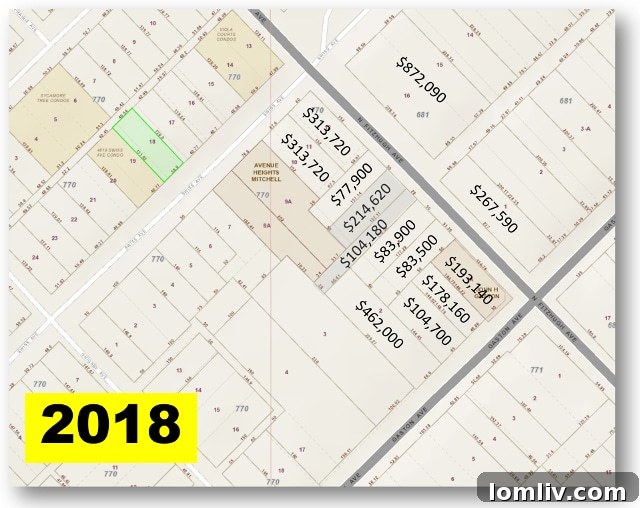
The findings from my initial review of these Fitzhugh Avenue properties were nothing short of astonishing and, frankly, quite perplexing. For instance, two multi-family apartment buildings situated prominently on that block had seen absolutely no increase in their appraised value over a span of five years. This period coincided with a significant boom in Dallas’s real estate market, particularly for rental properties and investment opportunities. Furthermore, another investment property on the block exhibited only marginal fluctuations in its value, hovering between $75,500 and $78,560 since 2011. This sustained undervaluation, particularly in an area witnessing substantial reinvestment and rising demand, stood in stark contrast to the palpable energy and economic activity observed on the ground. It suggested a disconnect between official assessments and the undeniable market realities.
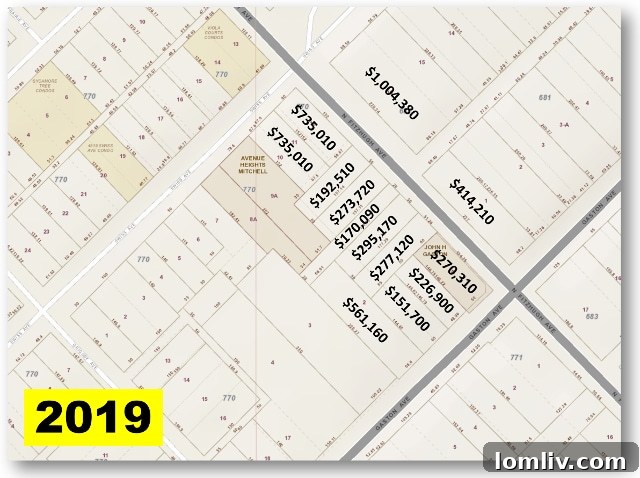
The year 2019 brought with it an equally astonishing, yet welcome, correction to these long-standing valuation disparities. The properties on Fitzhugh Avenue, which had previously seemed immune to market forces according to DCAD’s records, finally saw their appraised values surge. Those two aforementioned rental buildings, whose values had remained frozen since 2015, experienced a monumental shift. Their collective appraisal catapulted from $313,720 to an impressive $735,010 – an astounding 134 percent increase. This dramatic upward adjustment reflects not only the underlying market demand but also the years of accumulated appreciation that had gone unrecorded. Crucially for the city of Dallas, these are investment properties, not owner-occupied homesteads. This distinction means that the city is able to base property taxes on the entirety of their significantly increased value, unlocking substantial new revenue that had previously been overlooked.
The single-family house that had been languishing in the sub-$80,000 appraisal range for years also saw a remarkable revaluation. Its assessed value soared to $192,510, marking a substantial 147 percent increase. While impressive, this was not even the most significant jump recorded. Two neighboring properties, located at 911 and 915 N. Fitzhugh Avenue, witnessed even more breathtaking surges, with their appraised values leaping by 232 percent and 252 percent respectively, all within the same year. These figures paint a vivid picture of a market correction that was long overdue, indicating a powerful re-alignment of official valuations with the dynamic appreciation observed in the Dallas real estate landscape.
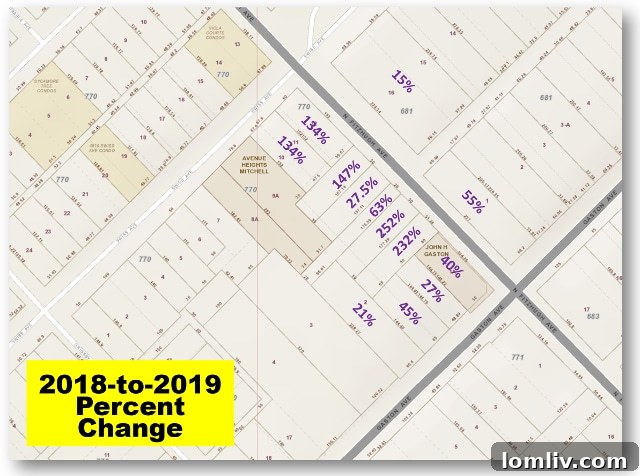
The range of these valuation adjustments across the entire block was wide, yet uniformly positive. As illustrated, even the smallest increase—a 15 percent jump—was recorded for a single-family home at 4902 Swiss Avenue, demonstrating that the market correction was broad-based. At the other end of the spectrum were the monumental 252 percent increases, underscoring the severity of the previous undervaluation for certain properties. Cumulatively, the financial impact of these revisions is profound. In 2018, the total appraised value for these thirteen properties stood at $3,270,220. By 2019, their reassessed values collectively climbed to $5,307,290. This represents an aggregate increase of $2,037,070, or a staggering 62 percent boost in overall value. Applying a conservative estimated tax rate of 2.845 percent, as projected by DCAD, these revised valuations are poised to inject an additional $57,954.64 directly into Dallas’s city coffers this year alone. This is not merely an abstract number; it translates into tangible resources that can fund schools, improve public safety, enhance infrastructure, and contribute to the overall betterment of the community. It underscores the critical importance of accurate and timely appraisals for the city’s fiscal health.
Given these significant discoveries and the subsequent correction in valuations, one might humorously wonder if a “finder’s fee” is in order for bringing these discrepancies to light. While the satisfaction of seeing these corrections implemented is reward enough, the underlying issue of appraisal consistency and equity remains paramount. It’s a testament to the fact that vigilant oversight and public discussion can indeed drive positive change in how our city’s assets are valued and taxed.
However, it is important to maintain a balanced perspective when discussing appraisal accuracy. My own predictions and analyses, while often pinpointing areas of undervaluation, haven’t always been flawlessly accurate across the board. For instance, in an article published in D Magazine last year, I highlighted what appeared to be significant undervaluation by DCAD for some of Dallas’s most opulent homes. A prime example cited was the estate at 5950 Deloache. In 2018, this property was appraised by DCAD at $20,185,280, despite being listed for sale at a much higher $24.5 million. This represented an apparent undervaluation of 17.6 percent at the time.
Yet, the market’s response often tells the ultimate truth. In August 2018, as Candy reported, the magnificent Preston Hollow estate ultimately sold for “just under $19 million,” after having been on the market since 2014. Reflecting this actual sale price, DCAD’s assessed value for 2019 was adjusted to $18,787,570. In this specific instance, a “hat tip” is certainly due to DCAD, as their final appraisal closely aligned with the property’s eventual market sale price. This particular case serves as a valuable reminder that market dynamics are complex, and while list prices can be aspirational, the actual transaction price is the most definitive indicator of value. It also underscores that DCAD, when provided with clear transactional data, can adjust effectively.
To provide a full and honest account (and to be fair to myself, of course), the overarching message and fundamental point of that D Magazine article—and indeed, of much of my ongoing commentary—was not simply to critique individual appraisals but to highlight a more systemic issue: taxation inequity. While Dallas as a city strives for prosperity and growth, it frequently grapples with the challenge of generating sufficient tax revenue to adequately fund its burgeoning needs. This struggle is compounded by a persistent sense of unfairness in property taxation. It’s a pervasive sentiment that some property owners, particularly those with complex commercial portfolios, seem to navigate the system in ways that result in disproportionately lower tax burdens, while the average homeowner often bears the brunt, paying a larger share relative to their property’s market value. This inequity is a critical concern, hindering the city’s ability to thrive and eroding public trust in the fairness of our financial systems. Ensuring that all properties contribute their equitable share based on accurate valuations is not just about revenue; it’s about social justice and shared responsibility for the prosperity of Dallas.

Remember: My primary focus revolves around high-rises, homeowners’ associations (HOAs), and urban renovation projects, exploring their impact on Dallas’s architectural and social fabric. However, I also deeply appreciate the delicate balance between preserving modern and historical architecture and the dynamic YIMBY (Yes In My Backyard) movement, which advocates for more housing development to address affordability and supply issues. My commitment to insightful real estate journalism has been recognized by the National Association of Real Estate Editors, which honored my writing with three Bronze awards in 2016, 2017, and 2018, alongside two Silver awards in 2016 and 2017. If you have a compelling story to share, an interesting real estate trend to discuss, or even an unconventional marriage proposal in mind, please don’t hesitate to reach out. You can email me directly at [email protected]. While I encourage you to look for me on Facebook and Twitter, you might find my online presence elusive – but you are always welcome to try!