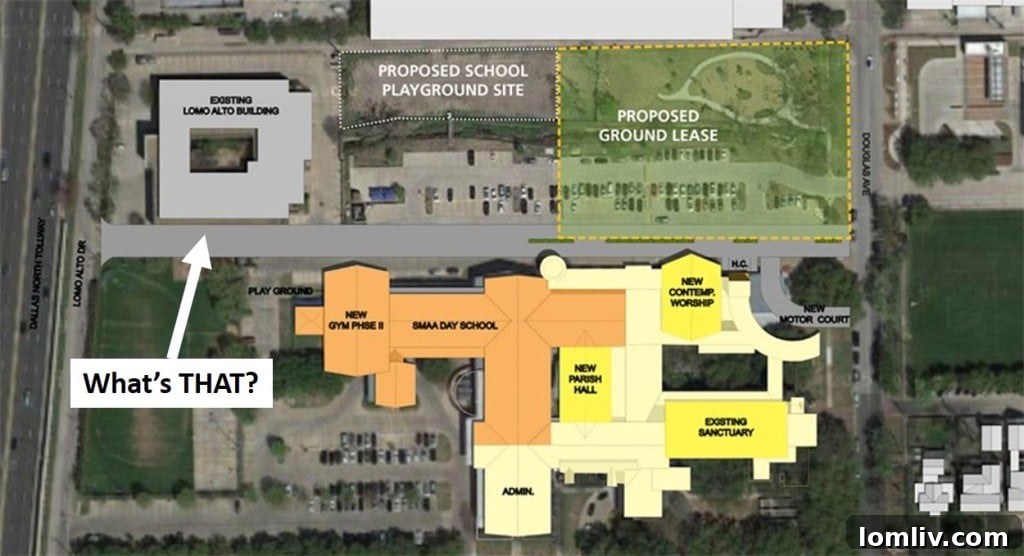
The dynamic landscape of Preston Center continues to be a focal point for urban development and community discussion. As part of an ongoing investigation into the area’s latest changes, a close examination of the zoning maps provided by the Preston Center Task Force reveals intriguing details. Specifically, the St. Michael’s Church parking lot on Frederick Square is currently designated MF-1(A), imposing a strict height limit of 36 feet, equivalent to three stories. However, a deeper dive into the adjacent properties on the same block uncovers a far more complex scenario, particularly concerning 8100 Lomo Alto, which is strategically located within Tract 2 of the Preston Center PD 314. This distinction is crucial, as it opens the door to significantly different development possibilities, sparking considerable interest and speculation within the community.
Unraveling the Ownership and Tax Implications of 8100 Lomo Alto
The ownership structure of 8100 Lomo Alto sheds light on the potential motives and strategies behind future development. Fredericks Square Title, the entity holding the title to 8100 Lomo Alto since 2003, lists Robert Wilson as a director. Mr. Wilson’s affiliations are notable: he is not only a member of St. Michael’s Vestry (the church’s governing board) but also serves as a senior counsel and former Managing Partner for the prominent law firm HaynesBoone, with a specialized focus on real estate. The mailing address for Fredericks Square Title, 8011 Douglas, is identical to that of St. Michael’s Church, unequivocally linking the church to the ownership of 8100 Lomo Alto.
This connection raises important questions, especially in the context of previous discussions regarding St. Michael’s plans to upzone the eastern part of the block. A recurring query has been whether church investments, particularly real estate, are exempt from property taxes. The general rule clarifies that only real estate directly utilized for church activities qualifies for property tax exemption. The office building at 8100 Lomo Alto, by definition, does not house ecclesiastical functions. Consequently, St. Michael’s Church is currently assessed property taxes totaling $159,032.89, which represents approximately 2.6 percent of the property’s value—a rate comparable to the 2.3 to 2.8 percent assessed on residential properties.
However, an interesting distinction arises with Fredericks Square Title. This entity is registered as a 501(c)(3) tax-exempt organization. Data from 2013, the latest available, indicates that Fredericks Square Title generated $900,583 in rental income from 8100 Lomo Alto. After accounting for expenses, including property taxes and mortgage payments, the organization reported net revenues of $386,890. Crucially, these revenues are not subject to federal taxation due to its 501(c)(3) status. This arrangement suggests a strategic advantage for any future development on the property: while local property taxes would still apply, the federal tax exemption on rental income could significantly enhance the profitability of a redeveloped site.
Navigating the Zoning Landscape: 8100 Lomo Alto’s Redevelopment Potential
Exploring 8100 Lomo Alto’s Zoning Capabilities
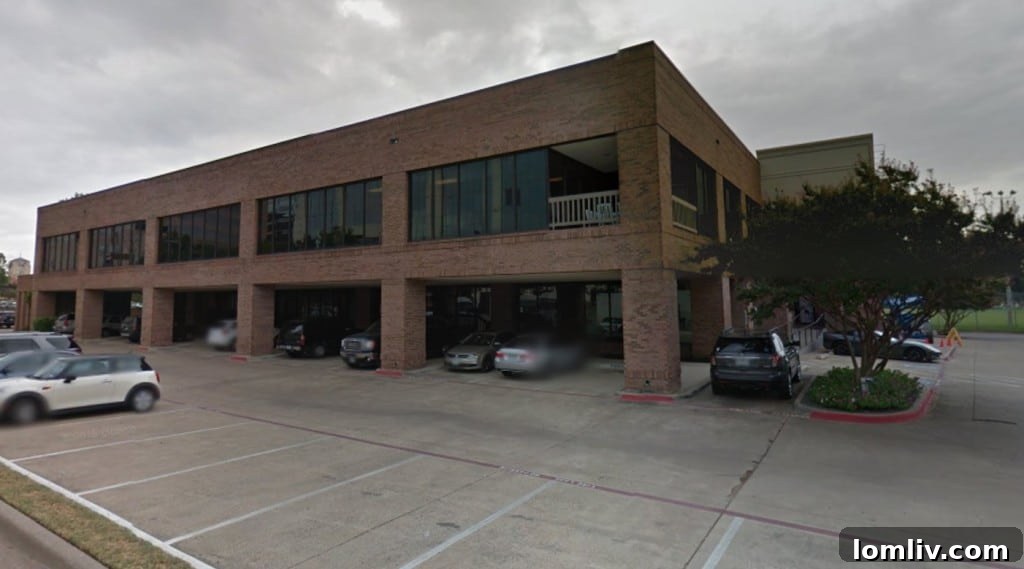
Despite the absence of explicit redevelopment plans from St. Michael’s for 8100 Lomo Alto, its location within Preston Center’s PD 314 Tract 2 offers substantial flexibility. This particular zoning designation permits the construction of structures that meet GO(A) and MF-4(A) classifications, alongside provisions for retirement living facilities. It explicitly excludes certain uses, such as bars, lounges, or taverns, ensuring the character of the development aligns with the broader community vision for Preston Center.
The height allowances under Tract 2 zoning are particularly noteworthy. The regulations appear to permit a building up to 180 feet tall, potentially reaching 14 stories, on the existing lot. There’s even a possibility for a taller structure, as parking facilities may not be counted towards the total story limit, though this interpretation requires careful confirmation. While Tract 2’s “Subarea A” includes specific setback requirements, known as “residential proximity slope,” designed to prevent new constructions from casting large shadows or looming over homes across the Tollway, 8100 Lomo Alto is not situated within Subarea A. This exemption provides greater freedom in design and placement compared to other parcels within the tract, potentially allowing for a more expansive footprint.
The process for developing on this lot is meticulously outlined in Section 51P-314.107 of the PD documents, focusing on “Development impact review in Tract II (including Subarea A)”:
(e) Development impact review in Tract II (including Subarea A). A site plan must be submitted and approved in accordance with the requirements of Section 51A-4.803 (Ed: Development Impact Review criteria) before an application is made for a permit for work in this district if the estimated trip generation for all uses on the lot collectively is equal to or greater than 6,000 trips per day and 500 trips per acre per day. See Table 1 in Section 51A-4.803 to calculate estimated trip generation. (Ord. Nos. 20397; 20619; 24914)
Interpreting these regulations, a 14-story building, complete with parking, could potentially be constructed on the 1.5-acre lot without requiring special development impact approvals, provided the projected daily automobile “trips” generated by the new use remain below 6,750. To put this in perspective, Laura Miller’s estimations for a 250,000-square-foot tower on the opposite end of the same block suggest approximately 2,750 car trips per day, which falls comfortably within Tract 2’s established limits. This indicates that a substantial development at 8100 Lomo Alto could proceed with relatively straightforward administrative processes, bypassing more extensive public review if traffic generation remains within specified thresholds.
From a total square footage perspective, if we disregard setbacks that might permit an even larger footprint and assume the current conservative 20,000-square-foot-per-floor footprint is maintained for a 65,000-square-foot lot, a 14-story building would yield approximately 280,000 square feet of usable space (14 stories x 20,000 sq ft). Such a structure would not be unprecedented or out of character for the area. For comparison, the neighboring 5950 Sherry Lane, built in 1997 presumably under similar guidelines, features a nine-story, 202,000-square-foot office building on a slightly smaller lot, accompanied by a five-story, 250,000-square-foot parking structure. This particular building, situated in Tract 2, Subarea A, necessitated specific residential setbacks, highlighting the relative freedom that 8100 Lomo Alto enjoys due to its Subarea A exemption.
DCAD Valuations: A Clear Indicator of Redevelopment Intentions
The Story Told by DCAD: Land vs. Building Values
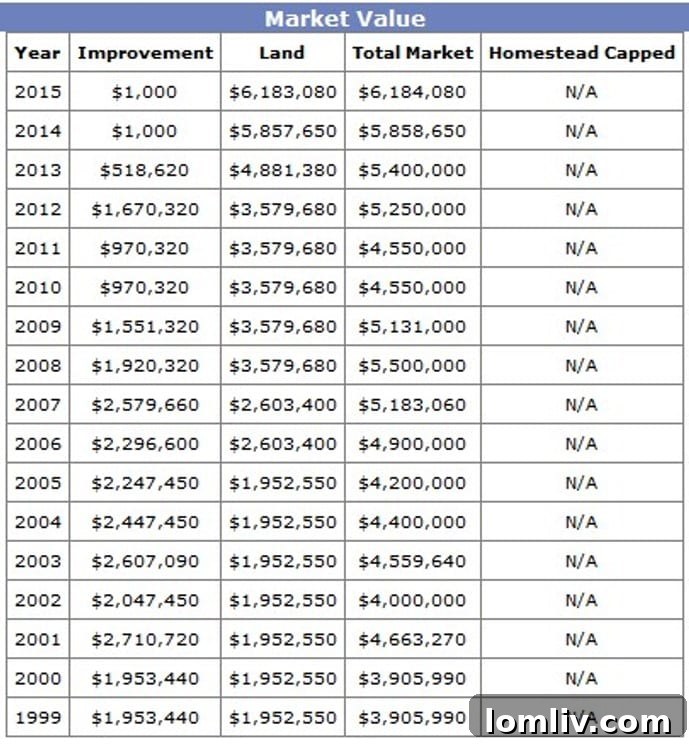
For those keen on discerning future redevelopment plans, the Dallas Central Appraisal District (DCAD) valuations offer a remarkably reliable barometer. The trajectory of 8100 Lomo Alto’s DCAD valuations provides a stark illustration of a property being primed for significant change. From 1999 to 2007, the values of the structure and the land remained relatively balanced. The period between 2008 and 2012 saw fluctuating building values, likely influenced by economic recession and market adjustments. However, a dramatic shift occurred in 2013: while the building was valued at a substantial $1,670,320 in 2012, its valuation was systematically downgraded to a mere $1,000 in 2013, 2014, and 2015. Concurrently, the land value experienced a meteoric rise, increasing by $2,603,400 over the same period.
For reference, 8100 Lomo Alto carries a total appraised value of approximately $6,184,080. Its sophisticated neighbor at 5950 Sherry Lane, in contrast, boasts a total value of $45,250,000—comprising $39,908,810 for the building and $5,341,190 for the land. Notably, the basis for the land assessment is consistent across both properties at $95 per square foot. These starkly divergent valuations make it unequivocally clear which building is considered a candidate for demolition and reconstruction. The strategy of significantly devaluing the existing structure while inflating the land value is a classic indicator that the property owner intends to clear the site for new, more intensive development.
This situation underscores the enduring adage in real estate: “location, location, location.” St. Michael’s Church, through its affiliated entity, manages to generate over $900,000 annually in rent from a building officially valued at just $1,000. This impressive revenue stream, combined with the strategic federal tax exemption, showcases a remarkable financial acumen, almost appearing as an act of powerful foresight in the realm of real estate investment.
It is highly improbable that DCAD initiated such a drastic revaluation arbitrarily. Such changes typically follow a petition from the landowner, in this case, St. Michael’s. Why else would a property owner seek to diminish the appraised value of their building so dramatically while simultaneously accepting a surge in land value? This action strongly suggests a deliberate move to prepare the site for a new chapter, likely involving a significant, multi-story development.
Therefore, the Preston Center Task Force and concerned residents are urged to remain vigilant. The ongoing developments and strategic maneuvers surrounding 8100 Lomo Alto suggest that St. Michael’s Church may very well be preparing to embark on another significant development project, potentially adding another high-rise to the evolving Preston Center skyline. The silent narrative woven by zoning maps, ownership structures, and property valuations speaks volumes, signaling a future transformation for this strategically located parcel.
Remember: Do you have a story from your HOA to share? Insights into the history of high-rise development in Dallas? Realtors, would you like to feature a listing—be it a renovation project in progress or a shining example of a completed transformation? Or perhaps host a Candy’s Dirt Staff Meeting for a unique discussion? Don’t hesitate to reach out to Jon via email. Marriage proposals are also gladly accepted (and legal)! Share your thoughts and stories at [email protected].